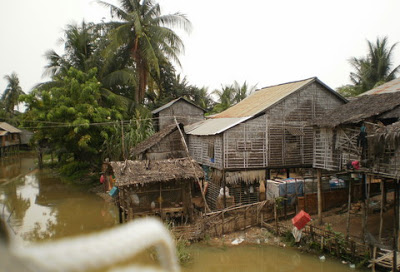
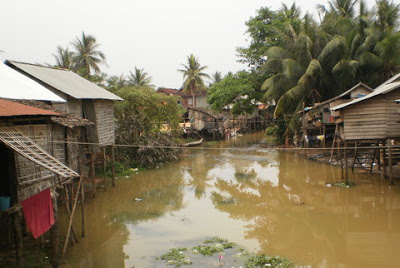
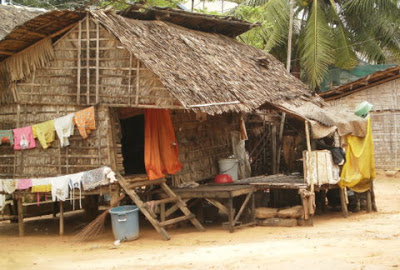
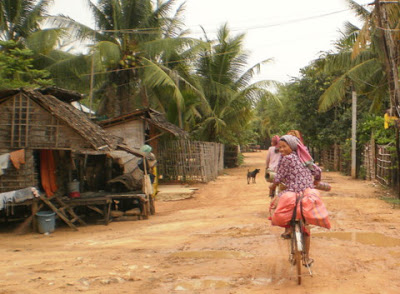
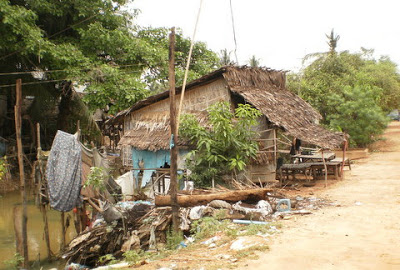
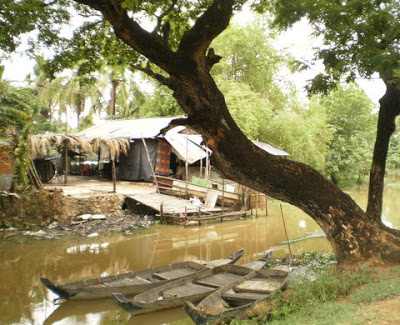
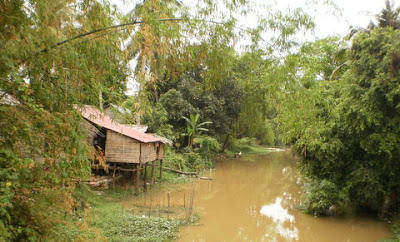
Village life outside Siem Reap
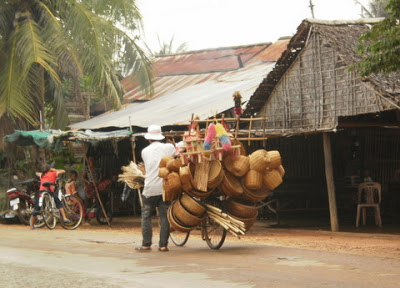 |
| Used to be able to see the broom seller like this in Malaysia. Rare now! |
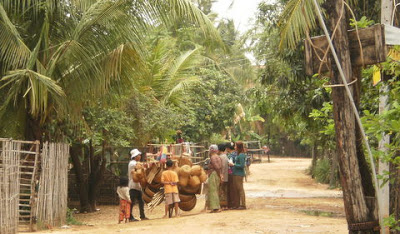 |
| Selling those baskets and brooms! |
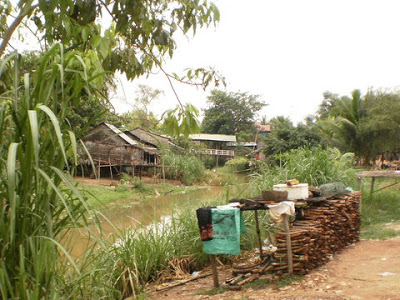 |
| Fire wood |
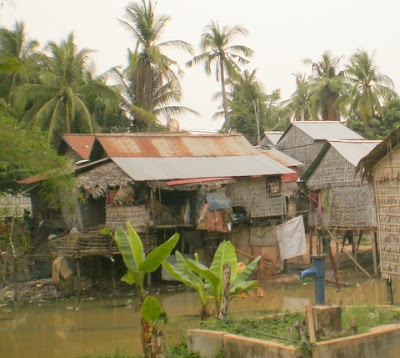 |
| Village pump |
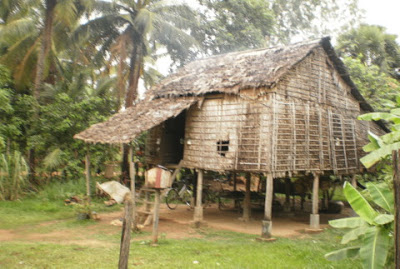 |
| No chimney |

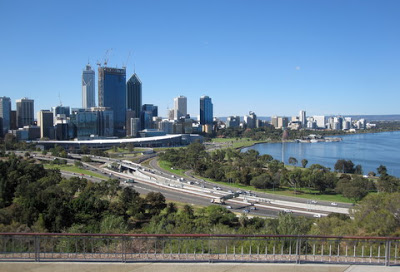

I’m not a person who has much time for commemoration of battles usually, but my Dad was at the Battle of Ypres in the First World War, and other such places, so I can’t pass by the war memorial overlooking Perth without remembering him.
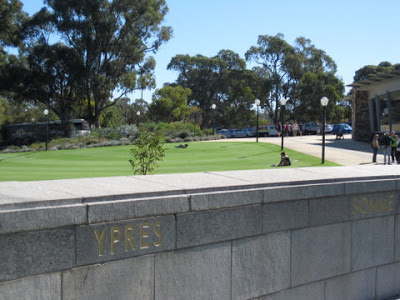


I was up in the park (King’s Park, overlooking the city) because my sister is one of the volunteer guides for the free walks there.

The other day, my niece was shaking her head over a piece about re-educating sissy boys by sending them to special camps. I groaned, assuming she was talking about some right-wing county, or a country ruled by religious bigots who can’t bear the thought that boys may be growing up a little different to their ideal macho man, that is, not growing up to be the kinda man who’s going to march around mountains with a hunting gun, or some other so-called masculine activity.
But no. Jak just pointed out to me that this was Malaysia, or to be more specific, the state education department in Terengganu. Yeah, I know, sounds pretty ridiculous, doesn’t it. It gets worse. Here’s what the Education Dept Director said, according to The Star newspaper:
…. the boot camp was designed to prevent the boys from developing feminine traits which could hamper their future. “The boys involved were selected from most schools in the state. They were carefully vetted before a final selection was made,” he told The Star. He added that if such tendencies were not curbed at a young age, it would lead to bigger problems for them in the future. He added among factors that encouraged effeminacy were parents’ action in dressing boys in girls clothing as they had really wanted a girl or if the boys were surrounded by female siblings.
Oh, right, he would have to blame us woman for this perceived horror. Yep, it’s always our fault. Have too many girls in the family and this is what happens. My husband and his brother (and their far more numerous sisters) might have something to say about that!!
And then there is this:
Department director Razali Daud explained that the four-day camp in Besut admitted boys identified by their schools for displaying “feminine qualities”. He said the 66 schoolboys were showing behaviours that were not “usually displayed by a normal male of their age.”
Oh? Who sez what it normal here anyway, eh?
“We understand that some people end up as mak nyah (transvestites) or homosexuals, but we will do our best to limit the number,” Razali was quoted as saying.
Actually, as any well-educated person knows, the true horror is telling kids who are outliers in the spectrum of what is possible that there’s something the matter with them. True horror is blaming these kids, when the fault lies with the faulty perception of prejudiced people who create senseless labels based on their meaningless assumptions.
A boy has long eyelashes and curly hair? He must be a sissy. He prefers to read rather than play a rough game of football? He’s a sissy. He paints or plays music or sings a beautiful soprano or is very shy or he stutters — he’s got to be a sissy. He’s skinny and under-developed for his age? He’s a sissy.
That’s the first crime against the child concerned. The second crime occurs when authorities decide that being a “sissy” — whatever that stupid categorisation involves — means that the boy will grow up to be somehow “bad”. And bad encompasses being gay. That’s right, against all medical and scientific evidence to the contrary, sissy = gay and … get this, also against all evidence to the contrary, you can talk ’em out of being gay (or trans or anything else you don’t agree with) if you catch ’em young enough. Sheesh. Don’t even get me started on the idea that being born GLBT is a sin.
I’m happy to say that there has been outrage in Malaysia about this, including statements from federal minister Senator Datuk Seri Shahrizat and the federal Women, Family and Community Development Ministry.
“We believe that such ‘boot camps’ must be abolished on the basis that they are harmful and do not serve the best interest of the child, and are therefore in clear violation of the Child Act 2001,” said Shahrizat in a statement today. “Every child is entitled to protection and assistance in all circumstances without regard to distinction of any kind, such as race, colour, sex, language, religion, social origin or physical, mental or emotional disabilities or any other status.”
The Terengganu Education Director has been back-peddling like mad, hopefully because someone has pointed out to him that what he said was not only pathetically stupid, but also woefully incorrect and viciously cruel.
What can we do to make sure this kind of silliness doesn’t happen again? Well you can sign the petition here.
The Angkor Wat temple complex (also early 12th century) was built as the state temple for the capital city. It is the best-preserved temple and the only one to have remained a significant religious centre since its foundation – first Hindu, then Buddhist. It is supposed to be the world’s largest religious building.


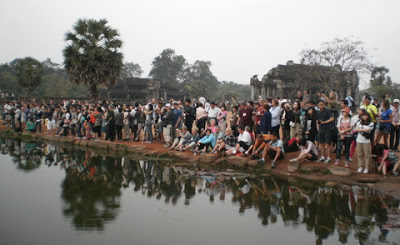 |
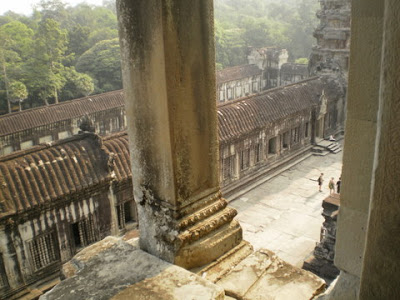
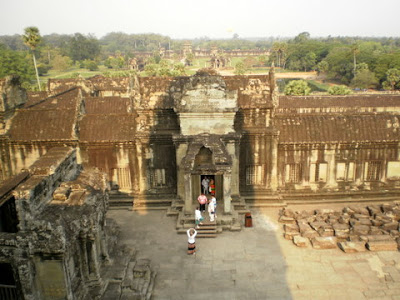
| And looking the other way, this is what you see… |
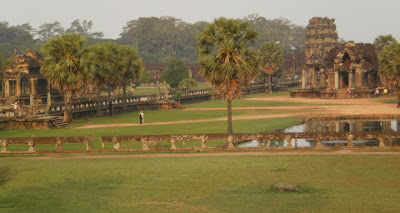 |
| View from the main temple building |
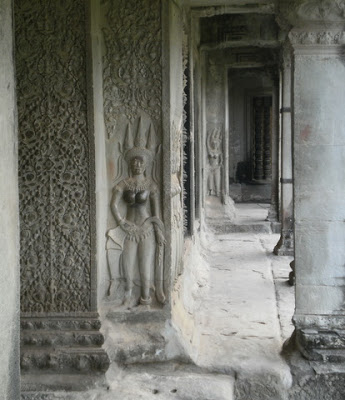 |
| No comment |
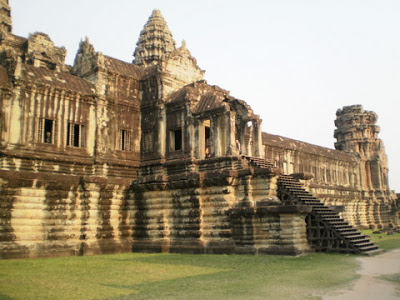
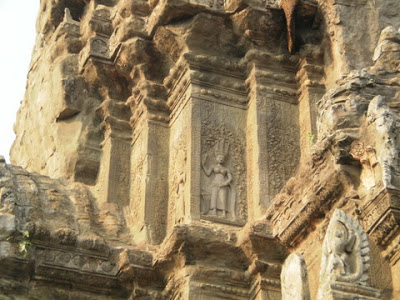 |
| There’s a swarm of bees in this pix – just right of top centre |

This is for Zak, and anyone else who dreams of being a published writer one day. Why? Because I was like you once – a kid who wrote and dreamed of being published. (There was no internet back then, in the cyber dark ages, and it was a great deal harder to find out anything about how best to do that. So you are much luckier now!)
1. Read.
Read what you love to read, as widely as possible. Never neglect your reading. As you grow older, you may think you don’t have time to read — but there always is time, even if it’s just a few moments on a bus, or while waiting for a friend. Only by reading can you learn so much so easily and pleasantly about how to write.
2. Write.
For fun. Write the stories you’d like to read. No one gets to be good at something without practice. Think about people who play the piano well – they practice all the time. It doesn’t matter if no one but you reads what you write – you are learning something every time you type a paragraph.
3. Things like spelling and good grammar are important.
Take the time to spell check and learn grammar rules. Only once a writer understands the rules, does s/he understand how rules can occasionally be broken.
4. Read books or articles about writing
You may find many interesting things on the web pages of some of your favourite authors.
5. As you grow up, seek the company of other writers.
We learn from one another. We support one another. We crit one another’s writing. If you are a fantasy/science fiction writer, then find ways to join your local SF organization or go to local meetings, readings or conventions.
6. Don’t be in too much of a hurry…
No one gets to play professional tennis and win trophies without years of practice. Writers usually don’t get their first book professionally published until they are are more than thirty. Of course, there are exceptions, but there’s no guarantees that you’ll be one of them! Writing short stories can be a way to get your name out there and even to earn pocket money.
7. … but don’t lose sight of your goal.
Teenage years can be a tough time to write. You’ll have lots of things to write about, but little time to do it. Keep writing nonetheless, even if it’s only occasionally. And don’t despair if your writing output plummets. You are learning valuable things about people. You are observing life at its most wonderful, and its most stressful and sometimes, sometimes even — unfortunately — at its most tragic. These are the memories that will make you a fine writer one day. Remember how life feels to you. Live. Think. Remember. Write. Consider keeping a private diary.
8. Buy books when you can.
If you don’t have the money, tell your friends and/or family that you want books for presents. Why? Apart from the joy of owning books, you will be ensuring that the book industry remains a healthy one. After all, they need to have money to buy your manuscript and publish your book one day! It is odd how many would-be authors don’t support book publishers in this way.
9. Looking ahead: Don’t plan on studying creative writing at college/university.
You’ll learn more about the things you need to know studying almost anything else – veterinary science, literature, geology, history, sociology, anything at all… You need to experience life. You need to have a job that earns you a living so you can write and hone your skills in your spare time.
10. Hold onto the dream.
Anything worth doing is worth doing well, and it takes time. Don’t lose heart.
The real heyday of this city lasted just over a hundred years, the whole of the 12th century, when it sustained anywhere from 80,000 to 150,000 people. At the beginning of that century, London had about 18,000.
 |
| An entrance gate through the wall |
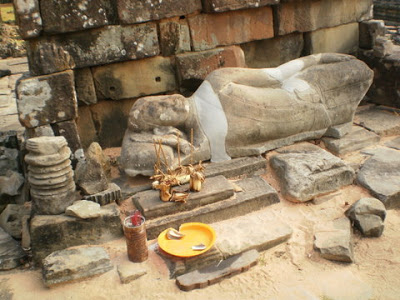 |
| Offerings at one of the ancient statues |
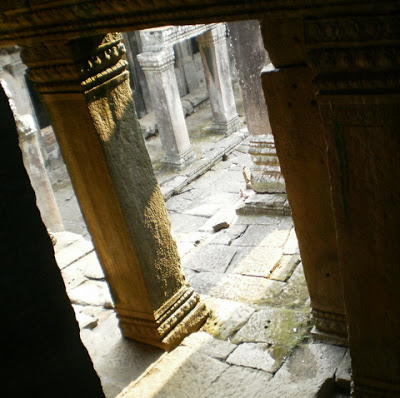 |
| 900 years later, still standing |
 |
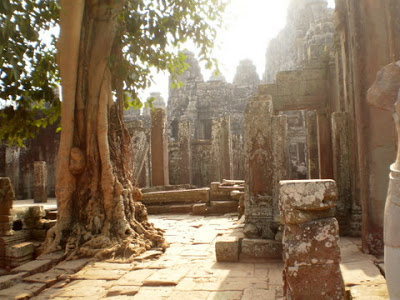
| Bayon Temple, the heart of Angkor Thom. That’s us… |
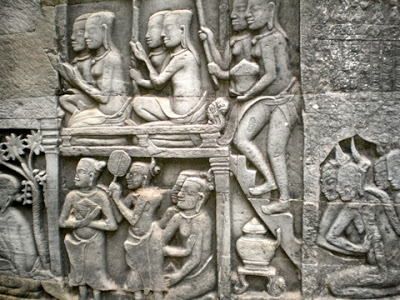 |
| How we know a little about Khmer life in the 12th century |
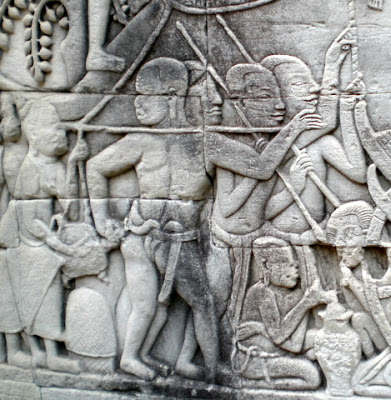 |
| Note the lady with the tortoise which is biting the butt of the man in front… |
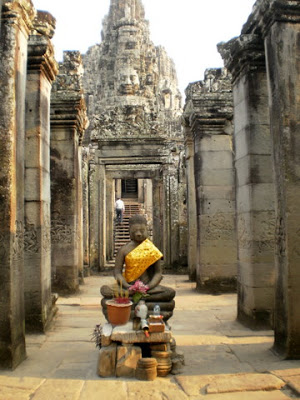 |
| Another example of present and past Buddhism |
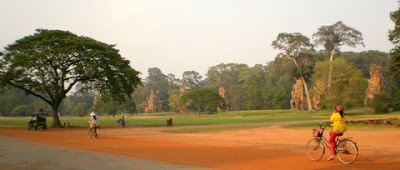 |
| These towers were apparently used as the base for tightropes and acrobatics |
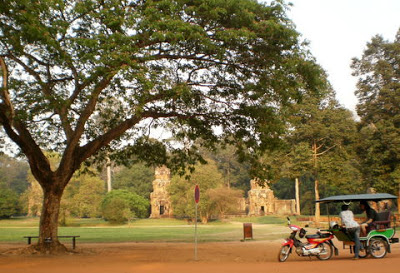
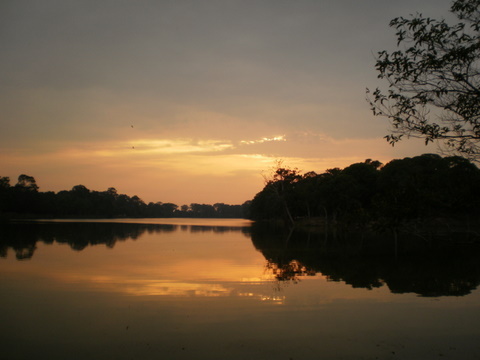 |
| We watched the cormorants flying in to roost |
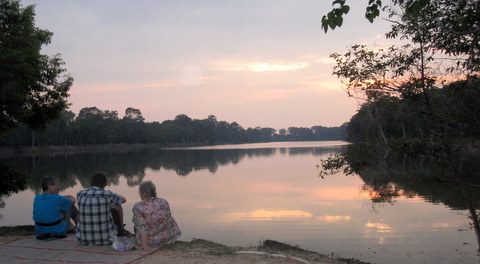 |
| G&Ts beside the canal |


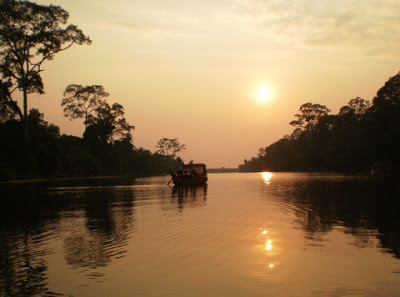 |
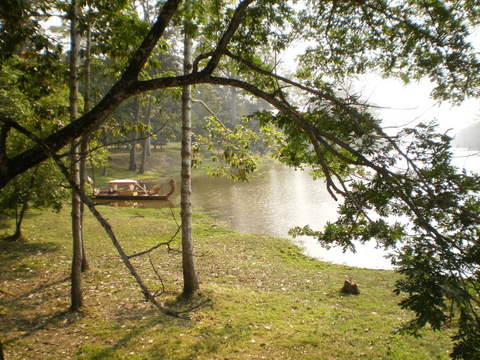
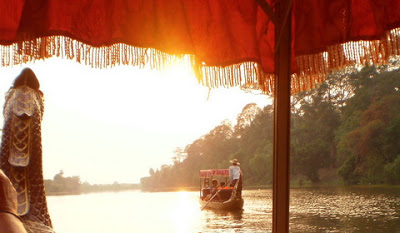
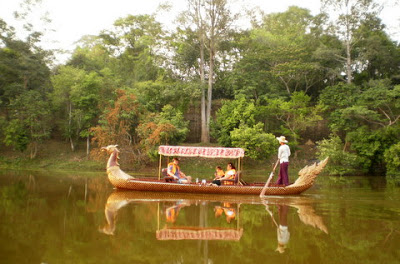
| We took an evening boat ride on the canal |
 |
| Daughter and family |
If you weren’t there, I’m sorry. You missed something really, really special.
There were, I think, four main reasons:
The venue – the Hyatt has a big circular open lounge in the middle and all the rooms used were nearby, with the result that everyone passed through this central area on their way to and from panels/art exhibition/dealers’ room etc. That way you couldn’t help but meet everyone sooner or later.
The guests – they were fabulous: Sean Williams, Justina Robson, Ellen Datlow and Sarah Xu.
The size of the con – just right for intimacy but not small enough to be incestuous.
The friendliness of the SFF folk, of West Australia in particular, but of all attendees in general.
Glitches in organisation? Sure, aren’t there always? But everyone was cool and none of it mattered much. Everyone was having way too much fun!
I didn’t take photos, but have a look at Cat Sparks’. See here.
Tomorrow I leave for Swancon/Natcon. I leave around midnight and get in at about 5.30 a.m. I shall be at the lunch for guests, and at the con in the afternoon. Note that Thursday night is FREE. So if you are uncertain about whether cons are for you, come along. I guarantee you’ll be hooked.
Barring changes, I have a panel that night:
Thursday 9.30 p.m.
“Seeing Green – natural imagery in fantastic fiction” with Kaaron Warren and Kate Eltham.
Mind you I will have had no sleep, and may not make too much sense…
My only other panel (so far anyway) is on:
Sunday at 3 p.m.
“Writing Abroad” with Kaaron Warren, Cristy Burne, Simon Brown
I will also be at the Ditmars on Sunday, at the lunch for guests on Thursday, the Orbit cocktails on Sunday, hanging around the bar…
Please, feel free to chat. We don’t have to have met before. And if you have an online name I would recognise, please tell me. My memory for names is awful and I sometimes have trouble connecting two separate personas, i.e. online and actual.