Kementarian Dalam Negeri Loves Ridicule?

http://photos1.blogger.com/blogger/3603/511/1600/bloggersagainstbanningbfj1.jpgThere’s a whole website up now to describe the insanity of the restricted/banned books issue. Do take a look here. This is so insanely ridiculous that one bookseller was prompted to mutter about Kafka, andI can see why.

The Malaysian Home Ministry (Kementarian Dalam Negeri) could not have found a better way to ridicule themselves, and their country, than this one. And the totally irrational decisions of their officers down in Johor have certainly made people wonder if they are on the take and will clear a book if they are paid under the table. After all it’s the only real reason most of us can think of for them to “restrict” (arbitarily forbid entry to, and confiscate without compensation) these books:

Well Women’s Sourcebook: Guide to Women’s Health and Wellness (The particular edition restricted has a large yellow daisy on the cover.)
Bali Style. (Publisher’s blurb reads: “A dazzling celebration of the traditional Balinese architecture, interiors, arts and crafts”)
The Jaguar Smile: A Nicaraguan Journey by Salman Rushdie. (As this is more a critical travelogue, I think it must be the author’s name that has aroused the ire of the Johor Thought-Policers. Perhaps reading the words “Salman Rushdie” is corrupting? Beware, you have just read it twice. You will never be the same again…)
Breastfeeding Your Baby. (There is a shocking pix on the cover. Maybe that is why it’s restricted. It shows a woman’s bare arm and shoulder as she looks down on her newborn. Or is it restricted because the baby appears as though it might possibly be naked?)

And that’s just four books from apparently endless lists of books.

Maybe the officers have the best personal libraries in the country? Maybe they need something to read to wile away the tedium before another consignment turns up for them to look at? Maybe one of their kids had a birthday coming up?
The whole thing is so ridiculous (and yet tragic) that we can only think of this kind ofWiggly Jukebox play-a-song book explanation, because there simply cannot be a rational way to explain banning a song book for 3 year olds – other than that they wanted a free book for their own kids. Especially when the officers or their Ministry refuses to give their own explanation.

A Rare Wild Saprophytic Orchid: Cyrtosia javanica (Blume, 1825)


This post is actually for botanists. My husband has found and photographed a rare saprophytic orchid at two Sabah, Kinabalu Pk, sites (Mesilau and Sayap) and has asked that I put up the photos because there weren’t any good ones of the species on the web.

The photos show the flowers, fruiting bodies and roots. If anyone is interested in any further info, or in obtaining better/more copies of photos etc, please email me.

Malaysian book banning: how to look stupid in the eyes of the world

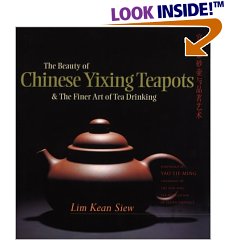
[The Beauty of Chinese Yixing Teapots and the Finer Arts of Tea Drinking : pix courtesy of Amazon.com where you can read an extract to see why it is banned. Or maybe you can read the extract and NOT see why it was banned.]

This blog post is all true, or based on things I believe to be true. I just thought I would make this clear, because you are going to have trouble believing it.

Let’s go back a bit in time, to 1992. I am sitting on a large cardboard packing box on the wharf in the port of Tunis, North Africa. There’s a truck behind me with a container. The contents of the container have been unloaded and are piled up around me – boxes, furniture, all out household goods. We are moving to Tunisia from Austria.

It’s a hot day and the truck driver has been sitting on the wharf for seven days, guarding our load and eating packaged junk food because he dare not leave the truck unguarded. He hasn’t showered in a week…but there’s hope. Finally things are moving. The Tunisian customs men have arrived to check our things. I had chosen my seat judiciously; it contains the contents of our bar, which I thought might arouse some problems, this being an Islamic country even though they have their own vineyards…but they weren’t interested in that.

A customs officer points to a box and asks us to open it. It is full of books. He takes out the one on top. It is a coffee table book, a gift from someone who lived in Papua, and it portrays the face art of tribal people. The customs officer looks through the book, staring hard at the pictures. Luckily there are only faces and not penis adornment. Then he picks up the next book, which is a Malay dictionary. He stares at that a long time, puzzled by the language. How is he going to tell if it is worthy of being banned? He tries another book, I can’t remember which one. And then another. And another.

The sun is hot, and we are all wilting. My husband says, poker-faced, ‘We have six thousand books.” A slight exaggeration, but I translate it anyway for the customs men. My husband waves a hand at the many unopened boxes around us in illustration of his point. You can see the customs officer thinking – how the hell is he going to check for banned books when none of our library is in a language he can understand?

Finally he brightens. “Avez-vous un télécopieur?”
“Oiu,” says I. “Nous avons un télécopieur.”
“Get it out,” says he. “You cannot import a fax machine until it has been tested.”
So, after some rummaging, we extract the fax machine and, after much filling in of forms, we and the truck are on our way.

It is three months before we get the fax machine back, but that is another story.

Down in Johor they do things differently. Book distributors have to run their imports from Singapore through the officers of the Malaysian Ministry of Internal Affairs. And they have a remarkable system of “restricting” books they don’t like, which can be anything from most books by Salman Rushdie to the obviously subversive book pictured above, about the pornographic art of sipping tea while discussing terrorist subversion. Or something.

For a look at the list of books that one distributor had restricted, see here and read Raman’s comments here .

And if you want to laugh – or cry – here are just a few:

Robert Jordan’s “Knife of Dreams”
Lots of things with Religion/Sex/Gay in the title – we mustn’t be well informed on any of these things, of course. And that can mean everything from “Introduction to Islam”, to “Poems and Prayers for Children” (I’m not kidding, remember), or the Kama Sutra.
Anatomy for the Artist: The Dynamics of Human Form
Mao: A Life
Feel: Robbie Williams

Sigh. I wish they’d just take a dislike to fax machines instead. Subversive things, faxes.

All’s right with the world?

Ok, so I know the world is in a mess, but there are some things that suggest otherwise, and this photo is one of them. The world is a good place to be when you are two years old and it’s Fall in Virginia. That’s my grandson sitting in the middle…

Why I won’t write another first person PoV novel.

First person writing has a long and illustrious history – from older classics like Dickens’s Great Expectations or R.L.Stevenson’s Treasure Island, to more modern classics such as Salinger’s Catcher in the Rye, Kerouac’s On the Road, Steinbeck’s Grapes of Wrath or Harper Lee’s To Kill a Mockingbird, to modern prize winners like Pierre’s Vernon God Little and, if I remember rightly, Martel’s Life of Pi. These are books that jumped into my mind as I am writing this – I hope I have remembered their first person PoV correctly! (If not, tell me.)

So it has come as quite a shock to me to realise – relatively recently – that there are a stack of people out there who simply won’t pick up a book written in the first person, on the apparent assumption that they won’t like it. Not just a few, but a surprisingly large percentage.

Now I can understand John Doe saying, “I don’t read chick-lit” or his wife Jane saying, “I don’t read Westerns”, on the grounds that there is a very good chance that they won’t like that particular genre. We all have our preferences. But the books within each of these genres have a lot in common within one another, and it is probably this commonality that John and Jane don’t like. John doesn’t like kiss and tell, Jane loathes horses and ranches.

But to say you won’t read something written in the first person kinda sounds to me like saying, “I don’t read books with red covers”. First person stories have only ONE thing in common – the first person viewpoint. To say you won’t like it, is to banish a slew of stories on every conceivable subject matter and theme, set anywhere on, or off, earth, many of them brilliantly written, and certainly not necessarily particularly simplistic or even linear. You can still have sub plots!

Would John and Jane also say they don’t like it when their friends tell them stories of what happened when they broke a leg mountain climbing and were then attacked by a bear / had a flaming row with their girlfriend only to be arrested for disturbing the peace / made a fortune on the stock exchange? All first person stories. We listen to first person stories all the time.

The reasons people give for not liking the first person written narration are often odd.
Take the “too linear” excuse. Yes, I agree, it can be linear, although there are ways of minimising this (see yesterday’s post). And if you look at many novels, you will find that they are often related from one point of view, the main third person character. Absolutely linear even though they use third person. A good example of this is (once again if I remember correctly) Challion’s Curse by Lois McMaster Bujold. As I recall, it didn’t waiver from the PoV of the main protagonist. A very popular book – and it could easily have been written in the first person. Wouldn’t have made a whit of difference to the story. And that doesn’t automatically make it a bad book.

So I don’t really understand the viewpoint of John and Jane. Not understanding is not why I am rethinking using the first person, though.

I am rethinking because, as a non-bestselling author, I cannot afford to have potential buyers browsing in a bookshop put the book down the moment they pick it up, on grounds that have nothing to do with quality of writing, or subject matter, or theme, or genre. I need readers, and it is just plain silly to put so many people off reading my work on the grounds of my choice of narrator. I don’t want to limit my reading public.

So, at least until I make it ‘big’ (when or if?), I am not going to write another book in the first person. Call me silly, if you like, but I’ve caved in to the exigency of earning a living from writing.

Writing in the First Person

So far I have seven novels either published or on their way to publication. Four of them were written (mostly) using the first person point of view.

My last glimpse through avian eyes appalled me: I saw birds turn into people and fall out of the sky. And then Morthred’s death swept over me, changing every particle of my body into something else.

For a moment I truly died.
There was darkness, a blackness so blanketing it contained only emptiness. Silence, an external muteness so intense I could hear the internal sounds of my body being ripped apart, particle by particle. Numbness, a lack of stimulation so pervading I felt I had no body. I thought: so this is what it is like to die.
I plunged into the darkness, into the silence, into the numbness, into that total deprivation. When I emerged, I was on the other side of death, in a life about which I understood nothing.
Everything had changed. Everything. All my senses had been altered so much I couldn’t…well, I couldn’t make sense of them.
I was Ruarth Windrider and I was human.

From The Tainted

I think I make a good job of writing in the first person. I even know of one writer who was inspired after reading my work to try the first person narrative, and as a result she has her first historical novel coming out next year, written from a first person point of view.

It’s not easy, and few writers bother to master it, believing the advantages (immediacy and intimacy with the chance for gut-wrenching action or heat-wrenching tragedy at a very personal level) are not worth the pitfalls (a possibly linnear story with a difficulty of developing sub-plots, over-emphasis on one character, only seeing the story from one side, only knowing what the “I” character knows at the time, etc).

Some of these problems can be circumvented with a little thought and ingenuity. A good writer can even have the narrator tell the reader things that they, the narrator, don’t know – in The Aware, the sharp reader could work out the profession of main male protagonist from what the narrator says long before the narrator realises exactly what the man does for a living. And she’s in love with the guy! And yet her lack of realisation comes across as a believable failure of her acumen, rather than sheer stupidity. It can be done.

Also in The Isles of Glory, the tale was framed by letters of other characters commenting on the main story teller; in adition, it was done as an oral history recorded by an ethnographer, and the “I” could therefore be changed to another character, at different times. (Think of the Wilkie Collins classic, “The Moonstone”).

In her Assassin trilogy, Robin Hobb had her main character, Fitz, able to see through the eyes of his pet wolf (dog?); at the same time, he had access to the spy network of the castle with its peepholes and listening posts – thus he could observe scenes as a non-participating unseen spy. A handy device when telling a first person story.

I chose first person for Heart of the Mirage because I thought it suited the circumstances of the main character. She is set down in an alien society, and sees everything with the eye of a stranger, just as the reader does. Because part of the time she is in disguise, she can’t ask too many questions. As such, the reader rides the adventure inside her head, wondering what is going on, striving to understand along with her.

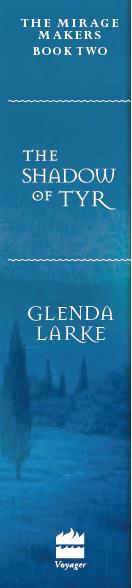
I have, however, switched to third person point of view for Books 2, The Shadow of Tyr and Book 3, Song of the Shiver Barrens, because the circumstances change and the story widens.

And I don’t think I shall ever write a book using the first person narrative again. Why not? I’ll tell you tomorrow.

A Walk in the Rainforest

One of the things I love about going into the rainforest is that every time you go, you see or hear something different, even if you use the same trail again and again. That is the nature of a rainforest.

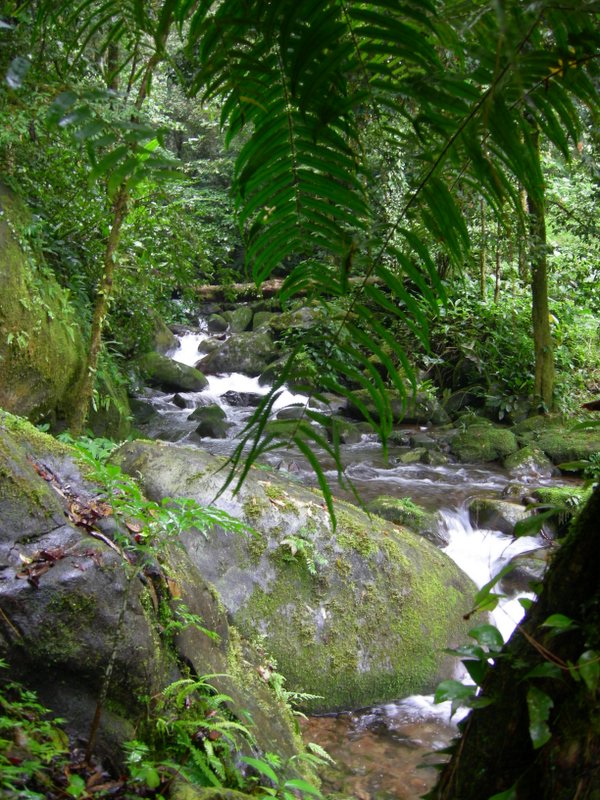
First there’s the general beauty of the surroundings.

Then there’s the perfection of the details. Take this moss-covered log at the base of a tree. See what is growing on it – the green moss, a brown and white round mushroom, a frilled red fungus, an orchid, a fern, the roots of a climbing vine. Taken as a whole, it is a snatshot of nature’s fecundity and recycling. And yet it has an almost fairyland beauty to it.

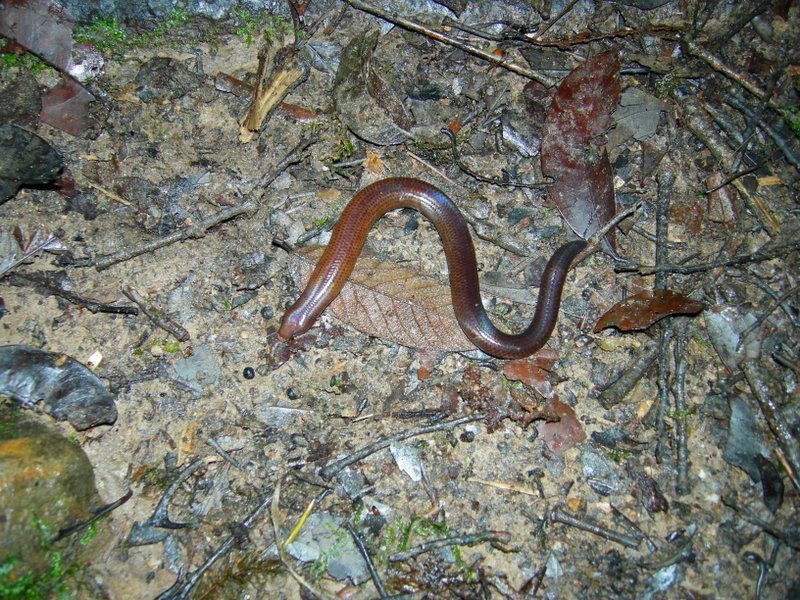
And lastly, there is the wonder of its wildlife. Here’s a picture of something I’ve never seen before. I think it is a blind snake. I ruled out a limbless Caecilian (salamander family) – it has no segments. In fact, it is covered with scales, so it is not any kind of worm either. It’s eyes are lodged under it’s skin. It wriggled like a worm, though, rather than slithered like a snake, desperate to get under the leaf litter.

If any herpatologists want a better photo in exchange for an ID, email me. It was found at about 1000m up on the western lanks of Mt Kinabalu, Sabah, Borneo.

Coming soon

Just been told that the “in-store” date for The Shadow of Tyr (in Australia) is December 11th. In other words, in theory, you should be able to buy it for Xmas.

Sometimes, though, bookstores get snowed under with new stock at that time of the year, and it may be difficult to get them to open the box in their backroom. (Be kind to your bookseller at Christmas time, ok? Keep your harrassment to a minimum – confine it to my books. ;=). Better still, pre-order.)

And let me take this opportunity to remind you to buy books as presents, to ask for books as presents, to get Father Christmas to give books as presents, to fill your house and everybody else’s house with books, books, books…

And if you need a reason, read the previous post. Fiction makes for balanced, nicely behaved human beings!!

Finally, something enjoyable is actually good for you

This comes via that wonderful source of reading info, Sharon of Kuala Lumpur, at her bookaholic blog.

“The more fiction a person reads, the more empathy they have and the better they perform on tests of social understanding and awareness. By contrast, reading more non-fiction, fact-based books shows the opposite association.”

All this from a University of Toronto study – see Sharon’s blog for more details.

“The researchers surmised that reading fiction could improve people’s social awareness via at least two routes – by exposing them to concrete social knowledge concerning the way people behave, and by allowing them to practise inferring people’s intentions and monitoring people’s relationships. Non-fiction readers, by contrast, “fail to simulate such experiences, and may accrue a social deficit in social skills as a result of removing themselves from the actual social world”.

So there you are – go buy/read more fiction. Especially mine… :=D

And in the meantime, back in that post on Trilogies, a book reviewer has placed his take here.