Murder Most Foul

A Tale of a Frog and a Snake
(Expedisi Kulamba, Universiti Malaysia Sabah)

There I was, a four-striped tree-frog, minding my own business in a tree overlooking the research tent of the Kulamba camp – until along came a striped-tailed racer. He was hungry and I was dozing…

I squealed and squealed, hoping someone would come to my aid. But all they did was grab their cameras…


Many thanks to Liew who stood on a precarious log, valiantly held by Wong, to take these shots over the protracted course of a reptilian lunch – well over an hour.

An Encounter with an orang-utan.

(Expedisi Kulamba, Universiti Malaysia Sabah)

I have been to the rehabilitation centre in Sipilok, where they take young or captive orangutans and try to return them to the wild. They do good work. They’ve also been doing it for decades – indicating the failure of the country as a whole to control the poaching and the killing of this gentle red giant in all that time– repair the damage afterwards is the motto? Malaysia boleh.
I have seen the semi-wild orangutan male at Gomontang Caves. But this experience in Kulamba was different. This was an encounter with a truly wild animal, one that has not had direct contact with man. A monstrous hulk of hair, twice my size, more like a Sumo wrestler with forklift arms dragging down to the ground. (Sound like your Dutch stepfather, Dave?)

All along the rivers we had been seeing the nests of this species. Like squirrels, they build a new nest each night to sleep in, high in a tree, by bending banches and leaves inwards to a central point and sitting on them, deep inside a wall of leaves. These nests remain as a monument to their temporary occupancy.

And then one morning we were lucky enough to see an animal – a large male peeking ut at us from the nipah palms at the edge of the river. He seemed unafraid, and climbed a tree in full view of us in the boat. Unfortunately I was so excited I managed to drop the camera in the bilge water, and missed the best photographic opportunty. Nonetheless it was a magical moment – one of those times when you feel that all is right with the world after all. I felt privileged to have met the gaze of this sad-eyed creature, to have felt a connection through a look. Although perhaps I should also add that the noise they make sounds like a fart of elephantine proportions…

We returned to the nest the next morning to take another look, but the heap of reddish hair was reluctant to wake up. We left him to it.

A Killer Fungus: or a tragedy called Cordyceps


(Expedisi Kulamba, Universiti Malaysia Sabah)

Yep, I have a thing about fungi now.

Here’s a cicada corpse. My perverse husband rejoices in these things. This insect was infected with a fungus growth that sent it mad. Something in that fungus made the poor cicada go to the underside of a leaf and cling there, nicely placed for the dispsersal of fungi spores. And there it slowly died as the fungus took over its body.

Jeff VanderMeer must have found his inspsiration in Cordyceps.

Birding the rivers of the Kulamba Wildlife Reserve


(Expedisi Kulamba, Universiti Malaysia Sabah)

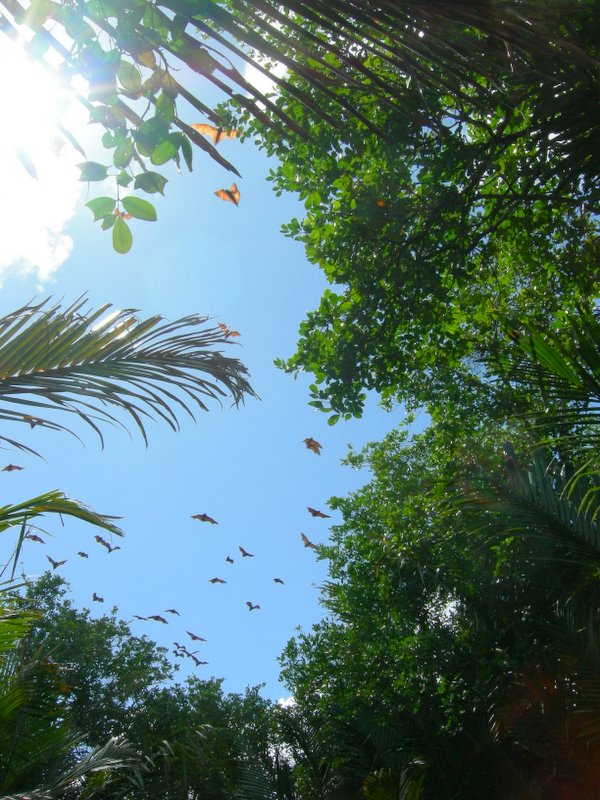
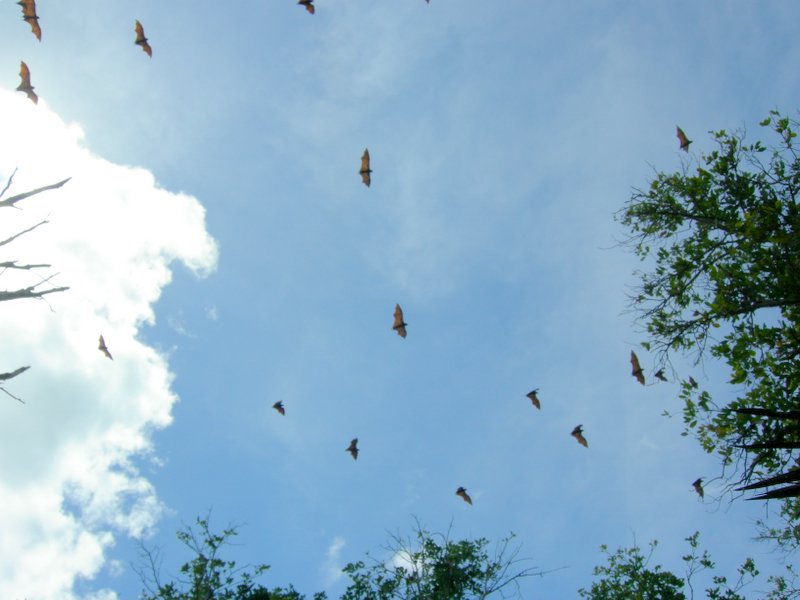
We two birders leave at dawn, sneaking out of camp before breakfast. It is the perfect time on the river. We encounter a roost of Black-Crowned Night Herons, and suddenly the air is filled with birds. And then with flying foxes. Their little furry faces stare down at us as they pass by, on their way to their daytime roosts.
There are snake birds, the Darters – consummate divers which have to spend the greater part of their lives drying out their wings just in order to fly. And the egrets – over 200 of three species in the one roost, their breeding feathers – once so beloved of milliners and fashionable ladies – swirling in skirts about them. The Storm’s Stork overflying. The brilliant Crimson Sunbird. Egrets fishing like terns in the wake of a boat out on Dewhurst Inlet.

One lunchtime, when we return to camp, there is an agitated fussing over out heads – eight different species of birds in a flock of fourteen or so birds, I can’t see what is bothering them; a snake perhaps. There are flocks of green pigeons everywhere, constantly flying or calling. We hear a prrrrr prrrrr – the deep cooing of the imperial pigeons as the sun goes down. We see the hanging-parrots with their bright flashes of red and blue and green.
And I make one discovery – I see a bird that has never been recorded from eastern Sabah, and rarely from Borneo. That sighting will go into the expedition report.

A Camp on the Sungai Kulamba

(Expedisi Kulamba, Universiti Malaysia Sabah)

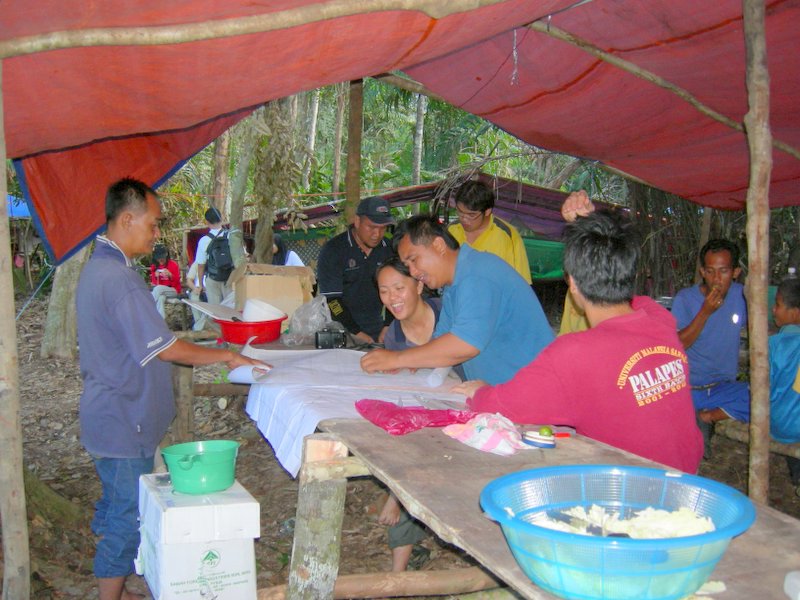
The camp has twenty-one people, researchers, lecturers and assistants and university students. We are aided by boatmen from the village, glad enough to earn more than they can get from fishing.

[Me, and some students, birding]

This is not the Kinabatangan of the well-heeled tourist, or even the young eco- backpacker. This is the end of civilisation where even the fishermen rarely trespass. There is an old logging road, and a logging camp, for – alas – even paradise has its snake. We use the road to explore the forest. The mud is gluey and I still haven’t managed to get my feet clean. (I am thinking it’s time I get a pedicure for the first time in my life, except it seems so horribly decadent. I’ve just spent a week with fishermen who earn less than $US 70 a month.)

There is a generator at night for a few hours – long enough to recharge batteries. We sleep in canvas cots under a roof – but the tropical rain often proves too much for the “roof”. One night I had to climb into my bed from an ankle-deep muddy pool – complete with resident frogs. Another time there was an ominous crack and one of the support beams broke under the weight of the water collecting on the canvas.


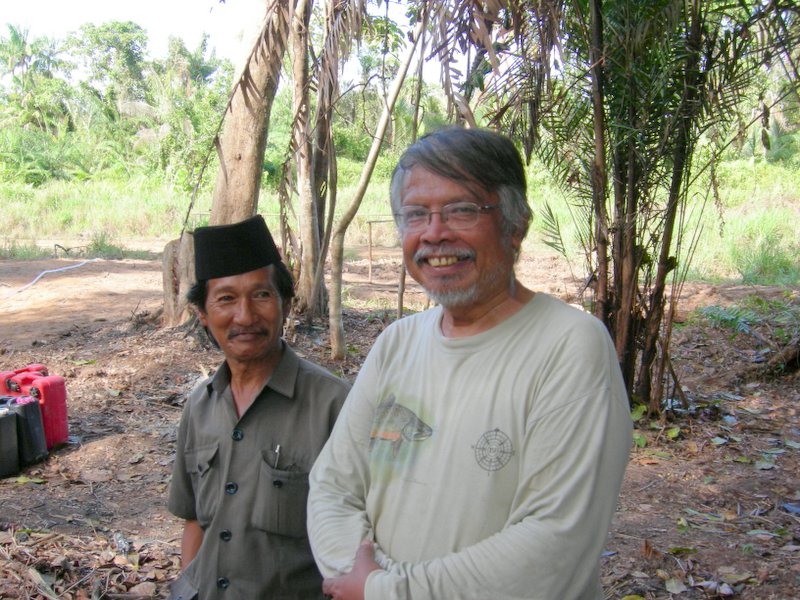
That’s the village headman standing next to my husband, fro the water village down at the mouth of the Kulamba. The villagers built the camp for us – and my husband reckons that must be why the canvas cots are all so short…

The mosquitoes are ferocious and persistent. The earth churns into mud. We wash in water pumped up from the river and cook with water filtered from the Kinabatangan.

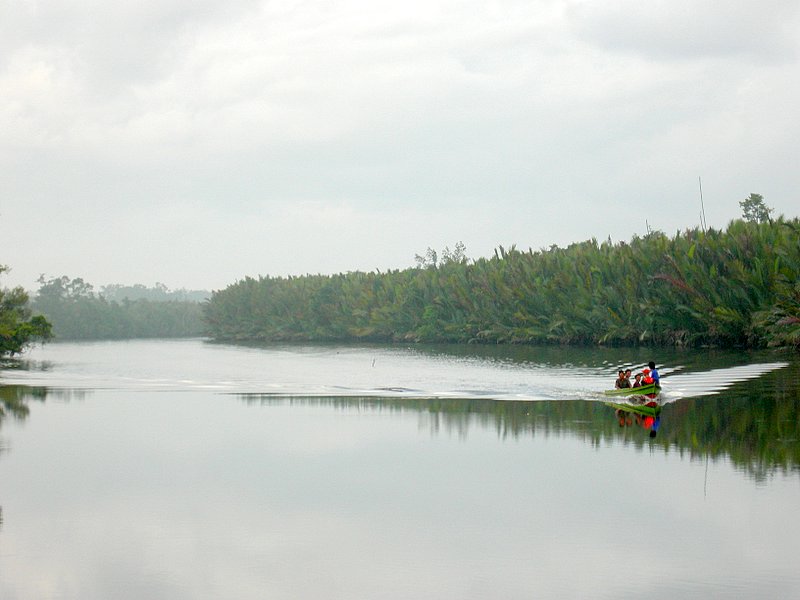
But, oh, the scenery along the rivers of this wetland.
Magic.

From Kota Kinabalu to the Lower Kinabatangan floodplains

Expedisi Kulamba Universiti Malaysia Sabah

I am back – safe and sound. I think. And the 9 days away, cut off from so-called civilization now seem surreal.

We travelled from Kota Kinabalu to Sandakan by bus, crossing Borneo from one coast (South China Sea) to the other (Sulu Sea). We stopped to buy fruit along the way…

In Sandakan, we boarded a local fishing boat and said goodbye to towns and taps and phone connections and flush toilets and restaurants and newspapers.
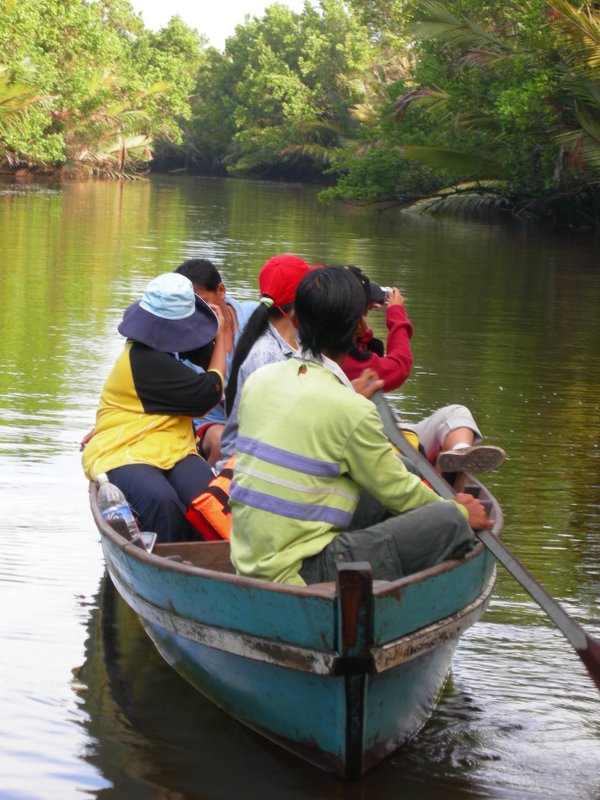
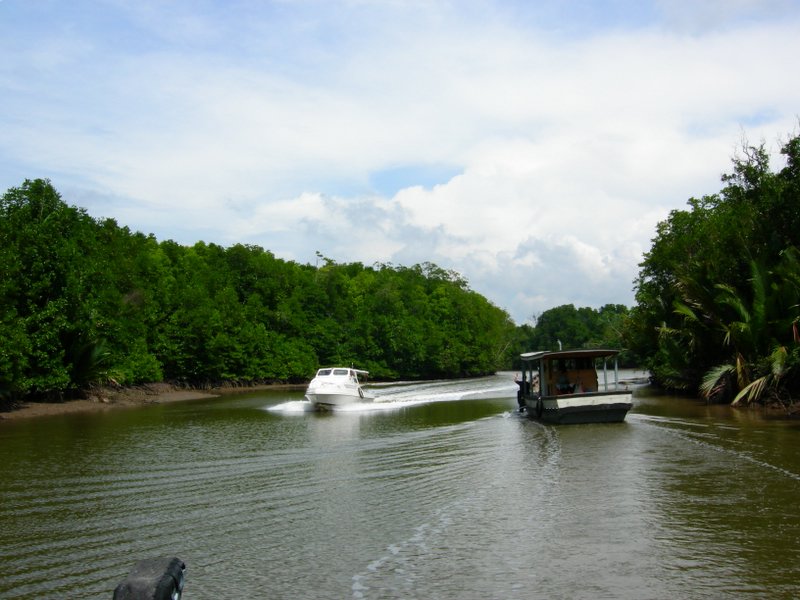
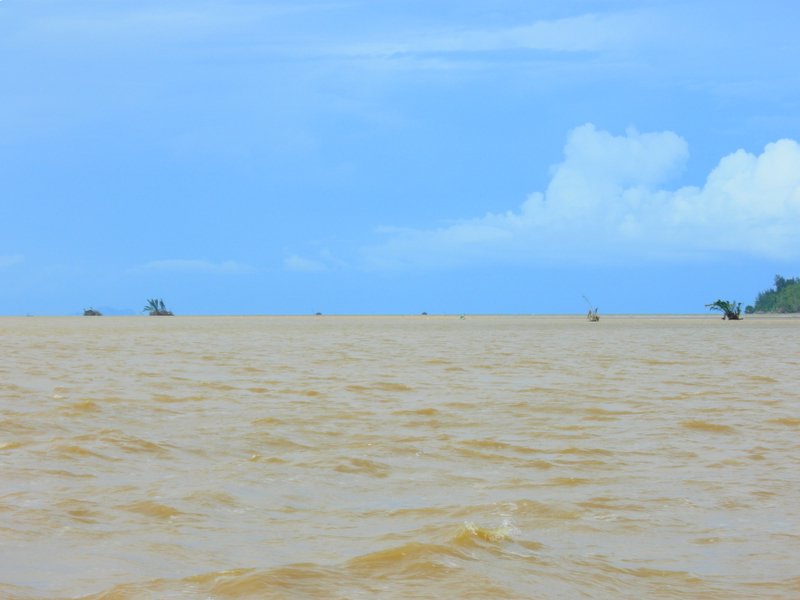
Heading south, we wended our way through a web of connecting waterways, never venturing into the open sea, until we arrived at the Kulamba River, a journey of almost seven hours…on a boat that had no seats.

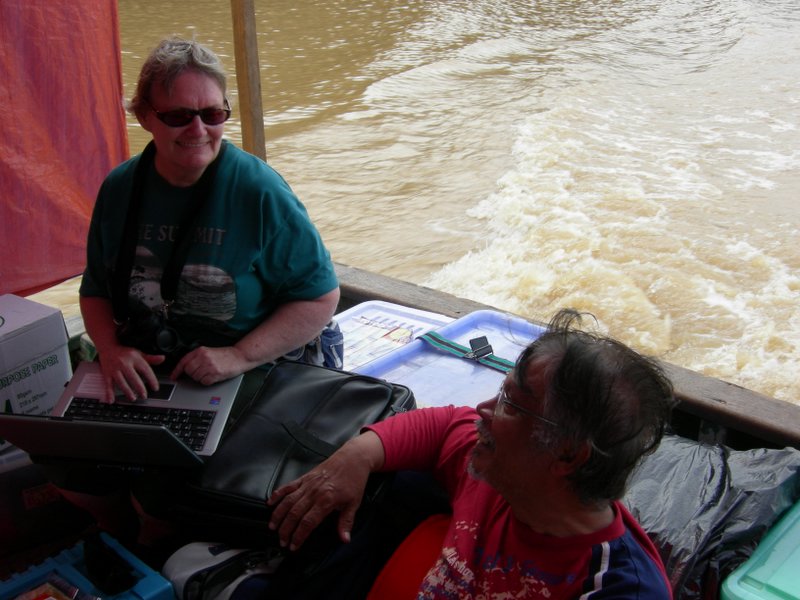
It was a wondrous, if uncomfortable journey. I worked for part of the trip, writing a project paper for my present job, but the rest of the time it was just a matter of taking in those wonders along rivers that are the roads, with traffic varying from paddled wooden boats belonging to fishermen, to luxurious speedboats bearing tourists who would spend more in a day than that fisherman would earn in a month.

We saw lots of proboscis monkeys, with a coloration that makes them look as if they are wearing pants and long noses that gave them the local name of “Dutchmen” – (perhaps politer than calling European colonizers “proboscis monkeys”?).


Birds – storks, egrets, herons, green imperial pigeons, sea-eagles. Orangutan nests. Fishing villages on stilts. A stop to explain our presence at the police post that is fully manned, complete with machine guns and two redoubts built of sand-filled tractor tyres and wood. The Sulu Sea has a long history of sea pirates…and the southern Philippines is a few hours’ sail away.

We pass by the two mouths of the Kinabatangan River, where the tidal flow bears out to sea not just Malaysian soil, but nipah palms bobbing along like weird monsters of the deep. More usually, they line the river in a solid impenetrable wall of fronds between the expanses of mangroves…


And so on into the sunset and past the nearest village on stilts over the water, to the Kulamba river, where we will stay under canvas. Just close enough away from the water to make sure the crocodiles are not tempted!

Many thanks to the UMS Institute of Tropical Biology and Conservation for inviting me along!

More tomorrow

What’s your theme?

I had an email from a reader of this blog who asked about themes. (Thank you Ink Paws!) Do I consciously write a book around a theme? Or is the use of themes by writers – as some of her teachers posit – more unconscious?

For me, the answer is sort of yes and no. One thing I don’t ever want to do is write a book that sets out to lecture – so I try not to belabour a point. However, I do consciously write to a theme, taking care that it enhances rather than dominates the story, even as the story that enhances the theme.

Here are some of my themes, and yes, there is often more than one:

The danger of having just one super-power in the world;
how power can corrupt even people who have the best intentions;
how difficult it is to have a truly sustainable society without making incredible sacrifices;
how difficult it is to live with guilt and how much courage it takes;
how easy it is to be patronising about people who are different;
how love doesn’t always conquer all, even though it is important to have it.

All themes from the Isles of Glory trilogy. [The marketing folk in the US who designed the cover seemed to think it was all about swords and sorcery and sex!]

Heart of the Mirage has a theme revolving around the tragedy of stolen children (read the acknowledgements at the back of the book) and what we really are – the person we were born and intended to be, or the person we were made into by our upbringing – or neither. It’s also about how strong women (and strong men, too) can still do foolish things because of love. It’s about how terrible betrayal can be.

The Shadow of Tyr is about deception. It also returns once more to questions of guilt and betrayal. It’s about the hollowness of revenge. It’s about what happens to a child when a mother simply does not have time for him. It’s about whether war can be justified.

Havenstar had themes about religion, about living with uncertainty, about prejudice.

All those themes (and quite a few more!) were deliberate choices, made sometimes before I started the book, or developed from my personal beliefs as I wrote.

So I found it interesting when it was pointed out to me by a fellow writer (and watch out for his new book; it’s brilliant), Russell Kirkpatrick, that there was one all important theme that runs through all my published books that I hadn’t even noticed, and yet is central to them all. When I thought about it, it was so obvious I felt a fool for not recognising that it was there. Duh. I mean, how stupid can you get?

And what was the theme? — Being the outsider in a society.

My main character(s) is always the odd man out, plonked down in a world to which they do not belong, and where they have to learn to cope and survive, and even be happy.

Havenstar: Keris is wrenched from her comfortable, safe niche as a mapmaker’s daughter by circumstances beyond her control and plunged into a world where nothing is comfortable, let alone safe, or even the same from hour to hour.

The Aware: Blaze is the epitome of the outsider – she is even physically marked as an outsider and a non-citizen who is not allowed to fit in by law. (Geez, that sounds familiar when I think about it.)
In Gilfeather, Kelwyn is forced out of his pacifist, sustainable community into a much more violent world, where he is destined to become part of the violence he abhors.
In The Tainted, Ruarth is suddenly human after spending all his life as a bird.
In Heart of the Mirage, Ligea is returned to her real home, only to realise she is a stranger among her own people.

And of course, one doesn’t have to look far to see where all that is coming from…!

Looking back over my life, I see that the first time I became an outsider I was just eleven years old. Our family moved when my father retired. We went from a farm and a rural community to live in the suburbs of a big city. (OK, by today’s standards it wasn’t all that big, but it was back then…) I found myself thrust into a new school and a much more sophisticated society than I was used to, and I still remember how difficult it was.

When I was twenty-five I swapped my country and culture for another; I did the same thing all over again when I was forty-one, and yet again to a totally different society when I was forty-seven. And in the process, I have switched languages four times too. And you know what? It wasn’t always easy.

Yep, no wonder I have issues with being the outsider…
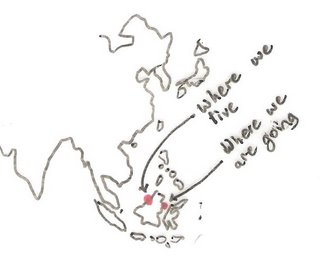
I am off into the wilds for a week tomorrow, camping along the lower reaches of the Sg. Kalumba, a tributary of the Segama River in eastern Sabah, where the proboscis monkey is king, Storm’s Stork nests…and the crocodiles are big. So no posts till Monday 20th.
Until then, let me ask you writers and readers out there:

What are your themes?
Have any of you had themes creep up and clobber you from behind, as I did?

I expect to find lots of replies when I came back. Play nicely, children!

How did the fantasy trilogy come to be?

As a result of the marvellous discussion that arose from my post on “What is a trilogy?”, someone has sent a question: how did the fantasy trilogy come to be? What is its history? (Thanks Shawn).

So I want to pose that question to all you knowledgeable folk out there.

My answer to Shawn included the following points:

It may have stemmed from the success of Lord of the Rings. [Does anyone know of any earlier fantasy trilogies?] And the structure came out of two things:

  • the physical length of the book meant it was better broken up, especially once paperbacks came to be all the rage
  • Tolkien was fascinated by the world he created more than the story, and to build a world like that you need an awful lot of words.

This second point is why fantasies still need lots of words, especially ones that are set in worlds not earth-like. Then, with Tolkien, readers found the fascination of immersing themselves in a strange and wonderful place for 3 whole volumes and wanted more of the same…and the trilogy was on its way.

Of course stories in a series, set in the same place and with the same characters, are no new thing. The Iliad and the Odyssey, tales of the gods in the ancient world, etc. In the nineteenth century in English literature you get serials (many of Dickens’s novels were serialised) and also series of mainstream novels e.g. Trollope’s Palliser books and the Barsetshirebooks – both series of 6 or 7 books, and very popular in their day.

But I wonder what the first real fantasy trilogy was? And which was the next after Tolkien?

Fungus Attack!

I have recently read Jeff Vandermeer’s book Shriek, which is – among other things, about the horrible effects of fungus moving in on a city and its people. Definitely not nice stuff to think about (although the book itself is a good read).

So I finished Shriek, put it down – and get attacked by fungus. Yuk. Apparently as a result of getting water in my ear back on that nice beach holiday I had with my daughter, and supplying the spores with a nutritious environment to grow in… It’s just as well I couldn’t actually see inside my ear or I would probably have really freaked out.

Anyway, when I start losing my hearing and having pain in my ear, I trot along to a doctor, who completely misdiagnoses the culprit and gives me antibiotic drops. I guess the fungus loves antibiotics, because it throve on the diet and cheerfully produced spores, and more little fungi to grow into big fungi. By this time, I was climbing the walls. My tinnitus had revved up to the noise level of a jet plane about to take off, the fungi felt as though they have taken over my brain – either that or stuffed it full of cotton wool – and the antibiotic altered my system to such a degree that I ended up with thrush in places I don’t really want to mention.

I began to think Jeff’s book was jinxed. Or booby-trapped, or something. (He posted it to me, so….hmmm…)

And through all this, I am trying to finish off an-over-the-deadline manuscript and get a start on an environmental project and stop, um, shrieking at my husband because I feel so rotten.

Anyway, I eventually get the thing properly diagnosed and start putting in drops. Kills off fungus, but by this time there is so much stuff in my ear – half a bottle of antibiotics, half a bottle of fungicide and a dead fungal orchard – that I can’t hear a thing, expect of course the tinnitus, which is now around the noise level of a continually exploding volcanic eruption. Moreover, the cotton wool feeling has invaded every part of my skull until I was sure I’d been in the hands of a taxidermist.

So yesterday I trot off to see a specialist. Who – bless him – syringes my ear and pronounces me cured. The cotton wool disappeared, I can hear, 75% of the tinnitus vanishes, all in the space of two seconds, and I am so grateful I almost dance on the doctor’s desk.

And I trot along to the hospital pharmacy to pick up a tube of medicine.
Which the pharmicist tells me to put in my eye.
I am not sure whether it was because she misread the label as “Optic” drops when it actually read “Otic”, or whether her English was so poor she said eye when she meant ear.
Just as well I didn’t follow that advice, because I see that the instructions warn: ‘Keep away from the eyes”. Hmmm……..

Now all I have to deal with is the thrush, which is refusing to vanish.

To be a birder you have to be….

….anybody at all.

Birdwatching – or birding to give it the modern word – is for anyone from any social or economic strata or ethnicity. All you need is a pair of binoculars and a sense of fun, the kind of person who likes quests and puzzles and clues and…um, that’s beginning to sound like a fantasy reader, isn’t it?

For the project I am working on at the moment, a little sidebar is going to be famous people who are or were birders. I have met one or two: Queen Noor of Jordan for example, who admired the bird T-shirt I was wearing. Yep, that’s another good thing about birding: you don’t have to dress up to meet royalty.

Dennis Yong and I once took Michael Heseltine (the guy everyone once thought would be Maggie Thatcher’s successor) and his wife out birding. We arrived early at the forest site to find the place absolutely crawling with Malaysian soldiers there to take care of his security – they were everywhere! Before the official car arrived, they all melted away into the forest, and we didn’t see them again, but – guess what – we didn’t see much in the line of birds either. They were spooked out of their feathers by the sight of all those guns, I guess. Talk about embarrassing.

That night I met Heseltine again at a fancy reception and he cut me dead. I don’t think, though, it was because of the lack of additions to his lifelist; I think it was more that he really didn’t recognise me, all dolled up and wearing national costume … It happens often enough. I have a dual persona.

Anyway, here are some famous people who are – or were – birders.

Laura Bush, wife of US President George Bush
James Schlesinger, former US Secretary of State
Jimmy Carter, former President of the USA
Members of band British Sea Power
Norman Lamont, former UK Chancellor of the Exchequer
Daryll Hannah, film star
Her Imperial Highness, Princess Takamado of Japan
Her Royal Highness, Queen Noor of Jordan
Bill Oddie, UK comedian, writer and composer
Kenneth Clarke, British MP and former Chancellor of the Exchequer
Van Morrison, Irish rock star and songwriter
Jim Crace, novelist and Whitbread Book Prize winner
Viscount Alanbrooke, UK Fieldmarshal (deceased)
General Dwight Eisenhower, former US President (deceased)
Theodore Roosevelt, former President of the USA (deceased)
Antonio Carlos Jobin, Brazilian composer (deceased)
Harold Wilson, former British Prime Minister (deceased)
Ian Fleming, UK writer of the Jame Bond books (deceased)
Eric Morecombe, British comedian (deceased)
Spike Milligan, comedian and actor (deceased)