What is ‘literary’ anyway?

I hate being on the defensive about writing fantasy. And yet I find I am, all the time.

When people find out I am a writer, their first questions is: ‘What sort of books do you write?’
I am tempted to answer, ‘Very good ones’, or something similar because I do get sick of seeing the interest die the moment I reply ‘Fantasy’ , to be replaced with a look that says, ‘Oh, trashy stuff.’ (Unless they think I mean porn, in which case I get very strange looks indeed).

It truly is amazing how many people who would never dream of reading fantasy are so sure it is crap. I’d love to know why they have arrived at this conclusion. (If there is someone reading this who feels that way, please come and tell me why … I am genuinely curious and I promise not to bite your head off).

Yet it seems even ‘literary’ sf authors get hit with the same contempt, so what hope have I got? Over on Langford’s Ansible March issue is a story about the UK writer, Iain Banks, who writes both ‘literary’ works and SF. (I love his work, both kinds)

Langford reports:

Iain Banks‘s new book… is variously described. An invitation to the related `The Herald Sunday Herald Book Series’ event calls it `his first literary novel in almost five years’ — as distinct from illiterary novels like The Algebraist (2004)?
Private Eye’s phrasing is `Banks’s first “proper” novel (as opposed to the sci-fi stuff he turns out under the name of Iain M. Banks) for five years.’
And Radio 4’s Saturday Review, after acknowledging this author’s habit of alternating the `terrestrial’ and the `intergalactic’, went on to say: `
The Steep Approach to Garbadale
is his first novel for five years …’

Apparently, you see, when an excellent literary novelist writes sf, he suddenly stops writing well and writes such trash that it doesn’t even qualify as a novel. Or he doesn’t write a novel, he “turns out stuff”.

Other literary writers who suddenly write a fantasy actually write “magical realism” or some other catch phrase, because of course such a wonderful writer couldn’t possibly write fantasy, could they?

When I first had books published in Australia, they were unavailable in Malaysia, because I couldn’t interest the publisher’s distributor in supplying them to book shops here – Australian books, he said, were too expensive for the Malaysian market.

But I was being well-reviewed in Malaysian newspapers, so I approached a bookshop in Bangsar. I also wanted a bookshop I could send people to when they asked where to buy copies. I offered the proprietor a win-win solution. I was willing to supply the books, and he didn’t have to pay me until they were sold. He refused the offer, and told me that he didn’t stock non-literary works and the kind of people who read “those” kind of books (i.e. trashy fantasy?) didn’t come into his shop anyway.

While saying goodbye to him, a customer caught sight of the sample book I had brought along, started talking to me – and bought the book from me, right there in the shop where “people who read those kind of books” weren’t supposed to shop, right under the nose of the proprietor.

The next time I was in that bookshop, I saw he had copies of Harry Potter all over the place. Sigh.

It seems an obvious thing to say, but shouldn’t every book be judged on its merits?
It seems equally obvious, but apparently also needs to be said: shouldn’t you read a book first before you judge its literary merit or otherwise?

How does one define ‘literary’ anyway?

I think it was Miss Snark who said something along the lines of:
Literary novels get good reviews and commercial novels get good sales.

And one of her readers said something like this:
A literary novel impresses you with the beauty of its prose rather than its story.
In a commercial novel, the story comes first and if you are noticing the prose, you’ve got a problem.

My book group used to argue a lot about this. About the only definition we could agree on was that of a ‘classic’ as a book that was going to last beyond its immediate generation. Something that was going to continue to be read 30 years and more further down the line.

Anyone have a good definition of a ‘literary’ work?
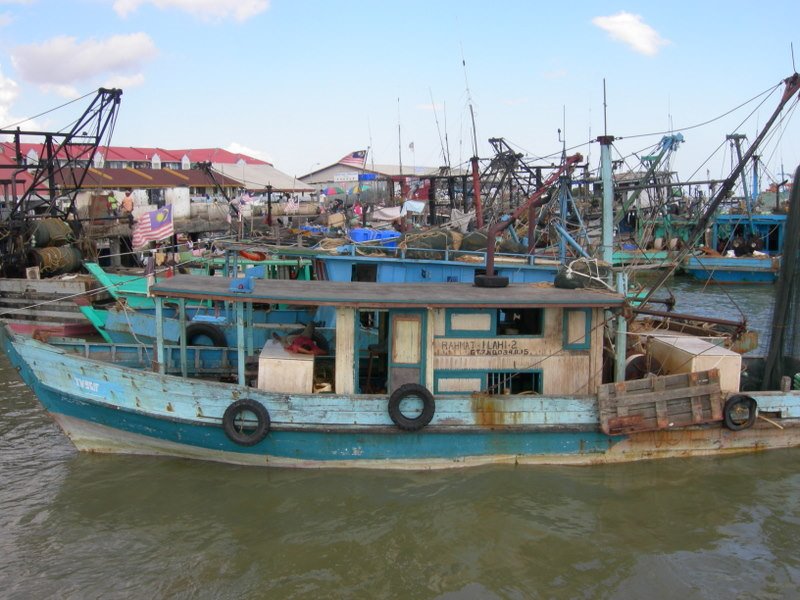
Getting off a ferry in Tawau Port

Some days back, I wrote about our very, very slow journey on a large wooden tongkang with a 75 hp engine from Tawau, mainland Sabah, to Sebatik Island.
Needless to say, on our return we decided to catch the regularly scheduled ferry along with the schoolkids and islanders – which took half the time. Now a ferry that runs every day at set times is going to arrive at some kind of passenger terminal, right?

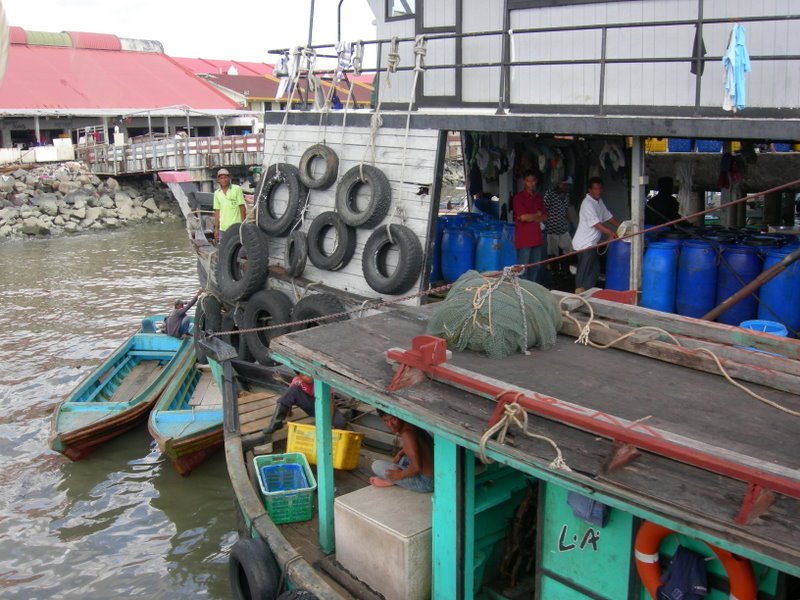
Picture One: we approach the passenger terminal.

Picture Two: we are about to dock

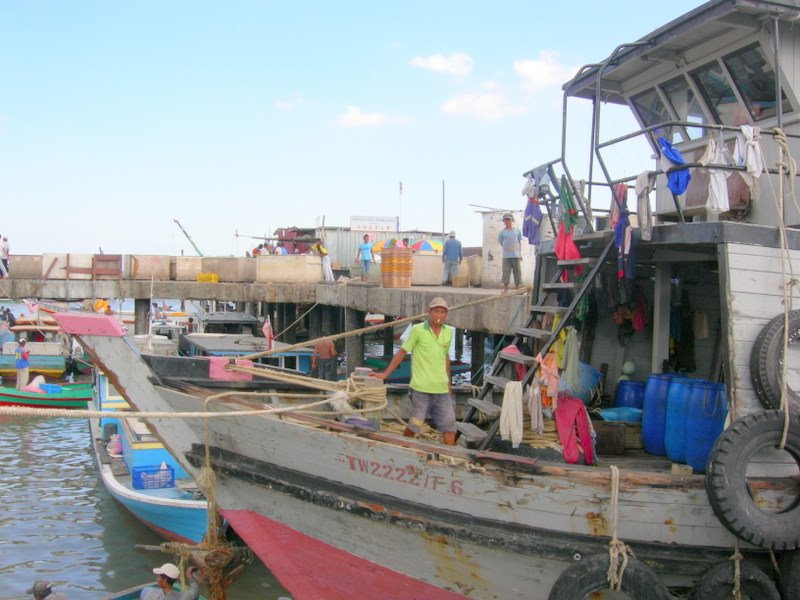
Picture 3: we contemplate the dock, which is the roof of the boat tied up to another boat which is docked…

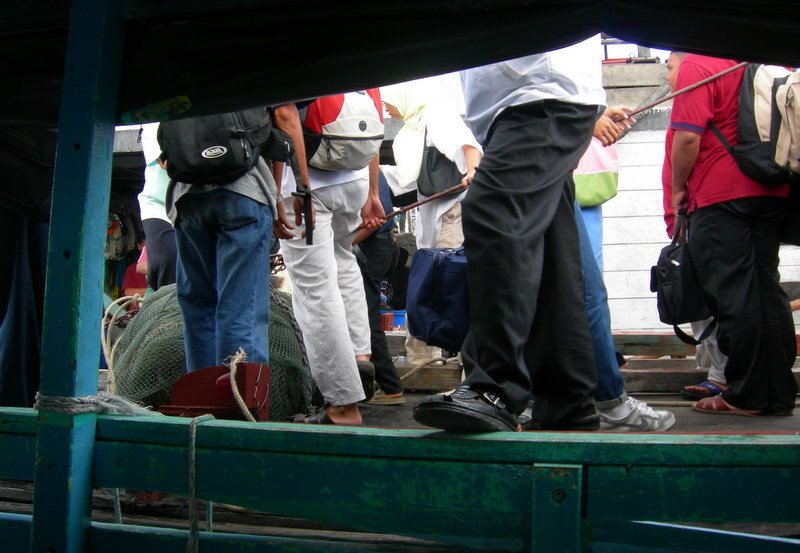
Picture 4: the scramble begins. The owner of the boat roof (take a look at those cracks), begins to have hysterics, unfortunately not caught on camera. All those people you see in the background are standing on his roof, about to be joined by those two in the foreground…

Picture 5: scramble over the fishnets and down a makeshift gangplank to…

Picture 6: the fishing boat next door which is being unloaded

Picture 7: Walk around this second boat to the steps, climb the steps up to the next deck…

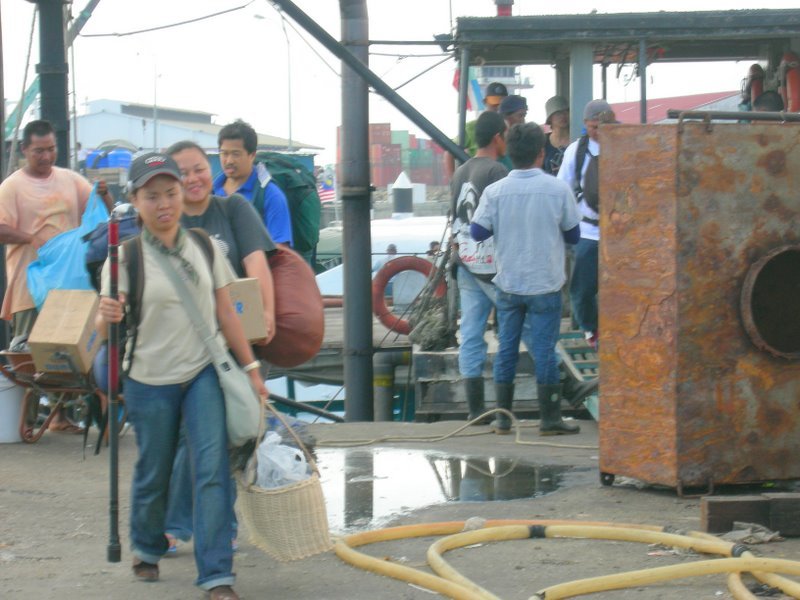
Picture 8: and, still carrying all your expedition equipment and baggage, get out on to the dock…

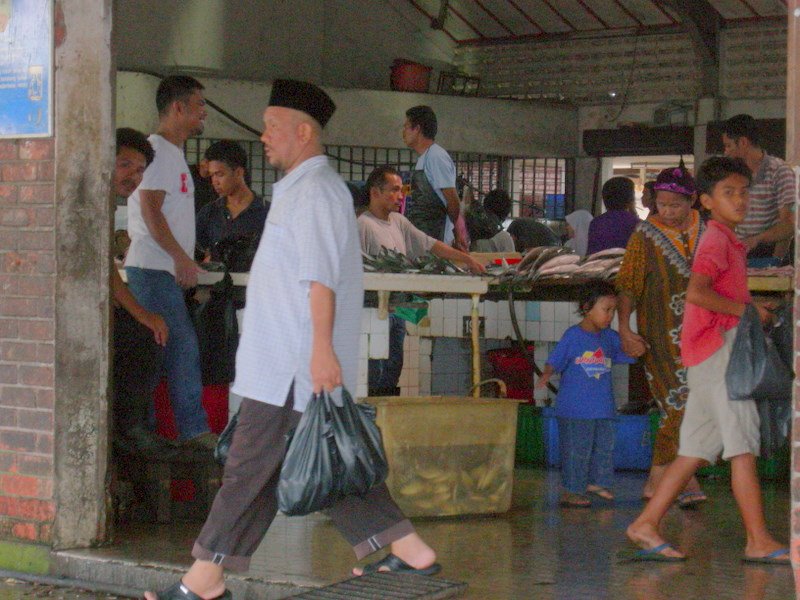
Picture 9: which is actually the dock for the fish market…


Picture 10: go through the fish market…

Picture 11: …and get ambushed by all the kids who just love to have their picture taken, especially on digital cameras where they can get instant feedback and see what they look like!

And so ends the saga of getting off a passenger ferry in Tawu Port.

I love Sabah.

Harriet Klausner under seige

It has just been pointed out to me that Harriet the Prolific is being gunned down big time over on the Amazon.com site. [see here]

It seems a group of disparate people have got together to disparage and shatter the “HK” myth (I kept reading that as Hong Kong which was a bit disconcerting.) They are posting their opinions on the comments section of the latest reviews done by the redoutable Harriet. She did, after all, post 44 reviews for March 11th which does seem, um, a little on the prolific side. And that’s not apparently unusual for her. Gives a new definition to speed reading, doesn’t it? As one of the commentators points out, it would take her a whole day just to pen the reviews – and that’s without reading the books.

Outsourcing (perhaps HK really does mean Hong Kong?) by publishers trying to boost sales seems to be the explanation put forward.

What does disconcert me a bit is that the commentators are extraordinarily vitriolic in their comments about the thousands of books “HK” is supposedly reviewing – they are all trash. I am not sure how they come to that amazing conclusion (unless they can do a Harriet and read tens of books a day). Perhaps it is merely the process of being read by Harriet that is sufficient to condemn a book as worthy only of being consigned to a third world loo?

I guess there are just too many supposedly literary types out there to whom the word “genre” implies “evilly bad”, and in this case it means science fiction, fantasy, vampires, thrillers, romances, chick lit, detective tales, erotica, police procedurals, media tie-ins, historical novels, family sagas, mysteries, comic novels – in fact everything from “An Irish Country Doctor” to “Speed Dating”. Harriet, after all, reads them all…

Quite obviously, there is no single Harriet Klausner doing all this. Which raises the question: who’s paying? Would any publisher bother? Why? Does a Harriet Klausner review carry such weight that it would boost sales? Are they kidding? (The average author reaction to any Amazon review, let alone Harriet’s, is that they make very little difference one way or another.)

There is one thing the commentators have got right, though. This shouldn’t happen.

This kind of “reviewing” is dishonest, it devalues all reader reviews and makes a mockery of the whole process. Every genuine reader reviewer out there should be up in arms – it insults them. The whole thing is unworthy of Amazon or anyone else involved.

{My theory, btw, is that there was once a real Harriet Klausner…}

Want to explore Indonesia anyone?

I have added some more comments on synopsis writing to yesterday’s blog.

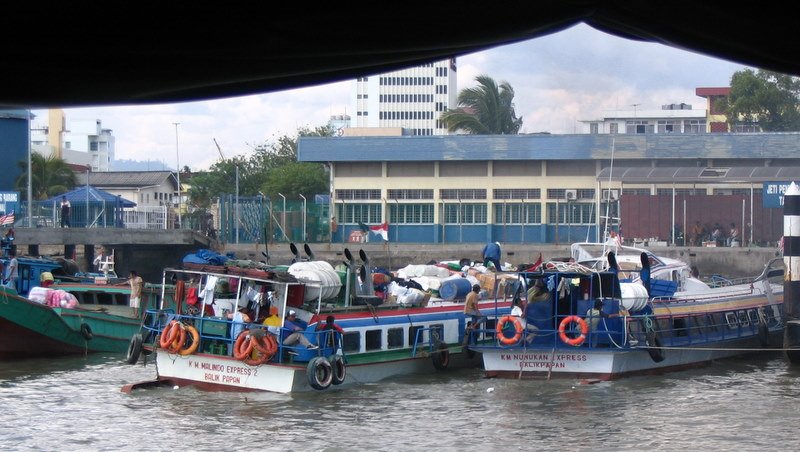
Poor Indonesia, they seem to lurch from one disaster to another. Including ferry disasters. Here’s a photo we took in Tawau of several ferries loading up for Indonesian destinations. Note the baggage on top like an overloaded bus, not to mention the definite tilt on the lefthand vessel. Double click if you want a better view.

I think I’d rather walk.

How to write a fantasy trilogy synopsis…I think

Ok, I have spent four days on this darn synopsis, (actually for a quartet rather than a trilogy). Which is ridiculous. I can write 5,000 words on a good day, and it has taken me four days to write a summary of just over 2500 words? I am now trimming it down…aargh. This has got to be harder than writing 25,000 words.

Here’s a few hints for any other poor sod who has to do this.

Firstly, if you are writing a synopsis, you have probably already got the interest of an agent/publisher. So you don’t have to worry too much about a startling grab-me hook. You have to do two things instead: make the whole story sound interesting and show the publisher/agent that you know where you are going with it. (Your ability to write good English is a given, right?)

Secondly, do NOT think that you are going to hold back the ending because “I want the editor to be knocked endwise by the twist when s/he reads the book”. A synopsis is just that: it tells the person reading it the story, in summary, and that includes the ending.

Thirdly, the problem peculiar to fantasy is that none of the fantastical bits are going to make too much sense in summary. “But the Redduner left his zigger cage on the pede…” may be a crucial incident in the tale, but it is going to mean absolutely nothing to anyone out of context. Worse, it all sounds a bit stupid. So how to get around this? In the actual book there’s a slow unfolding of how the magic works and what it does; in a synopsis you have to explain very briefly, and NOT show.

So what I do is start the synopsis with a few paragraphs under a subtitle of “The World” or “The Land” or something similar, where I describe briefly what makes this world unique and how its magic works. I end this section with a bit on the trilogy’s themes (nothing too heavy handed though. I’m a storyteller first.) And I hope to make this section really interesting because I suspect it will do more to sell the books than the truncated version of the story that follows – although that will now make sense, at least.

Fourthly, I deal with each book separately. I turf out all the minor characters and try to sketch in the bare outlines of the story, enough to be coherent, not enough to muddle. You can’t do much to show your skill with characterization, but I feel it pays to put a bit in about a couple of the most important characters. Here’s how I describe the villain of the piece: …a cold-eyed pede rider named Shanim, known for his unquestioning loyalty to Devin and his indifference to suffering, either his own or anyone else’s.

Anyway, I can tell you one good thing that came out of this exercise. I know exactly how Book 4 is going to end now. I always knew what I wanted to achieve by the end – that is, I knew the state of the world and the position of the characters at the end of the quartet – but I couldn’t quite get a handle on the climactic ending that was going to get me there, [what Russell Kirkpatrick calls “a typical Larke climax” of cataclysmic instability a la “Gilfeather”, “The Tainted”, “Havenstar” and “Song of the Shiver Barrens”].

Now I have it, and it’s a beaut.

I hate writing synopsis, but they sure do help to get your thinking straight. I am on top of the world tonight – hey, this quartet is gonna be good.

Photo: Sebatik Island, Sabah.

So where do you come from?

Here’s a couple of more photos taken on Sebatik Island.

My elder daughter reckons she can’t think of anything that would prompt her to leave a comment on a stranger’s blog. Come to think of it, she won’t even do it on mine.

I guess there must be many of you who share her reluctance, because there’s a heck of a lot of you drop by and never say a word.

So today’s blog is for you, the unknowns. The last 100 visitors here came from 16 different countries:
UK (25)
Australia (24)
US (15)
Malaysia (11)
and also Canada, India, Spain, New Zealand, Philippines, Finland, Hong Kong, Sweden, India, Brazil, Germany and China.

Raptor watch

I stood at the foot of the lighthouse and looked out across the Straits of Malacca. One can see Indonesia on a fine day, someone said. Not that day: in the distance the horizon blurred into sea haze, and hence to sky.

Far below me, a steep tree-clad slope tumbled into water and a coral reef. Every so often a turtle would surface for air and then drop away into murky depths.

We were waiting. And waiting. Bored with the sea watch, most of us looked at other birds in the surrounding remnant forest – resident sea-eagles, scarlet minivets, tiny falconets, dollarbirds doing their aerial dance that earned them their other name: rollers.

And then someone said those magic words: ‘There’s one!”

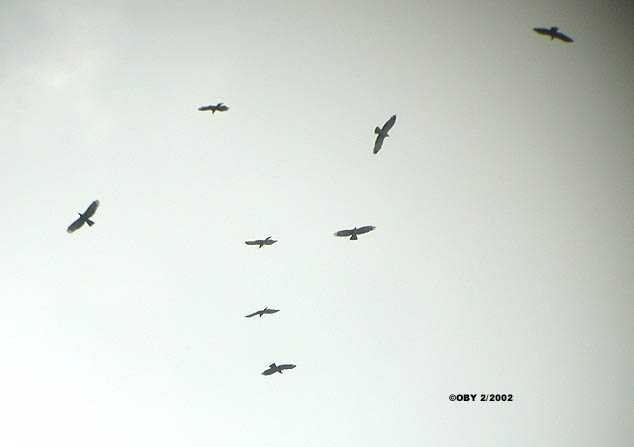
It took me a while to see it – a speck against the water far below. Flapping, flapping, flapping. Growing larger by the minute. And then another behind it, and another. A line of birds approaching like the straggling vanguard of an army worn out by battle. And we were looking down on them, not up.

And battling they have been, trying to power their bodies across water, when they are built for grace, for gliding on the thermals and the rising air of a land mass.

The first bird is panting, its beak open in the heat. Then he stops the laborious beating of his wings and the uplift of warmed air from the cape catches him gently and lifts him. He tilts, and banks over us in lazy circles. Can I see relief in that glinting eye as he passes me? What does he think to see us there, watching him with our binoculars and telescopes, recording his passing with a pencil stroke in our notebooks, or a click of our counters?

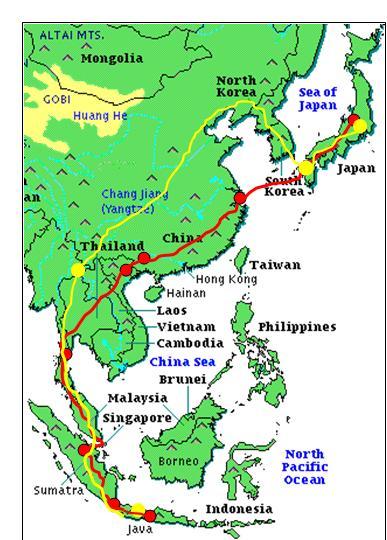
He is not home yet; he has just come from Indonesia and is bound for Japan or northern China, or Russia maybe. His journey is 10,000 kilometres long and he has another couple of months to go, back to the place where he was born. He might be shot at, trapped, blown off course, drowned in the sea. Or he might nest and raise young and be back this way again in October.

My eyes fill with tears. He is magnificent, somehow noble in his thoughtless instinctive dedication to return to his birth place. He is symbolic of all that is right with the world, and symbol of all that could go wrong.

It was my first raptor watch, twenty-five years ago.

This year I won’t be there. And I am saddened.
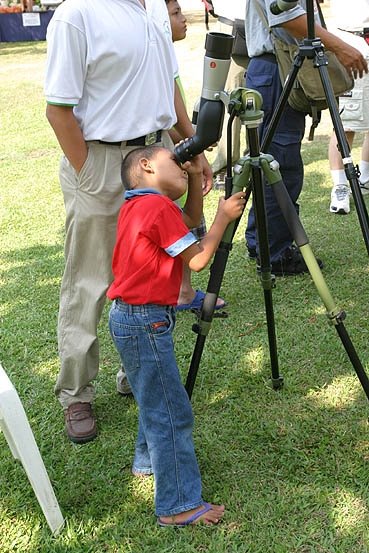
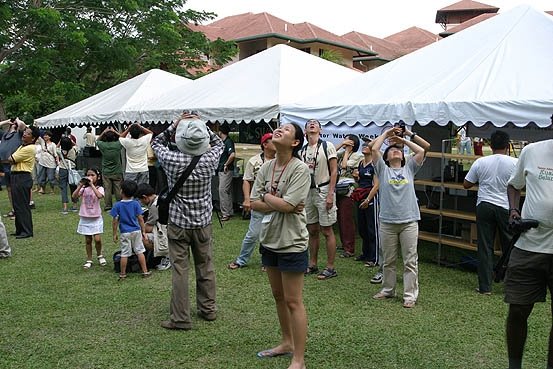
http://photos1.blogger.com/blogger/6515/2239/1600/migrmap.0.jpgIf you live in Peninsular Malaysia or Singapore, then you should be in Melaka this weekend, at Tanjung Tuan, at the edge of the beach in the Ilham Resort grounds. You should be there to watch this. Even if conditions are poor for arriving raptors – and that does happen – there are a ton of things for you to see with your whole family, including grandma who can sit under the trees (and see the raptors too when they pass overhead). There are competitions for kids, and talks, and telescopes to look through, guided walks to go on, something for everyone and most of it is totally free or available for a ringgit or two. If you aren’t there, what the hell’s the matter with you?

For more information, look here: www.mns.org.my

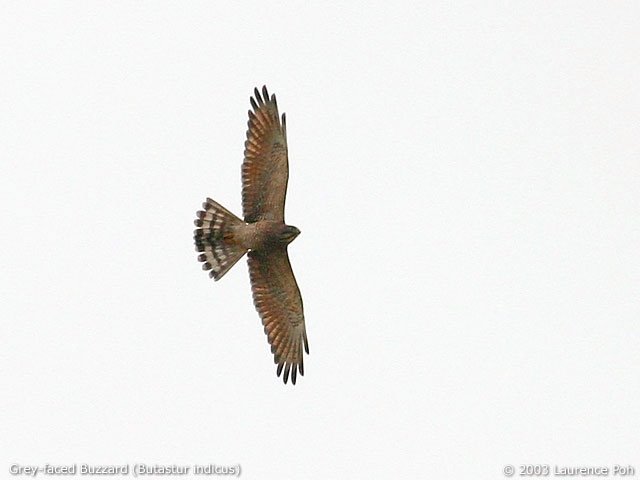
All photos supplied by the generosity of Malaysian Nature Society members.

I hate writing synopses…

I loathe, despise, abhor, abominate the necessity for writing synopses. Right now I am writing this blog, rather than write a synopsis.

But as the final book in a trilogy winds down towards publication date (at least from the writerly involvement point of view), the ugly spectre of Glenda writing a synopsis hovers yet again…

My publisher’s editor has not written me an email saying that there are just one or two small things that need altering (all editors have a penchant for understatement), so I can only assume she is satisfied with The Song of the Shiver Barrens. My agent has hounded the accounts department, and the cheque for the delivery of the MS is already in my bank account and partially spent (bless both agent and HarperCollins Oz for their efficiency.)

Which all means that Song of the Shiver Barrens is well on its way towards its July publication. And with that, The Mirage Makers – a project that has been with me since 1992 – comes to a close.

Ok, so there is still the copy edit to be dealt with, and the proofs to read after that, but this is the period when my agent begins to speak of selling the next trilogy. The one that’s only partially written… “I know you’re very good at these synopses from your previous work,’ she writes. Huh. She must know how much I hate doing ’em and thinks a spot of fulsome flattery will fuel my fingers at the keyboard. Yeah.

I mean, how can you condense the plot of three books – or four in this case, because it’s not a trilogy but a quartet* – into a one or two page synopsis??? How do you impress an editor with the depth of your characterization, the twists and turns of the spectacular ending, the sensawunda of your spendiferous world?

It would be bad enough having to write the synopsis of a novel set in, say, suburban US/UK/Australia. At least you could say something like “Philip Twitterton, a mild-mannered glass-blower from Sydney, has just murdered his ex-model wife with a box of kitty litter, and is now wondering how to remove – in secret – the smelly, bloated body of the 400 pound woman from his apartment…”

Nice hook(s) and loads of information in the first sentence.

But how about this: “The Four Quarters are in trouble. The Droughtmaster is dying and someone has been murdering the young Drouthlords…”

So what? you may ask. Somehow I have to convey how and why that is important to both the land and my young hero, when it is going to take me half a big fat fantasy to explain…

Besides, how the hell do I know what’s going to happen in book four when I haven’t finished book one yet? I sort of know, but the details are hidden in the mists of the future, and will only be revealed with I immerse myself in the world of the Four Quarters and talk to all those characters now rattling around in my brain planning their betrayals and triumphs.

Oh, and if you want to help, go out and buy The Mirage Makers. That way, it won’t matter how lousy my synopsis is; my sales figures will be so spectacular, the publishing houses will be clammering at my agent’s inbox to buy the rights to The Random Rain Quartet.
See? You too can make a difference…

I hate writing synopses.
——————————————

*The Random Rain Quartet consisting of:

Book One: Drouthlord
Book Two: Droughtmaster
Book Three: Waterpainter
Book Four: Rainmaker


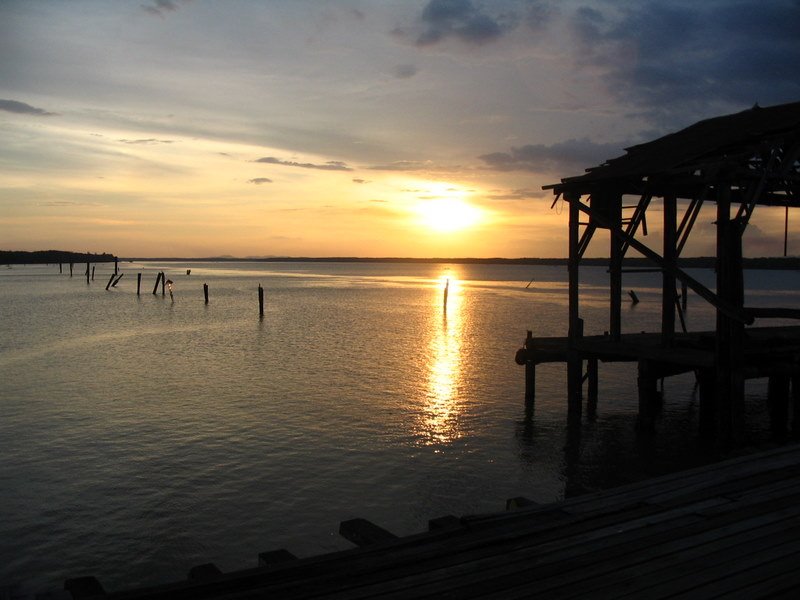
Another sunset from Sebatik Island

Kill them books! Quick, before they enlighten you…

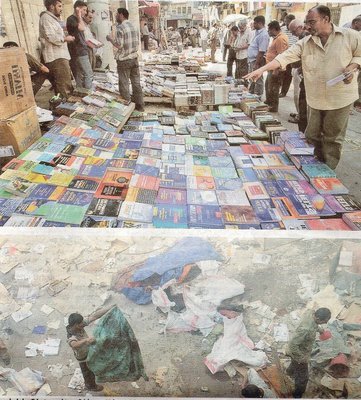
Criminals in Baghdad have just blown up the book market. They killed a lot of books as well as people.

Some people fear knowledge. They know it sets people free. They know it enables us to make up our own minds, instead of swallowing their hate and bigotry unquestioned.

A few brainless librarians in the USA ban kids’ books that contain the word “scrotum”;
Nazis burned books;
Communists banned just about anything that looked interesting (in the hope that brains would die of terminal boredom?);
Right-wing Christian nuts stop their kids from reading about wizards;
The Malaysian government censors ban anything that looks iffy to their literary-challenged minds.

In Bagdad they blow up books. The only difference is the matter of degree. Loss of stimulation that prompts the ability to think for oneself on the one hand, loss of life as well as the books on the other. It is all tragic. It is all a step backwards.

Some people cannot see that a closed mind has no value, and certainly no virtue. How can there be virtue if you have never seen an alternative? Never been allowed to think for yourself?

Savoir c’est pourvoir

Before and after pix pinched from the Malay Mail newspaper via Bibliobibuli