If you have been reading my blog, you will know that I have temporarily shelved the book I was writing to plan another trilogy instead. I have not yet signed any contracts, so at the moment I am fancy free. Am a writing? Yes. Can’t ever stop. And I am researching the story I am writing because it concerns many things I don’t know too much about…(and some I know a lot about but want to know more.) No, it will not be set on our earth, but still – I aim for authenticity.
Here are some words to (I hope) intrigue you: spices, the wicked twin, birds of paradise, scurvy, arranged royal marriages, aromatic bark, kora-kora, trade wars, buccaneers, archipelago, witchery, faustian pact, 17th century galleons, bloody flux, pomanders, milliners, trepang, massoy, plumed cloaks, lost heir, deception and mayhem … need I go on?
Nah.
Needless to say, I am adoring writing this story. Ideas and words are just coming too fast!
![]() |
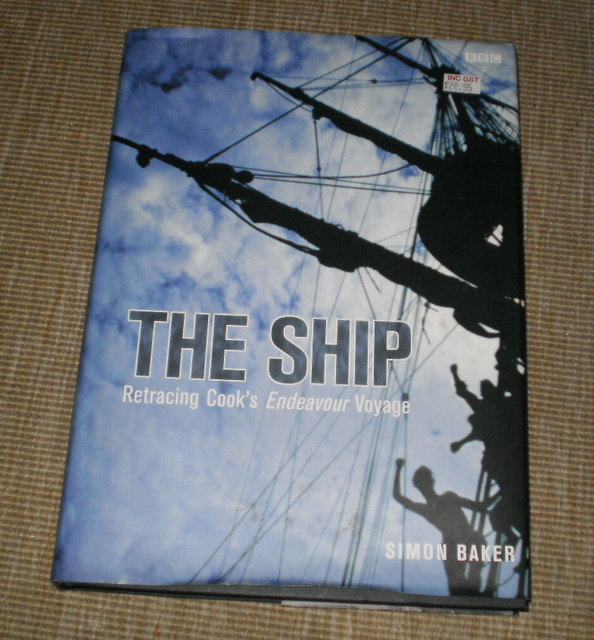
| The Ship: Retracing Cook’s Endeavour Voyage |
So where do I start the research? Shipping plays a big part. And this book is handy, even though it deals with an 18th voyage, rather than a 17th century one, by Captain Cook on the Endeavour.
The book, written by Simon Baker, belongs to me: I bought it, not for this research, but because that voyage was part of my history. It tells a fascinating story, not just of the voyage of the original Endeavour but of a 20th century version of that voyage in a replica ship. It’s a wonderful book to own.
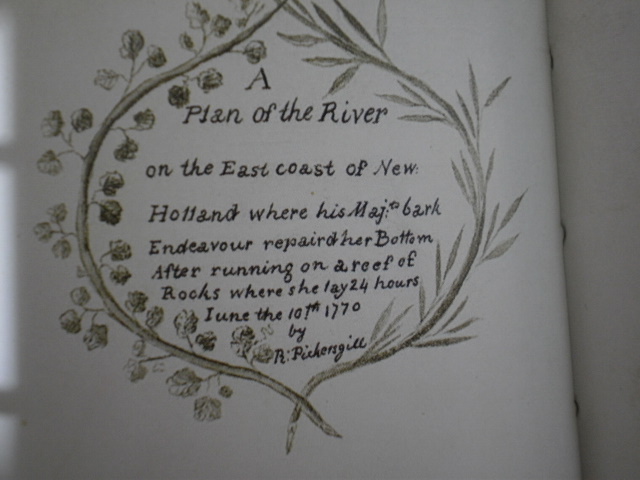
Take a look at the map below, dated June 10th, 1770. It shows part of the Endeavour River in Queensland
It was drawn by a young man – he was only 19 when the voyage began – but he was already skilful at chart making. His name was Richard Pickersgill. If he had not sailed on this ship as master’s mate, if he had not returned safely to England, I would not have been born.
![]() |
| Don’t you love the expression “”repaired her Bottom”? |
If you want to know still more about the harrowing experience of being a British sailor in the 19th century, then try this website. Oh, yuk.
If you want something about sailing ships in general then this is a great website to start on, by a chap called Rob Ossian, one of those wonderful folk who so willingly share their passion.

Friend Dr Gillian Polack is running a series of guest blogs over on LJ here to celebrate March, Women’s History month. So pop over there and read posts from a selection of truly remarkable women, some of whom I have the pleasure of knowing.
Gillian herself — writer, editor, historian, lecturer, teacher, novelist — is a pretty remarkable woman, and you can read about her here.
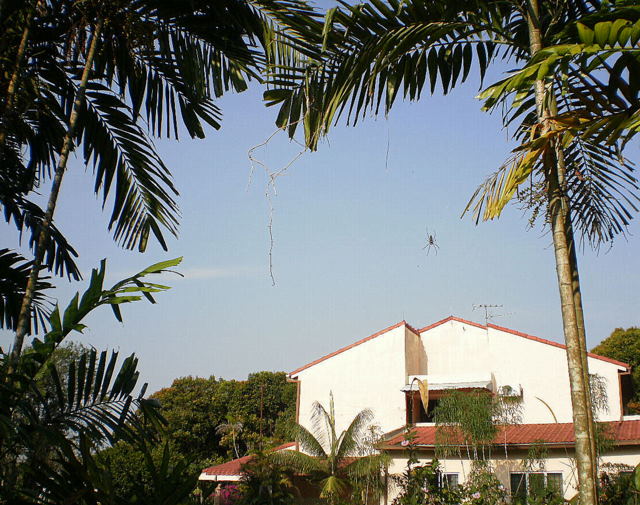
This is a pic from my garden looking at the neighbour’s house. And that dot in the sky is…
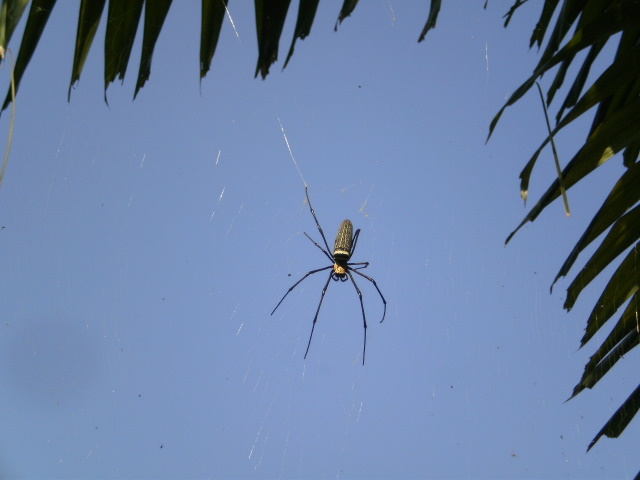
this:
It’s an Orb spider, some times called a bird-eating spider (and yes, they do.) With it’s legs outstretched it would cover my open hand, easily. And they are no big deal for humans, so he can stay there as long as he likes. You can read more about it here.
Still haven’t managed to catch sight of that cuckoo in the garden, but am still thinking it sounds like a Banded Bay, and that would make sense as we have the brood host, the Common Iora, and there is a fairly wooded area at the back of our house, bordering the golf course.
Why on earth would one do research for a fantasy novel set in an imaginary world? You make it all up, right?
Well, sort of. But it has to be believable. Which sounds weird, but if the world is not internally consistent, then the reader loses interest. One way to make a pre-industrial society of a fantasy world believable is to know how people used to do things way back when in our world. Actually there I have a head start over many younger writers. I saw my mother make soap/butter/cream/jam/ginger beer/ out of raw ingredients, or gut a chicken, or trim a lamp or darn the heel of a sock or cook over a wood fire. I saw my father skin a sheep, hang a gate, use a whetstone, milk a cow, build a house with only the simplest of tools and so on – all sights most Westerners never see any more.
When I moved to Asia there were other things to see or to learn: using a hand turned grindstone to make flour, winnowing rice, grating coconuts the traditional way, using a loom, weaving mats by hand, using leaves as plates and countless other ways of living with the natural and making do without the manufactured.
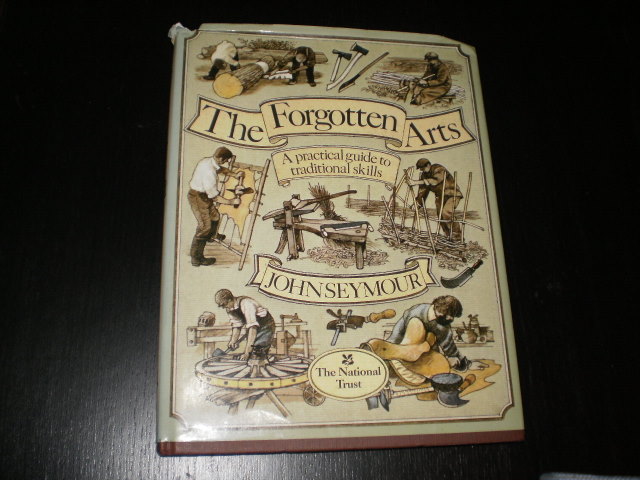
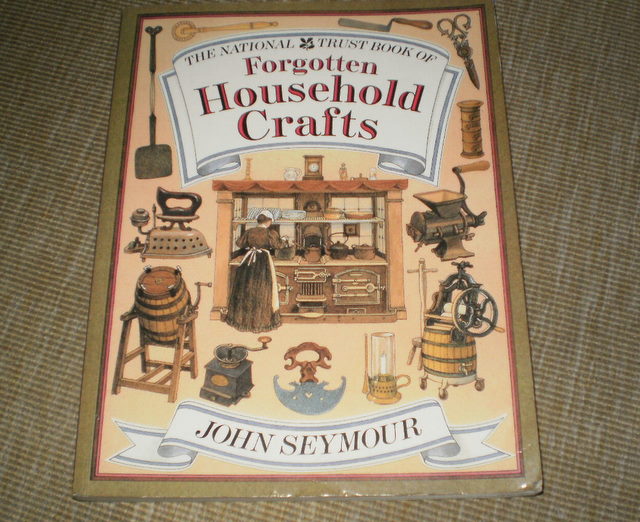
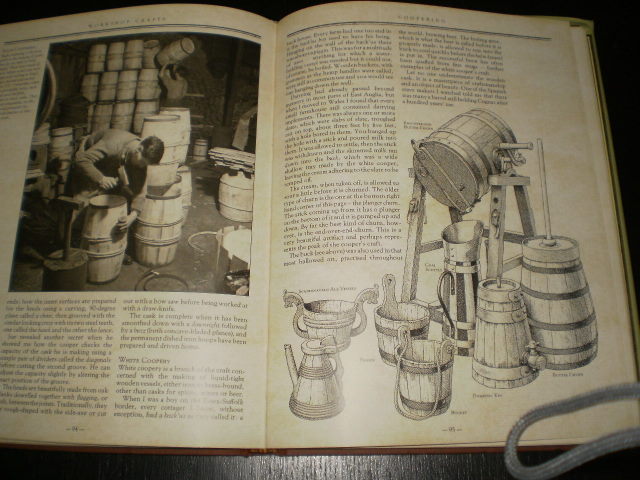
However, if I do need information outside my own knowledge, I delve into one of these two books by John Seymour. A wonderful source of info on everything from making a wooden bucket, or an ice house, or a birch broom to what are the contents of a tinder box.
Titles: The Forgotten Arts: A Practical Guide to Traditional Skills (more about farming and building) and Forgotten Household Crafts (about cooking and housekeeping). The fascinating thing about both books is that he wrote about things he himself
could do, or he went to people who still knew how to do these traditional arts and asked them.I am going to continue this theme in my next post…and show you some more of the texts I am dipping into for my next books.
The other day I noted a vote going on over at the ASIF site (Australian Speculative Fiction in Focus). It was to find the most popular series by an Oz author. They selected all the authors who have a completed trilogy/series, took one of those and asked readers to vote. Looking at it, I was thinking to myself I’d be hard put to choose which one – when the authors were folk like Karen Miller, Sara Douglass, Juliet Marillier, Jennifer Fallon, Trudi Canavan and so on… My God, with a line-up like that, how on earth could one choose? As my Mirage Makers was also up there, I didn’t vote, but quite frankly, I would not have known which to pick.
Anyway, the winner was Sean Williams’ Books of the Cataclysm, and as he is one of Australia’s most talented SF writers, that was no surprise. What did astonish me was that Mirage Makers was second. Wow. Thank you all those that voted for it.
I may be officially astonished, but today I am also officially one very contented author.
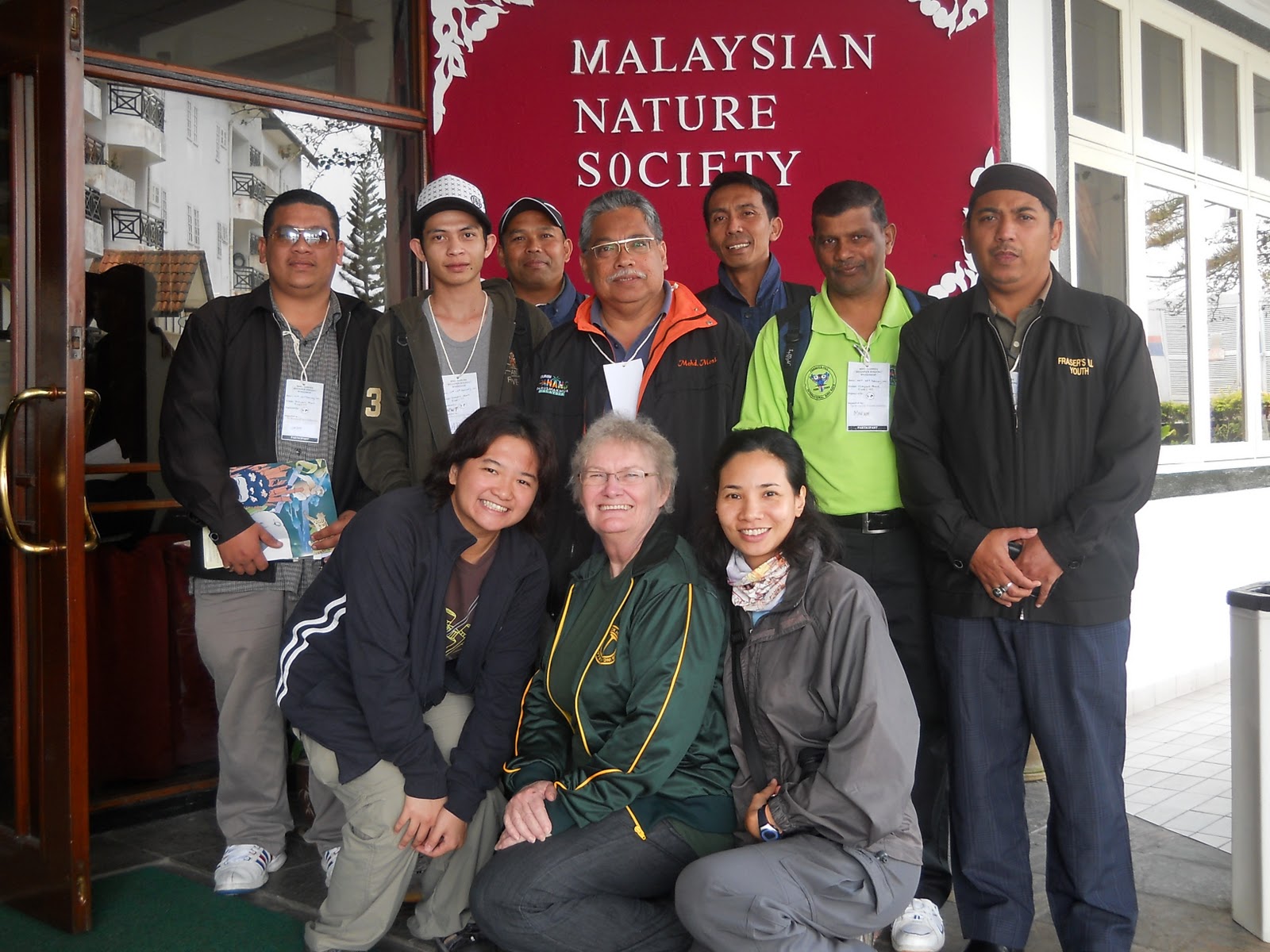
![]() |
| Photo: Me and my 2 fellow trainers and the participants after giving a training session up at Fraser’s Hill for beginning birdwatching — as part of the tourism project I’ve been working on for the past three years. |
![]() |
| Watching the Tailorbird nest… you can see the inside lining in this shot. I don’t go near it now, as the birds are taking it in turns to sit on the eggs. |
The nest was really blown around in the wind during a thunderstorm yesterday – our trip switch was tripped twice by lightning in the space of an hour! – but the bird remains quite snug in its leafy cover.
In other news: husband returned from a weeklong trip to Christchurch New Zealand, escaping the earthquake by two days.
I have been doing the proofs for the Voyager first pages of Stormlord’s Exile.
I had a pair of resident Oriental Honey Buzzards calling for almost half an hour as they circled the house. Possibly, they are nesting in the golf course that is not far over our back fence. And a cuckoo was going berserk in the garden this morning, so some of the small passerines should be watchful when they come to nest… Not absolutely sure what species the cuckoo was, but I think it might possibly be the Banded Bay. I have heard the Plaintive Cuckoo in our garden, but not for a long time.
Oh, and I saw a male Orange-headed Thrush up at Fraser’s Hill, which was a nice sighting. Very attractive migrant.
And that’s about it. Nothing really exciting. Sometimes life is best with the small pleasures and an absence of excitement and adventure.
Take a look at my last blogpost first, if you haven’t seen it.
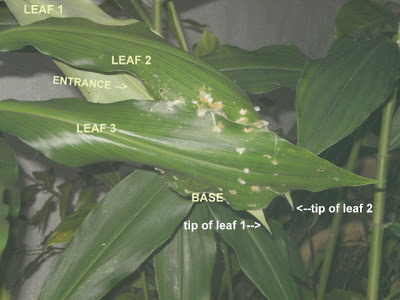
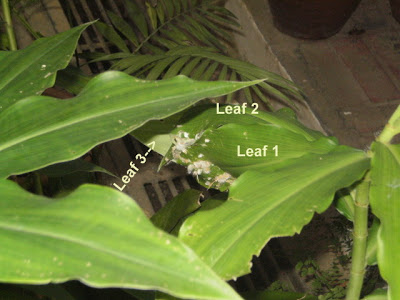
I have two species of tailorbirds that nest in my garden. The fleeting glimpses I’ve caught of the owners of this one indicate it is the Common Tailorbird, sometimes called the Long-tailed. The other species is the Ashy.
I took these pictures at dusk – I waited to make sure the builders had gone for the night, as I didn’t want them to abandon the nest because I was too close.
![]() |
|
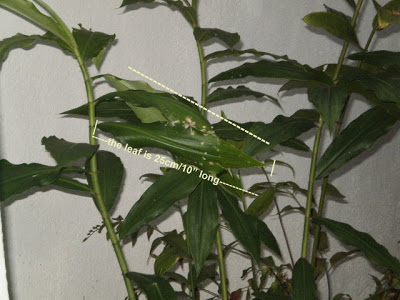
| The entire nest can be seen between the dotted lines |
![]() |
| It consists of three leaves, sewn together by the bird’s needle – its beak, using as thread anything wispy like tree cotton, thistledown or fluff. You can see the curve of the nest interior by looking at the line of stitches |
![]() |
| This is taken from the bedroom window, looking directly down on the nest at the backside. |
The bird works mostly from the interior, poking a hole and then threading the fluffy stuff through to the outside. On the outside, it fluffs it out still more so that it won’t pull back through, and the stitch is done. The leaves are still on the plant, still growing – the perfect camouflage, one hopes…
Help, one week since I blogged. I am neglecting this lately…just two many other things going on in my life which are simply too dull to mention!!
Well except this. Now this is cool:

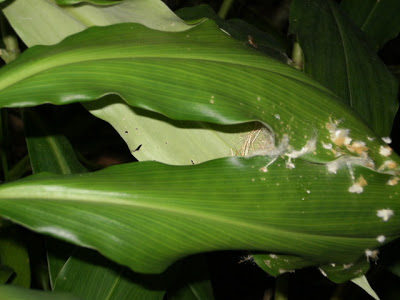
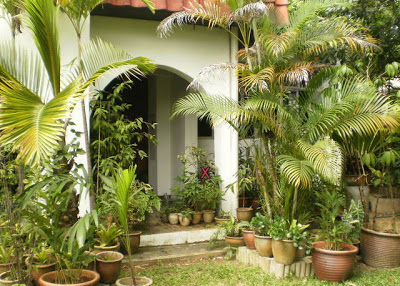
Behind that X there is a pair of tailorbirds industriously building a nest – tailoring it, in fact, using their own brand of thread. More photos will follow, but for now, I don’t want to disturb them.

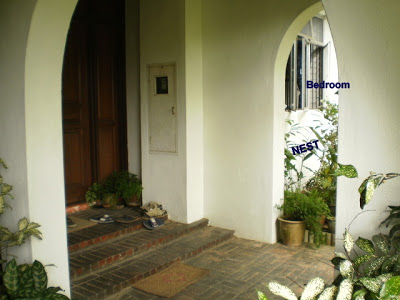
Here’s another photo showing the front door to the left. The nest is inside that big leaf directly to the left of the ‘N’ in NEST. These birds are tiny…less than 12 cm/5″ from the tip of their beaks to the tip of their rather long tails. Their bodies are half that! They could sit on your finger and you wouldn’t even feel the weight.
My husband and I were swapping stories in the car…harking back to our primary school days.
I lived on a farm and we had our own dairy cow, so if there was one thing I had plenty of when growing up, it was fresh unpasturised milk and cream and fresh home-made butter. Yet when I got to school, we were given one third of a bottle of milk to drink under some government scheme or another. I loved my milk cold and with the full cream skimmed off the top. At school it was pasturised, disgustingly warm (having been transported in crates on the open back of a truck), and topped with a glob of cream in the neck of the bottle. I loathed it, but refusing to drink it was not an option.
Post World War Two, after the defeat of the Japanese in Malaya, the returning British* were understandably concerned about the nutrition of the half-starved population, especially its children. So twice a week each child had to bring from home a cigarette tin, which would then be filled with powdered Klim Milk to take home.**
Anyway, boys will be boys, and those kids at the Bukit Beringin school in Malacca (hardly more than an open platform of cement with an terracotta tiled roof at the time) were no angels. On the way home from school, husband used to put a whole lot of powdered milk in his mouth to blow at his pals when they weren’t expecting it.
If he needed school supplies – a new pencil, for example – he’d take an egg from the henhouse on the way to school slip it into his pocket, and swop it for what he wanted at the shop along the way. Of course, if there was a bit if roughhousing on the way to school with his friends, you can imagine what happened to the egg. And he had to sit all day with that mess congealing in his shorts…
Ok, so husband has the best “when I was a kid” stories…