The magic of modern technology

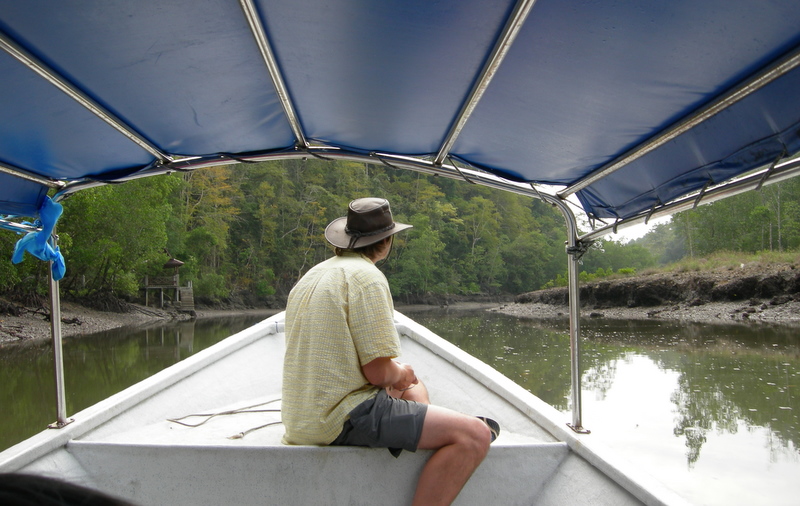
Exploring the byways of Langkawi by boat

Years ago, when I first arrived in Vienna to live, I was unsettled to see quite a few swastikas spray-painted on to public structures, along with some anti-Jewish sentiments that were as vicious as they were puerile. Geez, I thought, am I coming to live in a land where everyone hankers back to the glories of the Anschluss?

Then I realised that was an unfair thought. Every single one of those graffiti might well have been painted by a single idiot. Modern technology – in the form of a good transport system and a few cans of spray paint, and a modern economic system that gives us disposable excess income, had made indeed made it perfectly possible for one person to do irreparable damage to the good name of a whole city.

I was struck by several things just lately that illustrate that thought all over again.

An irate Australian from the Islamic Council of Western Australia remarked (about a series of video lectures made by a racist-religious bigot calling children to martyrdom and jihad): “Some lousy guy stands up and calls himself a leader of the Muslims, calls himself a cleric because he can read the Quran. Why do people like me have to sit here and give an interview because every Tom, Dick and Harry gets up and makes some studid comments – and then we are called to account?” (From yesterday’s “The New Straits Times”)

And I wonder if anyone called the Pope to account, every time a Catholic bombed someone in Ireland…hmmm.

Then, over on Dec 29th’s Baghdad’s Burning, (a blog by a young Iraqui woman who has had her life ruined by the invasion), outlining a situation I predicted way, way back at the beginning of the Iraq war:

Al Qaeda? That’s laughable. Bush has effectively created more terrorists in Iraq these last 4 years than Osama could have created in 10 different terrorist camps in the distant hills of Afghanistan. Our children now play games of ‘sniper’ and ‘jihadi’, pretending that one hit an American soldier between the eyes and this one overturned a Humvee.

And I think: all it takes nowadays is a few young men with a bomb instead of a spray can. So very few can make life hell on earth for all of us. Or if you want to go a bit further back: all it takes is a few irresponsible or moronic politicians to make a mess of things, and we all suffer.

And when will humanity learn the difference between being strong and being violent?

Sure, building a good fence can keep the peace. But build a wall and lob bombs over the top, and you end up with a lot of angry people and a lot more than a spray can in mind…

I saw this so clearly back at the beginning of the war. I am still flummoxed as to why it has taken so many people so long to see what I saw so long ago.
A word on the Aurealis Awards

It’s just a week to the presentation of this year’s Aurealis awards for Australian spec fic, taking place in Queensland.

Every time any award winners are announced, there’s always talk of how unpredictable these things are, how little they mean etc, etc. Inevitable, I suppose, because it’s not ever a first past the post thing. Book awards are not a race with a clear winner. Judges are basing their decisions on their own personal preferences and the judges of the books for 2006 would doubtless have selected different winners for the books entered 2005 which were judged by another group of people.

The one thing that makes the Aurealis Awards a tad different from many such awards is that the judges of a section (in my case fantasy novels) read pretty much every book eligible in that category (books published that year by Australians and Australian permanent residents anywhere in the world are eligible). In many other awards the books submitted are weeded long before the judges see then, simply because there are too many.

William Boyd, the latest winner of the Whitbread Award, now called the Costa Award, remarked that it was “the equivalent of a win on the horses or the lottery”, which is true – lovely to have, but don’t let winning put your nose too far up in the air, or feel that a loss is a kick in the pants.

So why then bother with awards at all?

Well, Boyd also said, “I think they’re a good thing because they encourage readers and that’s what all writers want.” I agree with that, but I also think it encourages writers. Not because we write to win or to be short listed, or because we can live on the prize money (the Aurealis has none) but because it means that there are people out there who care enough about what we are doing to have organised this prize in the first place, and others who do the work involved year after year, without remuneration, whether it be organization or judging. I find that encouraging; morale-boosting, if you like.

I don’t know who will win this year. There are books by four other very talented writers short listed (in my category, Juliet Marillier, Grace Dugan, Sean McMullen and Michael Pryor) but I do want to say thank you anyway. Thank you to all the people who have had a hand in this award. To all those who put in the work. I appreciate it and I’d appreciate it even if I wasn’t shortlisted.

And to all those who are going to the prize giving next Saturday, I wish I could be there, just to see you all.

Was it possible to have a feminist society?

Another photo from the Langkawi holiday
I had a radio interview with Grant Stone on Faster Than Light today. (That’s in Western Australia). I don’t think I was very coherent on one question he asked, which arose out of my portrayal of the main protagonist in Heart of Mirage as a strong, powerful woman.

The point I was trying to make is this, that if a writer wants to portray a society where women have equal opportunity (not a particular accurate definition of a “feminist” society, I realise), and the work is a fantasy set in a pre-industrial world, they said author is going to run into problems of believability.

I’m not saying it can’t be done – but the writer has to understand the dynamics of such a world and adjust their plot accordingly.

Think about a pre-industrial world and this:

  • Muscular power is exceedingly important in any non-industrial world (as anyone who has tried to mend something without proper tools knows)
  • Physical protection probably involves physical strength to a large degree.
  • You have to have some kind of birth control. Women can’t be equal if they are forever pregnant or lactating or child caring. They find it hard to be the explorers and adventurers, too, if they have a toddler clinging to their skirts – yeah, I just got reintroduced to the curtailing effect of a two-year-old.
  • If she doesn’t have access to really good health care, a woman is at a disadvantage because she is childbearing and often dying as a consequence.
  • If there is any basic inequality in a society, who is usually the loser – the group that is the inherently physically stronger? Not in my book…

Probably the only way you could achieve a truly equal opportunity land, would be to develop the magic to even things up.

Of course, women did achieve power in non-technological societies, but they were the exceptions, not the rules.

And women often did achieve a certain level of cultural and social and even financial clout in some societies, for a variety of reasons – sometimes religious, sometimes because of the way men worked or warred (when men marched away to fight, they could be gone for years). It’s an interesting exercise to consider just why women achieved high status. (Often it was at the expense of other women – i.e. the servants or slaves.)

And interestingly enough, my husband was born into a matriarchal society. That’s right, even in today’s Muslim world such things exist. Property is passed down the female line. A man moved
into his wife’s house, not the other way around. Just to make it even more curious, the head of the clan, of which my husband’s family is a part, is always a man. In fact, it would have passed to my husband, except he didn’t want it.

Shadow of Tyr review

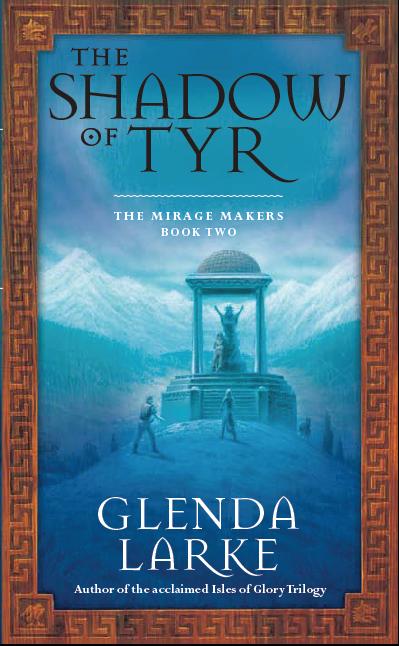
There is a truly wonderful review of the second book of The Mirage Makers, The Shadow of Tyr up at Specusphere, the Queensland site for “fans, users and creators of speculative fiction industries”. You can find the full review here.

In part:

“Her writing is smooth, easy to read and consistent in its excellence, as we expect of an established writer.

“Larke writes this sometimes tragic tale with great sensitivity. Many years and many locations have been shoe-horned into this volume: it is epic fantasy on the grand scale. The characters are well-drawn and differentiated and the tale sweeps us along with the grandeur of its purpose.”

I just love it when a reader understand what I have trying to say, and loves the book at the same time. My thanks to the lovely Satima Flavell.

BTW, if you are an Australian resident, there’s a simple competition to win one of 5 copies of the first book, Heart of the Mirage up for grabs here.

How much notice do you take of Amazon reviews?

Ok, so we established the other day that we writers are totally pathetic, and we look at our Amazon reviews with obsessive regularity to glean whatever drops of approbation we can find to feed our voracious egos…

But I am wondering: just how much notice do READERS actually take of those reviews? Now I know this is probably an extreme case, but just consider this example:

A book, Danse Macabre by Laurell K. Hamilton, sits at 3,590 on the Amazon.com rankings after publication in June 2006. That’s over 6 months ago, it’s a hardcover and the paperback is not out till March 2007, so that’s a pretty good ranking. It has 533 reviews. Wow. But it has been almost universally rubbished by those reviewers – it has 2 stars.
WTF? People are still snapping up the book, reading it, and then writing a review about how lousy they think it is. There are already 9 reviews for January. Don’t any of them read the reviews first, and wonder whether they really ought to buy it in the first place? Apparently not. Or not enough to give the author a lousy ranking.

Interesting, eh?
From a writer’s point of view, I guess the moral is: if you get a bad review, don’t worry. Perversely, it might even sell more books…

What kind of book ending do you really, really hate?


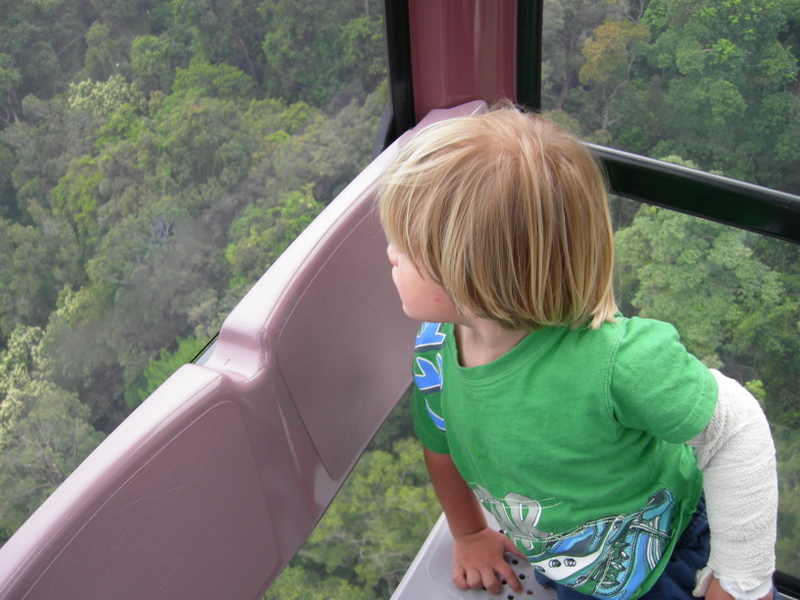
I am still deep in messing around with Song of the Shiver Barrens, so here are some Langkawi Island photos to look at, all taken from the cable car. Want to see what a rainforest looks like from above? Langkawi is the place to go. Click on the photos if you want a better look.

Plus a question. What type of book ending do you deeply dislike.

I am particularly interested in sff of course, but no need to confine your comments to that…and note, I am not asking what you like, but what you hate. And I am thinking of the real ending, i.e., the end of the trilogy not Book 1.

Beware holidaying with the Noramlys

Langkawi Islands

(This post is for you, E. Be warned…)

When the Noramlys travel, you can almost guarantee that things will not go as planned. Over the years, we have, between us:

had a passport stolen in a foreign country (daughter and me on separate occasions), been in a traffic accident that totalled a 4WD (me), broken a collarbone (me), missed planes and trains (lots of us), been robbed and dragged behind a car (me), narrowly escaped arrest for immigration violations (me), been involved in a massive airline strike and stranded for hours at airports and spent days trying to get home (all of us), been booked on a flight out of Beijing that didn’t exist and consequently had to commuter hop across China to Ulan Bator (husband), arrived without luggage (all of us, but particularly husband who actually rarely arrives with his luggage), been on a plane that turned back twice over the Pacific for mechanical failure (husband; on the third try he was almost the only passenger on a huge PanAm jet), been refused entry to Italy and narrowly escaped deportation (daughter), been caught in the middle of revolutions (husband and me, several times in different countries), been turned back by floods (husband and me), been on a plane that suddenly aborted a landing into Caracas in a rainstorm at the last moment, without explanation (husband and me), had someone take her bag by mistake at the airport and take it to his hotel (daughter), have a bag stolen at the airport (me), had numerous bags rifled by airport employees (all of us), spent a holiday in the Sahara in December on the only days of the year it rained (husband and me), been lost trekking in the Sahara (daughter), had the boat we were on start to sink (husband and me). I could go on and on.

So how did my daughter’s visit compare this time? Here’s the list:

Luggage didn’t arrive, even though they were arriving on different flights from different places.
Luggage had been broken into and camera memory stolen.
On way back, a sculpture was broken.
Daughter – bad cough and not up to par for the first week.
Son-in-law – very bad food poisoning.
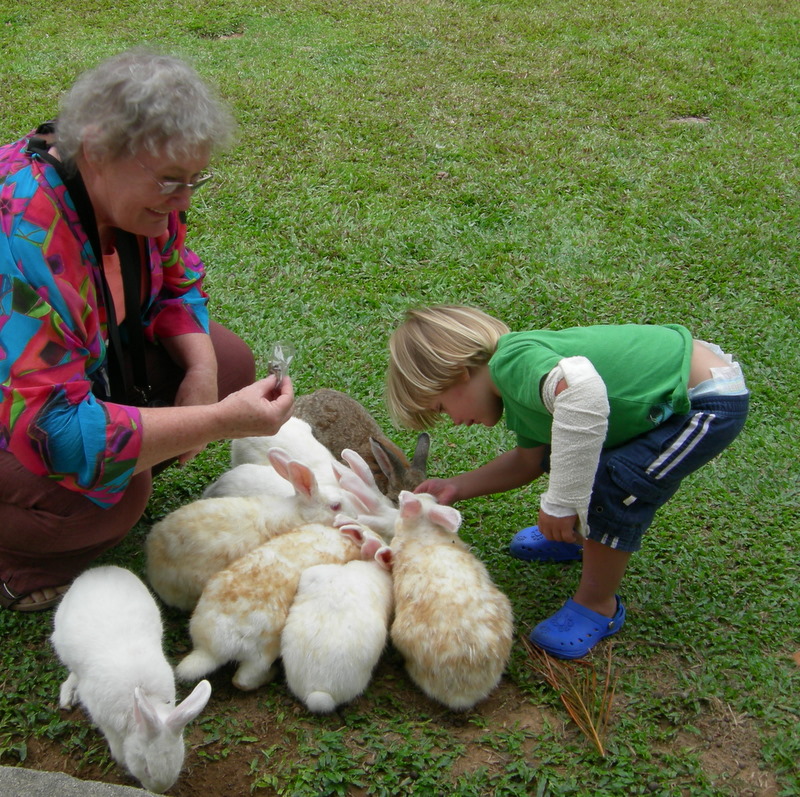
Grandson – broke his forearm.
Sis-in-law who came with us to Langkawi broke blood vessel in foot and couldn’t walk.
Daughter suddenly realised that her passport contained a stamp that said she couldn’t use it again, just before she was due to leave for Australia. This necessitated frantic gathering of necessary documentation, waiting in queues etc, only to be told that she needed a new Identity Card first, which meant more frantic scurrying around and waiting – great way to spend a holiday. And don’t forget, there’s a two year old involved here.

Yep, we all had a great time.

But if you ever travel with the Noramlys, be careful. Be very careful.

The kind of day a writer dreams of having…

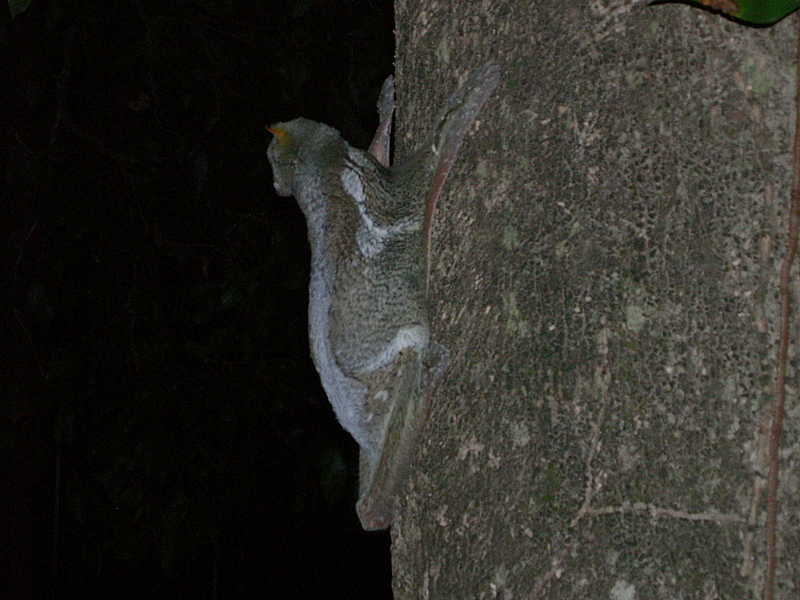
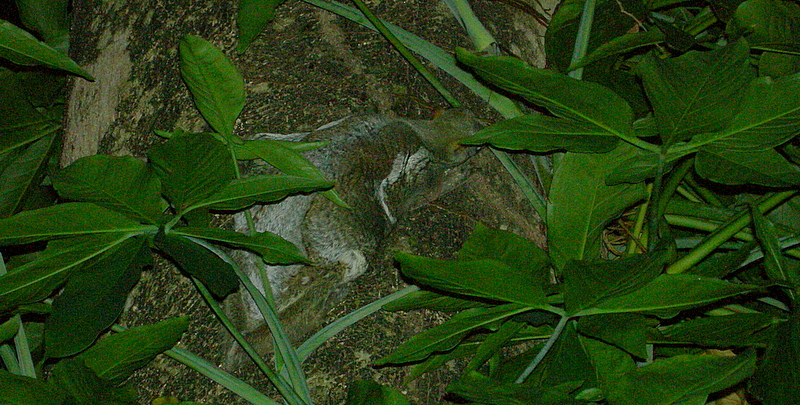
But first let me show you the answer to yesterday’s wildlife trivia. The answer is a Colugo. Also known (erroneously) as a flying lemur. It’s a herbivore mammal that flies (well, glides actually) using a membrane that stretches from the tail via back and front legs to the sides of the neck.

And now for the nice things that happened today. Well, first I realised someone posted 3 rave 5-star reviews on Amazon for the 3 books of The Isles of Glory, which is always nice.

(OK, I know one is not supposed to put any store by Amazon reviews – they are all supposed to be written by one’s mother or best friend or something, right? And I promise you, once I am hugely famous and no longer need the reassurance that someone out there likes my work, I’ll stop reading them… Until then, bless you, you Amazon reviewers. I love you all. )

Next my Australian editor, wanting something to put in the 2007 sampler, read the new first chapter of The Song of Shiver Barrens (the old first chapter was totally scrapped) and seemed to like it enough to use. I’m a little embarrassed as it is only a day or two old and not polished, let alone copy edited! Still, I feel I must be on the right track.

And just a few minutes ago, my lovely agent (may she be showered with blessings in 2007) sent me an email detailing another offer for yet another foreign language version of The Isles of Glory to be published 2008.

In Trade first, then Mass Paperback. My first TRADE!! Eureka!

Major publisher in a major language. (Having once had an serious offer from a Big English Language Publisher that later fell through before signing, through no fault of either mine or my agent, I am not saying more than that, but believe me, I am already grinning from ear to ear on this one. ) Yay!!

Langkawi Island and the writer

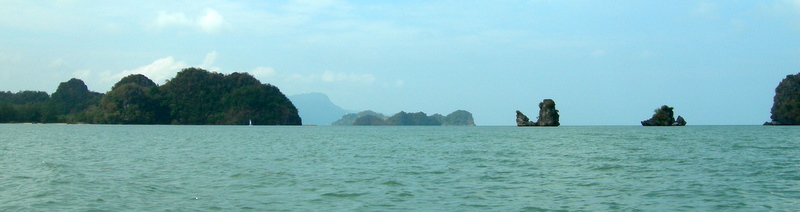
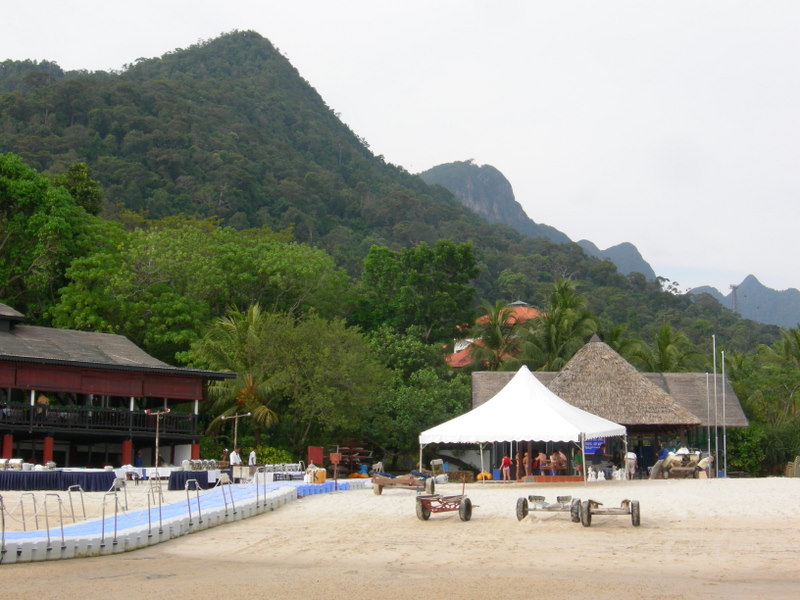
Langkawi is on the west coast, up near the Thai border, a scatter of islands across a green sea. It’s supposedly named after the Brahminy Kite or Helang Kawi. Hence the statue.


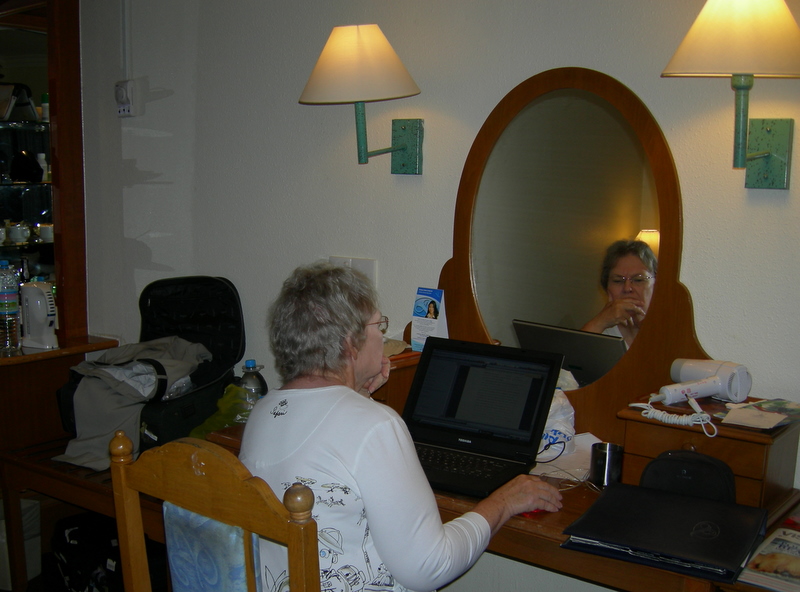
Here’s the hotel and the chalet where we stayed; the other photo is me hard at work…now that’s desperation. Er, dedication.

My agent and my editor both want changes to The Song of the Shiver Barrens. Which means I am going to be flat out for the next month. Don’t expect too much civility from me for a while…I have a deadline. They call ’em that for a reason – ultimately, if you don’t meet the final one, you’re dead.

This is actually a new process for me. Usually my MSS are accepted with a minimum of changes, so I have been spoiled. But this book suffered from being written in too short a time.

For the curious – how much notice does an author tale of editorial suggestions?
Answer: a lot, if you are wise. They know a lot more than you do about what appeals and what doesn’t work, believe me.
What if you don’t agree?
You discuss it. And you listen. Hard. Ultimately, if you already have a contract, your decision will be the final say, and what you write will be published. An author can’t – or shouldn’t – compromise their integrity, that I do believe, but I also believe that an author who won’t at least listen and think about requested changes is an idiot.

I have usually found this: when an editor says something needs changing, they are probably right. However, when they suggest HOW it should be changed, they don’t necessarily proffer the best solution. You are the writer; solutions are your job.

And right now, I’m hunting solutions. So if I don’t write over much on the blog, or don’t comment on the comments, you’ll know why – but never fear; I always read everything everyone says, and I appreciate the time you all take to say stuff.