Poetry in SF notion…

_
This from Jim Hines, author of Goblin Quest, etc. You can see the whole poem here.

I am the Very Model of a Modern SF Novelist

I am the very model of a modern SF novelist,
I’ve manuscripts space opera, anime, and fantasist,
I know the kings of fandom and the best flamewars historical
From Andrew Burt to LiveJournal, in order categorical;
I’m very well acquainted too, with matters editorial,
I keep my cover letters brief and never too suctorial,
About rejection etiquette I’m teeming with propriety,
With many cheerful facts about your online notoriety,
I’m very good at worldbuilding and proper use of ansibles;
I know the hyphenated names of beings unpronounceable:
In short, in matters space opera, anime, and fantasist,
I am the very model of a modern SF novelist.
_

Rejection Letter

Last Friday was apparently “post a rejection letter” day, which started here with Shaun K.Green. Ok, so I’m rather late.

I opened up a file, and here is an extract from the first one I came across, sent to my agent back in 2000.

“I couldn’t persuade our sales people that it was strong enough for us to make the right sort of commitment to it. Of course, they want the next top-of-the-bestsellers fantasy, and Noramly doesn’t attempt the formulaic big-big fantasy that’s seen as the answer. She’s very interesting, thoughtful, provocative, politically aware; but the first person narrative of (The Heart of the Mirage) offers a different perspective on a fantasy world, and though very well wrought, the world is not made available to the reader in the same way as it is in an epic fantasy.”

That’s a lovely rejection letter.
Five years later I met the author of that letter, and she was just as nice as it suggests. And it’s all moot now anyway as the book has been published (by another publisher in the same country)!

Persistence. So much of the road to success is persistence. Ok, sheer stubborn, pig-headed bloody-mindedness. My luck was in finding an agent who was just as obstinately dogged as I am.

[Ah but that whole first person thing – no matter how good the book, the first person narrative puts some people off, even though the story would in fact be less effective if the third person narrative was used.]

Now you see one of the reasons I have not written a first person book since The Mirage Makers.

Writing progress

Getting there, getting there. If I think of the target for the first draft as being 170,000 then the picometer looks like this which is even better:

However, I am taking a bit of a break for a few days, and going back to book one instead. There are a few minor mistakes in continuity and a bit of tweaking that needs to be done; besides, I need to check that I remember what happened in the first book…yeah, my memory is that bad!

Anyway, here’s a bit of description from Book One, if you feel like a peek.

Davim the Drover, Sandmaster, sat on his pede at the top of the dune they called the Watergatherer. To the east and west, the red line of the dune humped away as far as he could see. To the north, it fell sharply to the plains. This, the front edge of the Watergatherer, was a wall of fine red dust unsullied by any plants or growth, a slope steep enough to have made walking difficult. Its top edge, towering a few hundred paces up, was as sharp as a sword cut. An occasional playful gust of wind tore grains away from the cut in flurries.

The back side of the dune was different. There were gullies and dips and hollows, but mostly it slipped gently down to the plain in a long slope of several miles. The red sand was dotted with vegetation: a prickly bush here, a sand-creeper there; a clump of smoke-bush behind that. Bare surface showed through, but the plants maintained a precarious existence, oblivious to the slow inching of the dune that carried them forward.

The red dunes of the quarter were waves swallowing up the land in front only to discard it behind two or three decades later, leaving it lifeless, the skeletal remains of a masticated meal. The Red Quarter had sixteen such dunes, each spaced equidistant from the next, each on its inexorable slither northwards to extinction, death being a long slow demise as they eased themselves into the expanse of the Burning Sand-Sea, a desert so hot and vast that not even a pede ventured there.

They were birthed in the south, those dunes, perhaps by the eroded red rock of the Warthago Range, or the red earth of The Spindlings. The plain they traversed was also red, although the earth was coarser and its vegetation sealed it tight against the depredations of the wind. It was covered with low bushes, rocks, the odd waterhole — until the next parallel hill line of sand ten or fifteen miles away.

Davim scanned the country carefully from his vantage point, watching for the man he expected. His fellow conspirator, he supposed, but he preferred to think of the man as the Traitor, for such he was to his own kind. Once Davim had respected him, though not now. Conspirators they might be, but Davim despised the treachery, useful as it was, that was bringing the Scarperman to him again.

Synopsis nightmare


I love it the way my agent blithely says: Send me a synopsis, will you? – as if I can churn one out in ten minutes. I’d rather write a 5,000 word chapter than one synopsis for a single book, and I’d make a better job of it, too.

And this one is for a whole trilogy.
We are talking summarizing half a million words down into something that makes sense and sounds interesting. For a fantasy. Right. Aaaaargh!

So I sacrificed a whole day of novel writing to write a synopsis instead…and I still think it sounds like the lunatic ravings of someone on hallucinogens. I had actually done this before, a year and a half ago, but at the time the books were unwritten and the trilogy was actually going to be a quartet, so it needed changing drastically now that it is only 3 books and one and a half of them have already been written.

Imagine an arid, ancient land where it no longer rains without magical intervention.

Such is the Quartern, where rainlords sense and move water and cloudmasters make and break clouds to bring rain. Their abilities bring them unlimited wealth and power, as well as a burdensome responsibility.

When potential new cloudmasters are murdered and the land is left short of water, a boy with the ability to move clouds becomes a pawn in a power struggle that leads to war, and two squabbling rainlords are forced to marry in order to produce more cloudmasters. In the meantime, in a poverty-stricken Quartern city, a girl able to depict the future on the surface of water is trapped in a painted destiny, not knowing that her skills will one day be crucial to the survival of the land.

The three books follow the story of these four characters in a time of drought and war, when men and women governed by greed seek to rule, and honour means risking all to stop them.

If only I could stop there.

Writing

I am writing,
writing,
and writing…

CHAPTER ONE

The man beneath her was dead.
His eyes stared upwards past her shoulder, sightless, sad, the vividness of their blue already fading. For a while his blood had seeped from his wounded chest into her tunic, but that had slowed, then stopped. She did not know his name, although she knew him by sight. He’d been a guard at Breccia Hall. Younger than she was. Eighteen, twenty? Too young to die.

Writertopia:

Inhouse mystery

Before and after pix:

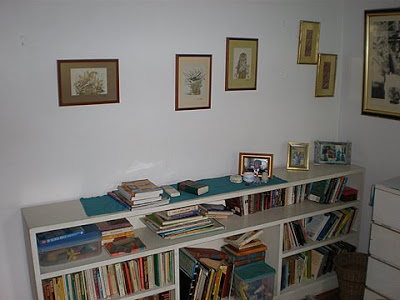
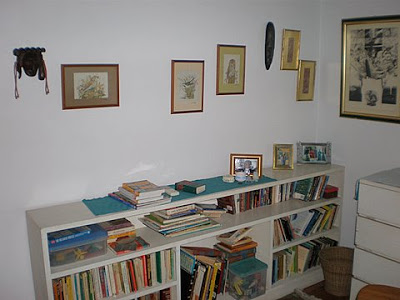
When my friend Hrugaar was coming to stay, I cleaned the spare bedroom. And I noticed that there were two items missing from the walls. Which was a bit freaky. Someone been sneaking into the house to pinch items from the bedrooms?

I turned the place upsidedown, wondering if this was the first signs of senile dementia or Alzheimer’s in yours truly. Perhaps in some unremembered moment of scattiness, I had tucked them away in the freezer or washing machine or something.

Commonsense prevailed. The room gets periodically used by visitors. One of my guests just didn’t like what was on the walls and took them down and hid them. They were eventually found – after Hrugaar had long gone – tucked away under all the items in a storage drawer of the room.

I’m afraid this just strikes me as weird. They were carvings made of wood, collected by my husband on his travels. Wood, you know. Dead trees. They aren’t emitting radiation. They don’t contain hidden cameras or microphones. They are harmless bits of wood, lovingly and beautifully carved for tourists, by not-very-wealthy artisans trying to make a living out of travellers coming to their country to gawk at them.

Yeah, I am intolerant of superstition. Very. Call it cultural differences if you like; I tend to think of it as the kind of thinking that keeps people poor and backward, that makes a women suffering from cancer seek out a witchdoctor or traditional medicine man, and end up dead as a result. The kind of thinking that makes someone gullible to conmen. The kind of thinking that makes conservation students too scared to go into the forest because of the “spirits” there. The kind of thinking that makes people try to find easy substitutes for hard work and commonsense, you know, “think positively and you’ll end up rich”. And before you laugh at that, think of the wild success that feng shui proponents have had, or that ghastly book called “The Secret” by Rhonda Byrne.

Maybe she was right at that – guess who made a fortune by believing she could write and market a book about wealth and health through positive thinking, positive that hundreds of thousands of the gullible public would buy it? Now there’s proof for you!