A good review that made me think…

This one is from Deathray magazine (February 2008 issue) in the UK, written by Owen Williams – another 4 out of 5 stars for The Shadow of Tyr.

I must admit to my shame that I don’t know this magazine.
I am guessing, but I think Williams is someone who has a love-hate relationship with the genre, and I’m relieved to find I fall on the good side of the divide! The review was certainly entertaining and had me thinking about my own work, which is always a good thing. Go out and buy the February issue to read it all. Here are some exerpts:

Heart of the Mirage was “immediately notable for fantasy world building that owed more to the Roman Empire and the Arabian Nights than to traditional medieval genre tropes. The follow-up The Shadow of Tyr…shifts the action to the heart of the Empire and replaces the Arabian elements with some shades of the American War of Independence.”
“Larke’s writing is breezy and refreshing, conveying some heavy themes with a light touch and a deft vocabulary; uniquely among fantasy authors, she knows the correct usage of ‘disinterested’. There’s also a lot of humour in the novel; a level of wit – rather than out-and-out comedy – that sets it apart from some of its more po-faced contemporaries, in a way a little bit reminiscent of Fritz Leiber’s Lankhmar series.”

Really strong and believable female leads like Ligea are all too rare in a genre where even exceptional writers, such as Robin Hobb, generally use men as their protagonists. The threat of Arrant taking the limelight from Ligea is worrying…”

I must admit, I had no thought of the American War of Independence when I was writing the book; I was thinking in more general terms, but I certainly was basing my story on a background of any Empire resulting in inequality and the misuse of power, and whether the struggle to be free is worth the price paid.

The bit about Fritz Leiber blows me away. Wow.

As for the last bit – well, I kind of thought of both Heart of the Mirage and The Shadow of Tyr as being Ligea’s story, while Arrant’s story is covered in The Shadow of Tyr and The Song of the Shiver Barrens. Ligea is in the latter too, and her role is important and crucial, but she doesn’t take centre stage. I don’t look on her as being overshadowed by her son though – she is far too strong an individual for that, but it is Arrant’s book. And I hope it is still good for all that…


Hurricane Katrina x 50

Burma/Myanmar is suffering. There could be as many 100,000 dead in a cyclone (hurricane/typhoon, call it what you will). Less than 2,000 people died in Katrina – and we thought the scale of that was huge?

People have no food, no clean water, no power – and little help.

The military junta that rules them is preventing aid workers from entering the country and denying the international press as well. Doubtless they are looking after their own interests – i.e. that of the top military brass – because that is about the only thing they do well.

When we look for examples of evil overlords to model the villains for a fantasy novel, we don’t have to look any further than 21st century Burma.

Authors that pass in the night…


…sort of like those proverbial ships.

One of the really, really great things about being a writer is the great people you meet who are also in the business. Next week I have one such person coming to stay – but more about that at a later date.

Several years ago I met another struggling writer at a convention in Melbourne. We made a connection – and parted to our distant parts of the world almost immediately afterwards with no expectations that we could ever get together easily. Which was sad, because we had so much to talk about and there were so many points of connection and contrast that could have kept us in conversation for weeks.

In the intervening time, I read about her successes with delight; she has received considerable critical acclaim for her work internationally and has gone from strength to strength. Another Australian sf/f author makes good on the world stage! There must be something in the water downunder (other than a suffeit of salt and yukky tasting minerals).
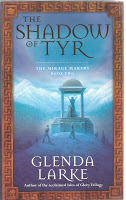
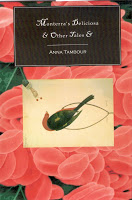
Yesterday, I received a package from her, completely out of the blue, containing some books – which have gone to the top of my to-be-read pile. She’s a special person.

Thank you, Anna Tambour. [And if you haven’t got my email by now, write to me giving me the correct address…]

The Shadow of Tyr : “intense and refreshing fantasy “


Another 4 out of 5 star review, this from Rhian Drinkwater at SFX Magazine in the UK (Jan 2008).

Here are some of the nice things said:

The Shadow of Tyr …stands up successfully as a story in its own right. It tells the tale of Ligea Gayed, a woman with powerful magical ability who is trying to end slavery and bring down an empire, and of her son Arrant, who’s born into the middle of a war and turmoil and who simply – and heartbreakingly – wants his parents to be parents and warriors or kings.

“It’s this frustrated desire that provides the driving force of the climax of the book, and though the major plot points are war, rebellion, death and strategy, it’s the intense emotions of the main players that really shine through.”

The Shadow of Tyr is not for those looking for bloody depictions of war, but for those more interested in the emotional costs of rebellions and politics, it’s a well-written and satisfying read.”

Hospital tales, lizard vandals and writing fun

Progress of Book 2, Stormshifter, in the Random Rain Cycle (all titles provisional):

And for those who want to know if I have sold it yet, the answer is no.

Hey, how’s that anyway? Back in the race, with over 5,000 words added, in spite of spring cleaning and hospital visits.

The cleaning remains unpleasant (are there actually people who enjoy this thankless task?).

The hospital visit was inconclusive. Both MRIs show … nothing. Other tests show that the problem has improved slightly, so we have opted for a wait and see policy. In the meantime I continue to be an eight-fingered typist. I set out for the hospital at 9 a.m. and arrived home at 4 p.m., so that was a whole day gone.

Highlight was hearing a conversation between a Chinese Malaysian family and a nurse, in Malaysian, with the crowning moment being – after much puzzlement on behalf of the nurse – her statement: “Oh, you’re in the wrong place! You were sent to cuci darah (wash the blood, i.e. dialysis), not cuci luka (clean a wound)!” Which kind of brought home to me how intimidating the whole hospital environment must be if you don’t speak the local language or English properly, and are not familiar with words like “dialysis”.

The most depressing moment of the visit was looking around masses of waiting patients, quite literally hundreds as I went to 3 different clinics and the pharmacy, all with nothing to do except wait, and noting exactly two people with books (one of which was a text book and not being read anyway.) Where is the joy of reading for these folk? Where is the idea of making good use of tedious waiting time? Why, oh why do Malaysians not read?? And to the solitary middle aged Malay lady who was reading a book – good on you.

The news from our street over the weekend was of a nasty break-in, with a man and his 12 year-old-daughter being woken up by gun-toting intruders, threatened with a knife to the neck for good measure, physically slapped, and put in terror of their lives because they didn’t have huge amounts of money and jewellery in the house.

Scares me witless, as we would have had even less if we’d been the ones robbed. I have given all my valuable jewellery to my daughters for just this reason, and I don’t own huge amounts of cash to keep in the house anyway. At least we do have a good alarm system.

So anyway, with this story fresh in my mind while I was working yesterday afternoon, and home alone, I heard a noise coming down the passage. I rushed out and came face to face with an intruder, armed with inch long claws, foul breath and a toxic bite. Fortunately he was as scared as I was and took off down the passage at full speed, forgetting how he came in the first place. He ended up on top of a bookcase and smashed a rather nice Japanese vase before decamping out the grille of the french doors. He was also only a metre long, most of which was tail…

Writing, not reading?

Several times I have been intrigued by someone approaching me who wanted to be writer, but who – as became apparent during the course of the conversation – read very little, even in the genre they wanted to be published in. This strikes me as curious in several ways:

  • firstly, why wouldn’t you support the industry that you want to be a part of;
  • secondly, how do you expect to learn about stories/books and how they are written (put together) without reading them – many of them;
  • and thirdly, shouldn’t you know what’s out there (to study the market) before you write your contribution to the genre?

Maybe it is all part of a trend – the physical process of writing anything is now so easy, and publication/communication is so easy through the net, that everyone now wants to be a writer. I started by pounding out things on a typewriter back in the days when even correction fluid didn’t exist, so believe me, I know it has got easier.

At the same time, there are so many forms of other entertainment at our fingertips, in our homes, following us around through iPods and other portable devises, that our reading time is cut – unless we make a conscious decision not to let other forms of entertainment take over. It is not a coincidence that I have not had a working TV in the house for well over two years now.

Still, it does seem weird that everyone and their cat apparently wants to write – but not everyone wants to read…

This (written by Rachel Donadio) from the New York Times, Sunday Book Review of 27th April, via Bibliobibuli (a great site if you want to keep track of what is happening out there in the literary world).

“… Americans are reading fewer books than they used to. A recent report by the National Endowment for the Arts found that 53 percent of Americans surveyed hadn’t read a book in the previous year…”

But:
“In 2007, a whopping 400,000 books were published or distributed in the United States, up from 300,000 in 2006, according to the industry tracker Bowker, which attributed the sharp rise to the number of print-on-demand books and reprints of out-of-print titles (…)the same N.E.A. study found that 7 percent of adults polled, or 15 million people, did creative writing, mostly ‘for personal fulfillment’.”

“And the numbers suggest the books will keep on coming. IUniverse, a self-publishing company founded in 1999, has grown 30 percent a year in recent years; it now produces 500 titles a month and has 36,000 titles in print…”

Do they get read? Not much, apparently. “Most writers using iUniverse sell fewer than 200 books.” Even though there is loads of help out there:

“…there are hundreds of creative writing programs offering M.F.A.’s and other credentialing. The Association of Writers and Writing Programs represented 13 programs when it was founded in 1967. Now it includes 465 full-fledged courses of study, and creative writing classes are offered at most of the 2,400 college English departments in North America.”

So…who is going to read all those books?

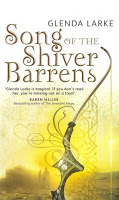
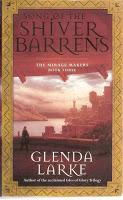
Review of Song of the Shiver Barrens


A four and a half star review by Natalie Baker over at The Bookbag, see here for full review.

“Summary: A fast-paced, adventurous final book in the series that will keep you on tenterhooks until the very end.”

“I might as well declare that I’m a fan of Glenda Larke. I very much enjoyed the first two books in the series and I’ve been waiting with impatience to discover what she had in store for Ligea, Arrant, and all her other characters. My expectations weren’t disappointed…”

“(…) more than enough in this story to keep me by turns amused, entertained and enthralled.”

“(…) It’s a mark of a good trilogy that the end of a book can leave you both feeling complete and still wanting more, and I’m hoping there’ll be many more books to come from Glenda Larke.”

Orbit Interview (3)

Some authors talk of their characters ‘surprising’ them by their actions; is this something that has happened to you?

Characters can certainly be remarkably stubborn if I ask them to do or say something out of character. They just veer off and do it their way. Sometimes I have to remind them that people can do the unexpected; mostly I give in to them. They should know best, after all.

One of the major themes of The Mirage Makers is the choice between upbringing and birthright. It’s something you obviously feel strongly about as a writer – is it also the sort of theme you enjoy coming across in books as a reader?

Yes. I love writers who look at large or universal problems within the microcosm of a character. It makes themes and theoretical concepts more personal, more understandable, less black and white. One can read an essay on “Nature versus Nurture” – or read about a fictional character like Ligea facing exactly that problem in her personal history. The abstract suddenly becomes much more immediate and real, even though she is fictional.

What do you think of the packaging given to your books? Do you have any strong feelings on cover art?
I love the Orbit covers! I think both the design department and the talented Larry Rostant, the artist, have done a superb job of echoing the elements of the story.

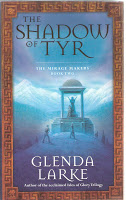
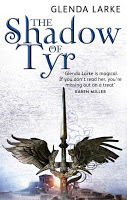
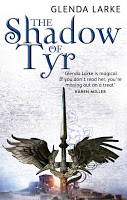
As I write this, I haven’t yet seen the cover for Song of the Shiver Barrens, but with the Heart of the Mirage cover there’s the strangeness of the cracked pinkish sky, the importance of the translucent sword, the mysterious, shadowy people watching, waiting…are they real? Or just a mirage? And on The Shadow of Tyr cover, don’t you just love the way the spear and the Imperial symbol seem to dominate, promising war and retribution? – but then look again, and you see that the feathers on one side of the wings appear to be broken. Perhaps Tyr has a weakness, a sickness? It sends shivers down my spine. Masterful.

I must admit, I have little understanding of what cover art can do to sell – or not sell – a book, but I think both readers and authors feel short-changed when a cover portrays something that is not in the book or gives an incorrect emphasis to what the story is about. A dragon on the cover should mean there’s a dragon in the story.

In the past, I think the cover of mine which mystified me the most is one for a book in translation that appears portrays the flight deck and crew of a space ship, when the book is about a world of sailing ships and magical mayhem in an archipelago!

Although you live in Malaysia, many people still consider you an Australian author. Do you have strong ties to the Australian writing community?

I am still an Australian, that will never change. Whenever I can, I go to Australian science fiction and fantasy conventions, and of course the internet makes friendships with my fellow writers so much easier. I’ve met or corresponded with most of the Australian published fantasy novel writers, at least those who write for adults; some, such as Karen Miller, Trudi Canavan and Jenny Fallon – and Russell Kirkpatrick from New Zealand – I count as good friends. We have acted as first readers for one another, I have a place to stay when I visit their cities, they have a place in Malaysia, and yes, we are availing ourselves of one another’s hospitality! The Australian scene is large enough to be interesting and vibrant, yet small enough to be intimate and familiar, and I value my contact with wonderful writers, as well as with my Australian editors and publishers and fans.

And, lastly, for those writers who have yet to see their books appearing in the shops, how did it feel to see your first novel in print?

Disbelief was uppermost, I think! There were a good many years between the day I found an agent and the day my first book was sold, and I was ready to admit defeat several times. But my wonderful agent had faith in my writing and never gave up, so neither could I. When the first copy of my first book arrived in the mail I think I was as delighted for her as much I was for myself.

Continuation of Orbit Interview…(2)

[This is a continuation from the post below.]

It’s interesting to see how you create your worlds; do you have a method of managing them? Do you lay out the world and story-arc before you start writing or is it more of an organic process?

The story-arc begins first and the world develops alongside it.

I start by doing a great deal of thinking. My favourite time for this is while driving or doing housework. I rarely write much of this down, because I end up knowing my world – the part I am writing about anyway – just as well as I know this one. I know without looking it up in my notes that the fishing boats of my invented land put out to sea in the morning and return to port before nightfall, just as I know, without doing a Google search, that our refrigerated boats here on Earth don’t have to do that.

I like to have the larger picture in place before I begin – the politics, the commerce, the religion, the landscape, the climate. Much of the detail, however, is only conceived while I am writing the story. I try to integrate these details as the story unfolds (rather than throw them in huge chunks at the reader), much the same way we learn the details of our new surroundings when we move to another country. I’m an expert on the real thing – I’ve lived on four different continents!

I do start with a map, though. It may, however, be altered to suit the story as I write. If a river is in the way of characters on a journey, I will re-route the whole valley!

The story-arc remains flexible until I write the last word, but when I start on the first chapter I must have a clear idea of the beginning, the end and the highlights – the key scenes. The rest is a bit fuzzy, like looking through a fog which won’t clear until I get there.

Can you tell us a bit about where the idea for The Mirage Makers came from?

As a young mother, I was horrified by two real life stories emerging from two countries. One was an Australian tragedy of almost incomprehensible hubris, where many Aboriginal children were forcibly removed from their parents, supposedly for the benefit of the children. They were often raised with no knowledge of their own culture or families, sometimes even taught to denigrate their heritage. The second story was the tragedy of the “Disappeared Ones” of Argentina. During this time, pregnant women caught up in the political brutality had their babies taken away at birth, to be raised by the families of their captors, while they themselves were murdered.

These events moved me. How terrible it must have been not only to lose your child, but to know they would be raised by people with different values, possibly values you despised.

A little later we moved to Vienna, Austria. One evening, I watched a TV historical drama (in Italian, which I don’t speak) sub-titled in German (which I can read, but too slowly to keep up with sub-titling). It was about an Imperial investigator being sent by Rome to Jerusalem to find out why people believed that a man had survived his crucifixion a year or two earlier. The investigator scorns the story as pure fantasy… About then, it became too complicated for me to follow, but it didn’t matter. My own imagination was already hard at work.

All those things came together to form the basis of the plot for Heart of the Mirage. I didn’t do anything about it at the time because I was writing The Isles of Glory, but a year or two later my husband transferred to Tunisia, and I could see the ruins of Roman Carthage from my study window and we had the base of a Roman pillar in our rose garden. When southerly winds blew, Saharan dust piled up at my front door, desert on the move…

That was when I had to start writing the Mirage Makers trilogy.

Ligea is such a strong and interesting female character and it was wonderful to see how she grew over the trilogy. Do you have any favourites among your characters?

Part of me loves all my characters, even the villains. I do like Ligea, not because she’s a lovely person − she’s definitely not that – but because I feel for her. She’s a woman who would probably have been kind and loving and nurturing, if she had not been raised to kill ruthlessly in the service of her Emperor and her manipulative mentor. She’s the child removed from her culture and her family, to be raised by her enemies to despise both. She does not have much of a chance, yet she manages to rise above her beginnings and develop as a human being. She can never entirely leave her past behind, but in the end, she does her best.

The character whose life history tore me up most when I was chronicling it, however, was Arrant. So many awful things happened to him, none of which he deserved, and sometimes I almost wept as I wrote about them. It was heartbreaking.