
Shale Flint the nontechnologist…

.
Where fantasy becomes all too true.

I wrote The Last Stormlord, knowing that the world I was portraying was far too close to the truth to be comfortable.

Where I went wrong with the solution – Shale shouldn’t have tried to be a stormlord. He ought to have gone for nanotechnology instead!

Peter G. sent me this link. Fascinating stuff.

Freshwater could become the oil of the 21st century – scarce, expensive and fought over. While over 70 per cent of the Earth’s surface is covered by water, most of it is unusable for human consumption. Technological advances have made desalination and demineralization feasible – albeit expensive – solutions for increasing the world’s supply of freshwater. However, nanotechnology-based water purification devices have the potential to transform the field of desalination…

And here’s another unrelated but interesting digital download on water available free until April 2nd. Don’t miss this one. It’s from National Geographic and includes all kinds of interesting stuff – as they put it:

Starting on March 22, World Water Day, through April 2, 2010,
you can download a copy of this free interactive edition of
National Geographic magazine. Get complete content from
the print edition, plus extra photo galleries, rollover graphics
that animate features like maps and time lines, and video profiles
of photographers who contributed to the issue.

Marvellous to look at.

And if you haven’t started reading the Stormlord/Watergivers trilogy, and want to see how magic would tackle the problem… go out and buy The Last Stormlord.
.
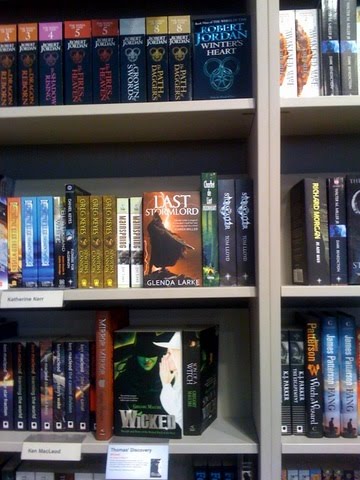
So, what is it about women’s fiction…

.
There’s been some interesting talk about sexism in literature lately. We’ve been there before, of course, but this particular salvo started a while back with regards to women horror writers. Now the discussion seems to have morphed into talk about depressing fiction by women.

The post that started it concerned an Orange Prize (for women writers) judge:

But the chair of this year’s judging panel has launched a stinging criticism of the current “grim” crop of women’s fiction– complaining that female authors appear to have suffered a collective sense of humour failure.”
There’s not been much wit and not much joy, there’s a lot of grimness out there,” Daisy Goodwin, the author and TV producer, told the Guardian. “There are a lot of books about Asian sisters. There are a lot of books that start with a rape. Pleasure seems to have become a rather neglected element in publishing.”

There’s been an excellent reply in the Guardian here, which has a different take on whose to blame:

But nonetheless it seems unlikely that a similar critique would be taken seriously by the press – or even uttered – if it were levied against male writers. Debates about who’s going to be the next Philip Roth are not coloured by criticisms of brilliant young male authors for not being cheery enough – I’ve not read any criticism that Legend of a Suicide, for example, lacks joy. But men in any profession are rarely criticised for failing to present themselves to the world without the perpetual beaming grins of beauty pageant contestants.

Lots of people have weighed in and here is one by Benjamin Solah that took my eye and is well worth reading. He says, among other wise words:

I would also argue that male writers do not benefit from our female colleagues being excluded from anthologies, short lists, long lists and awards. Sexism in the industry, whilst primarily affecting women no doubt, still lowers the quality of literature for all of us.

So what do you think? Is women’s fiction that is taken seriously too depressing? Is witty fiction too lighthearted to win prizes? Are women’s issues not serious? Is it sexism or simply women=Venus, men=Mars syndrome? And why does this issue or similar issues occur again and again?
.

The only time I’ll sit next to Stephen Fry

I’m a bit of a bookstore junkie. Which is hard, when I live a long way from a decent one, in fact from any book shop at all.
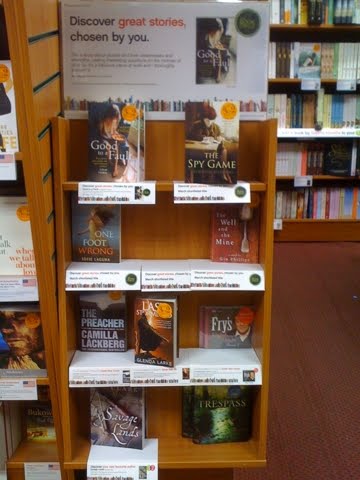
My Australian editions never make it to Malaysia at all when they first come out (although @eyerizzz tells me he saw a couple of my first books from in 2003 and 2004 in BookXcess, the discount store in the Klang Valley, from the sales of which I doubt I will earn a cent…).

So when I need an ego boost, I have to depend on others.

And they come good! Cheryl Morgan sent me the one with the book sitting next to Stephen’s and my daughter sent the other, taken in a small Waterstone’s in London.

Ok, satisfied now. Head is nicely swelled.


.

writing, books and reading

.
To follow on from what I was saying yesterday:

There is an excellent article by critic John Crace on The Guardian page about what makes a good book.

He talks about some interesting stuff, much of which seems obvious, yet is often not realised by readers. For example, not all books by the same author are equally good.

Ever looked at the Amazon reviews of one of those prolific authors who wrote a highly popular and fabulous book in the past and people keep on buying them even though they are now writing mechanical not-so-good, rip-you-off potboilers? There’s one I can think of whose first book- maybe 30 odd years ago – I loved. You can still find it being sold. It has 170+ reviews with an average of 4.5, deservedly so, about as good as it gets. He followed up with some other really good books about the same world.

His latest book, though, has a 2.5 rating. And it’s still on the best seller list. Get with it people; there are stacks of good books out there. If a writer’s latest books don’t treat you, the reader, with respect, then don’t give him your money.

Another point from Crace: hype sells books – it doesn’t mean the book is good.
There’s a classic SF/F book out there at the moment that illustrates this. It had huge amounts of marketing money thrown at it. I have read it. It’s uneven, brilliant in spots, but mostly dull. I suspect it was hyped because a non SF/F editor was impressed with the ideas – an editor who reads very little SF/F and doesn’t have a clue about the quality out there. That’s what it feels like anyway. It has a rating of 3.5, which means that most people didn’t think it deserved the hype. It has been selling pretty well too.

When I think of some of the wonderful SF/F books I’ve read, which fall by the wayside because of a lack of marketing, it breaks my heart…

Crace also says creative writing courses are a waste of time: I can usually sniff out a book that’s been written by a creative writing student within a few pages; there will be no plot to speak of and each sentence will have been polished so many times it will be dead.

Crace again: A good novel should be readable.

And then the clincher: he says some of the best novels are to be found in genre writing. One of the examples he gives is Stieg Larsson. I have just read the first of his 3 books, The Girl With the Dragon Tattoo. I understand it was the second best selling book of 2008 (not sure whether this is just in UK or worldwide in English, or what…) It was a can’t put-it-down whodunnit which I loved.

I didn’t agree with everything Crace said, but interesting nonetheless.

.

my reading…

.
I have totally been neglecting my book list for this year. Too busy writing to do much reading!

Anyway, just thought I’d make mention of one book I read recently (it took me 2 months to finish).

The Man-Booker Prize winning Wolf Hall by Hilary Mantel.

Which has to be the most irritating slog I have endured for a long time. Shame, because I studied this period of history at uni (the book is about Thomas Cromwell’s rise to power in Tudor times), I love the topic, the era, I am enormously respectful of Mantel’s research — and the reason for it being such a slog was such a small thing that could have been fixed.

In the interests of not using the names “Thomas” or “Cromwell” too much, Mantel uses “he” most of the time. Which leads to such monstrosities as this, a passage that starts after a text break:

When Fisher comes to his senses and asks pardon, the old bishop begs the king to consider that he is ill and infirm. The king indicates that the bill of attainder must take its course: but it is his habit, he says, to grant mercy to those who admit their fault.

The Maid is to be hanged. He says nothing of the chair of human bones. He tells Henry she has stopped prophesying, and hopes that at Tyburn, with the noose around her neck, she will not make a liar out of him.


When his councillors kneel before the king, and beg that Thomas More’s name be taken out of the bill, Henry yields the point. Perhaps he has been waiting for this: to be persuaded. Anne is not present, or it might have gone otherwise.

They get up and go out, dusting themselves. He thinks he hears the cardinal laughing at them, from some invisible part of the room.

The first he is Fisher. The second is – I think – King Henry, but because of Mantel’s propensity to use he for Cromwell all the time, I can’t be sure. It could be Cromwell protesting to the king, although I don’t think so. The third he I assume is Henry until I read on. The fourth refers to Cromwell, so I guess the third does too. The fifth is King Henry. The sixth…I assume is also Cromwell. And so it goes on throughout the book.

The problem is that every time Mantel uses he I am plucked out of the story to think about who she means. What should have been a wonderful read became tedious hard work, because my brain is programmed to think that a stray he refers back to the previous male character mentioned, especially if that character was the last subject of a sentence.

And this is supposed to be writing good enough to win the Booker? Nope, sorry. Not to me.

Grammatical rules are there for a purpose. Break them at your peril. If you do it well, it can enhance the story, do it badly and you spoil the book for the reader. Obviously the Booker judges didn’t mind having to sort it out every time they hit a he. I did.

On education again…

.
Still been thinking about the ignorance of at least one small group of university students I mentioned in my post last Thursday.

Here is a Malaysian talking about censorship and the effect it has had on our education system. You can read the whole thing here: Silverfish* newsletter.

“In the sixties our universities were world-class, the pride of the developing world, among the best in Asia. Now, we struggle to be counted. Students, those who can afford to, go overseas. They don’t even want to consider attending a local one if they can help it, whatever the quota. As for the quality of the graduates, one need only ask our employers. Since the eighties we have lost thousands of our skilled workers overseas, not for reasons of economics, but due to real or imagined sense of injustice and an intolerable climate of intellectual asphyxiation. We have lost the battle to attract the life saving FDI because our workers are no longer considered competitive. Our civil service is constantly in the press, fire-fighting the results of poor decision-making. We hear of police confiscating books from shops one day, and ministers promoting reading the next. Even our football team is languishing. It is as if thinking itself has been outlawed.

“Some may point to the eighties when civil servants were told to sit up, shut up, and punch clocks, when we sacrificed our young at the altar of Mammon for some to get unbelievably rich, when bad news was banned, when argument and debate ended, and when wisdom flowed from only one source. It was the end of dissent, the end of thought.

“Now the high points in our life include talking about roti canai tossing competitions in Subang Jaya and teh tarik experiments in outer space. Oh yes, we also have a committee for winning Nobel Prizes.

“Stupidification is not a condition, it is a process. We are not born stupid, but we can get there if we try hard enough.”

Hear, hear…

___________________________________

* (Silverfish is a Bangsar bookshop that leans towards the more literary (the Proprietor once refused to take my books even on no-prepay consignment!). He is also a brave man, never missing an opportunity to speak out on book related issues, particularly censorship and reading and education.)

The story of a Voyager Oz author…

.
Today’s blog post is here.

It’s all about how I got published in the first place, and why my first book was published in the UK, not Australia.

And to answer a question that keeps on cropping up: my next book (after the Stormlord trilogy is done with) will be a return to the Havenstar world – but no, it won’t be a sequel. It will have different characters.

RSI: Important advice for beginning writers…

…that they will rarely hear until too late.

I started on this train of thought after reading Sean Williams’ blog entry here, with all the writers commiserating, including myself.

If you are intending to be a professional writer – or in fact, are expecting to spend a great deal of time at a keyboard in your professional life (or gaming life!) – give a thought to RSI: Repetitive Stress Injury.
Because the odds are ten to one it will creep up on you and leave you partially crippled.

So think about it at the beginning of your career.

What can you do? Google around and see what works for other people, but expect to spend some serious money. Look on that as investment in a healthy future. In the long term it will cost you less than doctor fees, surgery, physiotherapy, time off work, medication, mental stress and worry – and the pain…

Realise this first: you are going to spend a lot of time at a desk. Yet all non-adjustable furniture is built to a average standard, and few people are actually standard. Especially women – men design and build most furniture and they build to the specifications for men. Ever walked into a bathroom and found that you can only see half your face because you’re not as tall as the man who installed the mirror? That’s the kind of thing I mean.

Secondly, desk specifications are often to old industry standards – and don’t factor in the height of a keyboard!

Until I went to IKEA and bought one of their more expensive desks that I could adjust to my diminutive height (5′ 2″), I never in my adult life had sat at a table or desk that was right for me.

Get a table large enough. You can’t work properly if you don’t have room for all the things you need within reach.

If you really, really can’t afford a new desk, then think of going to a lumber yard and buying a piece of flat heavy quality board, large enough for your chair and feet, small enough to fit at and under your desk, and of sufficient height to make the table top height right for you. Conversely, if the desk is too low for you, consider a board to place over the desk top to make it higher, or solid pieces to place under the legs. The important thing is: do not use a desk that is wrong for you.

Get an adjustable chair that fits you. If the rest of the family complains, tell them to go get their own.

Use a large adjustable monitor screen. A laptop screen on a desk is not going to put your eyes at the correct level. If you can’t afford one, then place the laptop on a stack of books to the right eye level, and use a detachable keyboard.

Which you must anyway, because you are going to get yourself an ergonomic keyboard. This is the most important buy, and should be the first thing you get. Different people will prefer different types, so try them out if you can. Honestly, this alone can make a huge difference.

Another thing to remember:
Take frequent breaks, even if it is only to lean back in your chair, and wriggle your feet and fingers.

If you have other solutions and suggestions, please add them in the comments section. If you are a writer with this problem, tell us in the comments. And spread the link around. Let’s get the word out there to the people who are not yet troubled by this, but who are in danger…

.