7
.
If you missed my introductory post on Dragon Dictate, see here.
I named one of my characters Celandine, which has optional pronunciation. I tried training Dragon Dictate to accept the pronunciation “cell-an-dine”. What it comes up with? You guessed it: “Cell and dine.” Or “sell and dine“. And when I don’t accept that, it tries “seven dine“, “seven dying“, “cell undying“…anything but Celandine. So now I call her Celandeen, and my dragon happily types Celandine.
The main complaint by writers is that they can’t dictate a story because their creative muse “doesn’t work that way” or something along those lines.
Hmm. Look at the way I started my writing career:
- A toddler, telling stories.
- Learned to write and use a pencil and a notebook. (Primary school)
- Started to use ink and pen — the kind you dipped into an ink well. (Primary school)
- Started to use a fountain pen. (Primary school, aged 11)
- Was given my first portable typewriter. (Aged 21)
- After some years, changed that for an electric typewriter. (Can’t remember when).
- Upgraded later to an electric that allowed for changes to a line of typing. (About 1980)
- 1982, bought my first computer: green screen; two huge floppy disks you had to keep on swapping in an out of the disk drives; no such thing as autosave. I thought I was in heaven. I worked my way through WordStar and WordPerfect. Or was it the other way around? I forget.
- I can’t tell you how many PCs that I’ve had since then, but now I’m on my first Mac, bought last year.
What I can tell you, is that I’ve been telling stories using all of the above, and switched from one to the other, usually with a big grin on my face. (Oh, that lovely fountain pen — I felt SO grown up.)
I can hear by fellow writers saying ‘But that’s different!’
Is it?
Then and now:
I used to think of the words, then my brain relayed the message to my hand to write them down using a pencil or a pen or by tapping on keys. Now I have to think the words aloud. That’s all. Dragon Dictate writes them down for me. (Occasionally I have to correct it verbally because it doesn’t hear me properly.) Not that much difference, really. The process is exactly the same, except for that one word ‘aloud’. Why should it make such a big difference, to the extent that it affects creativity?
I guess there are a few disadvantages:
- You do have to get used to Dragon Dictate, and you do have to train it. You have to allow yourself a couple of weeks of frustration before you get used to it and it gets used you. But honestly? I think I took longer than that to accustom myself to using a Mac after years of PCs!
- Occasionally, Dragon Dictate can be irritating and it can slow you down. For example, above when I said “aloud”, it insisted on typing “allowed” and for some odd reason, wouldn’t do what it usually does — give me the alternative in the sidebar so that I can select that word or phrase using my voice. But these hiccups are a minor matter and can be fixed later.
- You can get into trouble if you have a noisy environment, or a cough. I used to listen to music while writing and I suppose I still could if I kept the volume down and put the player on the other side of the room. If you’re the kind of writer who talks to yourself or swears at your computer, I suppose Dragon Dictate might not be for you.
- I personally don’t find the program particularly helpful when I am revising. It is possible, and I do use it if I am totally rewriting passages or inserting new paragraphs, but for altering a word here and there, or swapping words around, for me, it’s not really worth the trouble.
- Of course, you are going to be speaking aloud so writing is no longer a quiet and secretive process. That’s going to make it difficult to write your latest chapter in the local Starbucks, or to write your sex scene when your seven-year-old is all ears in the same room.
But does it actually change my creative process? Does it actually make me a worse writer, or a very different one?
I don’t think so. It changes the dynamic a bit, but not nearly as much as switching from a typewriter to computer did! And it has so many advantages:
Firstly, I’m not the world’s greatest typist and my typing was not improved when I developed arthritis in my little fingers. I am now an eight fingered typist! I tend to make quite a few typos. With Dragon Dictate I am writing the initial draft at least twice the speed that I used to, possibly even faster. I will admit that I do seem to have to take longer to make the initial corrections than I used to.
Does that mean that my first draft is not as good as it used to be?
I don’t think that’s what it means all. I think that when I type I tend to make more corrections as I go along than I do now with DD. The first draft is therefore a little more shaky than it used to be, but I don’t find that problem, given the extra time using DD bestows on me.
And we mustn’t forget the initial reason I bought the program to begin with. Repetitive strain injury (RSI).
So why are so many writers scared of changing to a speech to text programme? I think there could be a number of reasons.
- The early text-to-speech programs were awful and for some, that has been their only experience. I’m actually quite astounded at how well Dragon Dictate copes with what I say and how easy it is –usually–to correct the occasional glitch in typing. Even quite recently, it was difficult to mix speech with mouse and/or typing in Dragon Dictate, because it tended only to recognise what it was told. With Dragon Dictate 2.5, that problem pretty much disappeared.
- We writers are an insecure lot. We are terrified that our next book won’t be as good as the last one, or that we can’t repeat the previous success. We are therefore scared of anything that might change a successful dynamic. Writing is bloody hard work and so much can go wrong with the creation of an entire book — many don’t want to try something that might upset their writing applecart.
If they don’t have DD or a similar programme, I would ask any writer to reconsider the MOMENT you start to have back, wrist, elbow, neck or hand problems. Because, quite frankly, we weren’t structurally built to type all day long, and if you have RSI, it’s going to really, really upset your creative process.
Your muse may still be there, but she’ll cringe every time you approach the computer.
Next month: watch for some more about using Dragon Dictate, the process of speech-to-text.
Sometimes, I wonder if my Dragon tries to improve my writing, by adding a little more pizzazz… “Her bedraggled appearance…” I say; and the programme obligingly types: “Her being strangled appearance…”
Like many writers, I suffer from repetitive strain injury (RSI) in the wrists and hands, resulting in pain, swelling and a lack of mobility. It’s not to be wondered at. After all, I can spend anything up to ten or twelve hours a day at my computer. I have tried an ergonomic keyboard, adjustable table and an adjustable chair. All these things have helped, but none of them eliminated the problem, because I am unable to rest the strained joints and tissues completely. Writing is my job and I have to do it.
So, like many writers, I’ve resorted to something quite different. I invested in a speech-to-text programme called Dragon Dictate. I talk, it types. That’s the theory. And because there are so many writers out there with RSI, I thought a blog post about dictating in general and Dragon Dictate in particular, might be helpful to my fellow writers. And if you don’t have RSI, it might be worthwhile thinking that it’s better to avoid it to begin with, rather than trying to mend it afterwards!
I am, by the way, using Dragon Dictate as I write this post.
First I investigated what was available, and of course one of the things I did was to ask writers who used speech-to-text how they felt about it. I was surprised to find that many didn’t actually use it for writing their fiction. Instead, they used it for things like blog posts, e-mails, letters and business matters. This does of course reduce the time spent using hands at the keyboard, but by no means eliminated their hours spent typing.
When I asked them why they didn’t use it for their fiction, they said they couldn’t write like that. They found it changed the creative process too drastically and they felt the quality of their writing declined. In fact some said it creativity vanished when faced with a dictating device.
That, I decided, was no use to me. I wanted to be able to use it to write my books. The Stormlord trilogy for example, is over half a million words. If I could have dictated that instead of using my fingers and wrists, I might not have the pain. So I went ahead and bought the programme — but with a different mindset. I would not use it just for the “other stuff”; I was determined to use it to write my stories.
And here I am, halfway through my new book at 70,000 words of which about half have been written using Dragon Dictate.
Part 2 Wednesday, where I will talk about the pros and cons of writing creatively using a speech-to-text programme.
In the Banker’s Club, Kuala Lumpur.
This is the view from the window, an unusual look at Times Square (where you can still find a Borders Bookshop!) and the monorail down the middle of Imbi Road.

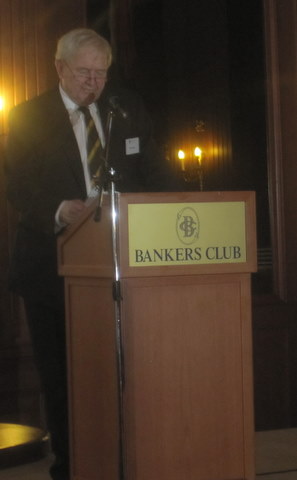
We were there at a reception given by the University of Western Australia (which is — with the Australian National University in Canberra — jointly considered to be Australia’s top varsity). Below is the Vice-Chancellor Professor Alan Robson giving his speech to the UWA Alumni Association.
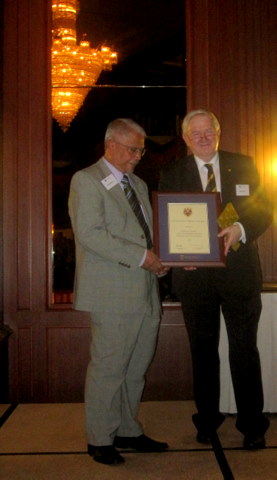
And below is Prof. Robson presenting a Distinguished Alumnus Award To my husband.
And here below is a group photograph of all the recipients.
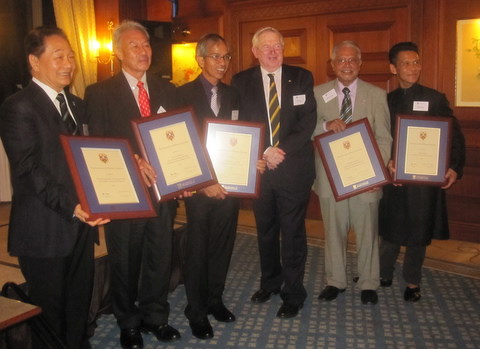 |
| From the left: Dato’Sri Wong Soon Koh; Prof Emeritus Dr Hood Salleh; Dr Roland Dom Mattu; Prof.Robson; my husband; Ramli Ibrahim |
The recipients were a real cross-section of UWA alumni representing ( from the left) politics, the social sciences, medicine, pure science and the arts.
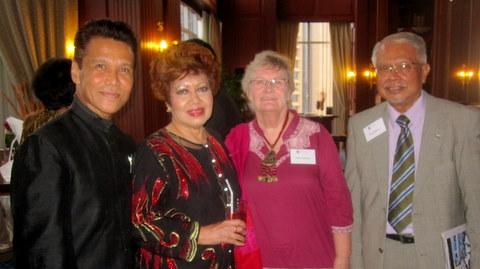
Above is Ramli Ibrahim, dancer, choreographer and artistic director — whom I first saw dance when he was a student in Perth — and his sister, whom I met when she came to do engineering at UWA, and stayed in our house more years ago than I care to count — with the two of us.
It was lovely to see old friends from student days…
There’s been a bit of an internet discussion, sometimes quite heated, and some of it incredibly silly, about George R.R. Martin’s world as portrayed in his series that starts with Game of Thrones. You can read the main posts and comments here and here if you feel so inclined.
But I am not getting into the discussion except to say a few general things that astonish me. In fact, I’m a bit taken aback that they need to be explained.
Firstly, don’t be a reader who confuses the story with the author in odd ways. For such readers, I have some news: a writer who portrays a misogynist world in his story, is not necessarily a misogynist. In fact, s/he may be quite the contrary. Such a writer may be trying to say quite uncomplimentary things about misogynists, or about the society that allows them to have power.
The selection of the setting for a story says nothing whatsoever about the writer’s beliefs in his or her own life. Really. If I set a book in France, I’m not necessarily Francophile. If I write a story that is set entirely within an army at war, it doesn’t mean I am pro-military. Or pro-war. If I set a book in a matriarchal society, it doesn’t necessarily mean I think a matriarchal society is a good thing.
Secondly, do not confuse a reader’s desire to read certain types of books with their desire to visit the setting — or to hanker after a past that is no more, or to think it was a better world, or to live on the other side of the world. I am jaw-droppingly astonished that anyone has to actually SAY that.
If a reader likes reading war stories — do you REALLY think that says they want to be dropped into a war setting? Let alone one with swords and no modern medics? Do I hanker after medieval Europe because I like reading fantasies set in that world? I’d run a mile rather than be dumped in the middle of the real Wars of the Roses, even if I had a stack of magic at my disposal!
Nor do I want to work in a morgue/police station/hospital/space ship because I watch TV programmes about pathologists/detectives/doctors/spacemen, ok?
Thirdly, this icky question of rape. Believe me, I understand if you don’t want to read a book which has rape inside the pages, let alone several rapes. But please, don’t tell a writer what s/he should and should not write about. Rape and sexual assault is part of — probably — every society on the planet right NOW*. To write a book about war, or about medieval times, and leave sexual assault out of the scenario, and you might just be viewing a story through rosy glasses… My Stormlord Rising was criticised because it portrayed quite a bit of sexual assault (most of it during war and invasion) against both men and women. If you don’t want to read about it, put the book down. Don’t blame the author for being realistic.
Fourthly, don’t assume a medieval society has the same mores as your own, and is only different because they use swords and horses instead of bombs and cars. Some folk were saying Martin was writing about rape and paedophilia. By our standards, yes, he did. But – and it’s a big but – transpose a 13-year old bride to another society, forced to oblige her husband whether she likes it or not, and it is neither paedophilia nor rape. In fact, there are societies right here in the present day (even in Malaysia) where people think of this as normal. Sorry to disallusion those critics who want to think they have a handle on what’s morally right and wrong. It’s not so easy. And be careful about you own sins before you jump down my throat on this one.
Yes, to us, the handing over of a 13-year-old girl to a mature man as his bride is horrific. But for most of history, including YOUR own, children were adults long before we nowadays think of them as adults today. A boy of eleven or even younger was expected to work the same length of day as his father, doing the same sort of physical work, and he didn’t get paid for it, moreover.
A boy milked cows for a neighbour, starting at 5 a.m., before he walked the long distance to school. He was eleven and the year was 1901. At 12 he left school altogether (he had no choice in the matter, even though the legal age to leave was 14 in Australia at the time) and he started farmwork in earnest, all day, every day of the week, every week of the year. No holidays. Cows and harvests and farmers don’t take holidays. That was the 20th century — and he was my dad.
Back to medieval times. A woman became marriageable the moment she had her menses. And once married, there was no question of EVER legally refusing her husband his conjugal rights. Of course, one hopes most men are a lot nicer than that, even back in 1135, but legally? He had the right. And this is still so in many societies today. You can close your eyes to it, if you like, but don’t tell a writer s/he’s being crappy to write those sort of things into his/her story. They are real.
Fifthly, don’t think that if a writer portrays a dark skinned people as having a different culture from that of white Westerners, they are portraying them as barbaric. In actual fact, the commentator is identifying themselves as an arrogant Westerner who believes that any culture — other than their own, of course — is barbaric.
I’ve got news for that kind of reader too. Every culture is barbaric. In the wonderful enlightened West, we hound gay kids to suicide, murder transwomen, sell our teenagers drugs that will kill them, and drop bombs on civilians and call it collateral damage, refuse medical treatment to the poor because they can’t afford to pay.
So dark-skinned “barbarian” metes out some horrible punishment to another he perceives as a threat. No lawyer, no trial, no regular sentence, no chance of appeal. And in the West we stick them in Guantanamo. No lawyer, no trial, no regular sentence, no chance of appeal.
Many of George R.R. Martin’s main characters are white-skinned and sort of Western in a Middle Ages sort of way. They are also — by our present Western standards — brutal, undemocratic, living in a world lacking any legal recourse for the wronged (especially if they are poor or don’t have a sword).
In Martin’s world, the dark-skinned are … brutal, undemocratic, living in a world lacking any legal recourse for the wronged. So tell me, just which were the barbarians again?
My point?
If you don’t like a book, any book, then criticise the writing or simply say, it’s not my kind of story. Don’t attack it by attacking the author because s/he must be like the characters. Don’t attack it because the world doesn’t match up to the one you think it ought to be (unless it’s supposed to be a historical novel). If you think a book promotes sexism/racism/monarchism/homophobia or whatever then be careful of how you illustrate your case.
Otherwise you end up saying more about yourself, than about the book and the writer you wanted to condemn.
————
*I think decent men have a hard time understanding how prevalent it is. I’ve never been raped, but I have been physically assaulted in a sexual way, twice, by complete strangers. Once when I was fifteen, once after I was married. Both times I immediately launched an attack on the attacker, they skedadled and nothing much really happened. (The second time, I clobbered the guy with a heavy pair of Zeiss binoculars … threaten a birder when they are biridng, and that’s what happens!)
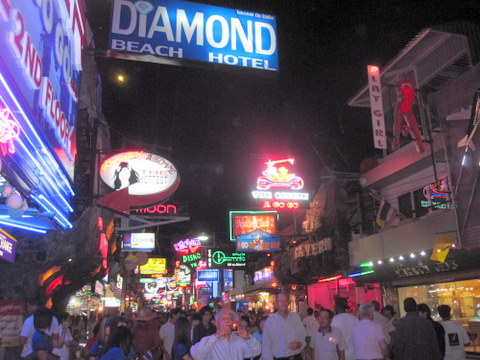
Pattaya by night is a different place. And definitely not a place for kids, and yet…there were youngsters here. All these photos were taken in Walking Street.
I don’t know whether to admire Thailand for being honest and open about their seamy side, or just sickened by what is the underside, I guess, of a great many cities in a great many countries. Is it better to be hypocritical like Kuala Lumpur? And hound women — or pretend they don’t exist — when they try to earn a living this way? I don’t know. I just know that I would like to be sure it was a choice of adults. I’d like to think they all had a choice.
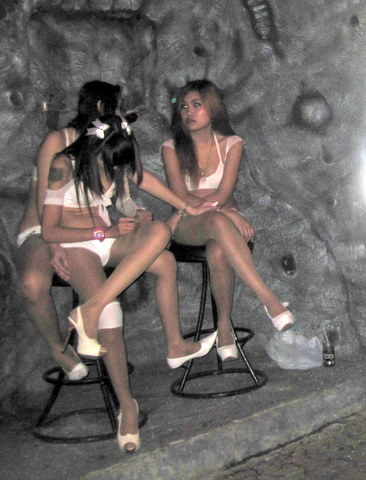
I can tell you I didn’t see too many truly happy faces, just plastered-on smiles that disappeared the instant the prospective customer did.


 |
| In between the girlie bars and the sex parlours, there are many legitimate businesses. |


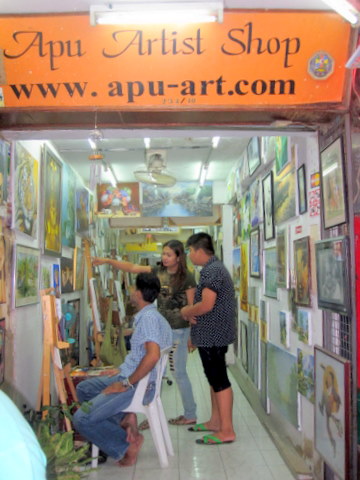 |
| Even an art shop with an artist painting a portrait from a photo |
 |
| And a temple — with a wrapped up tree, and offereings |
 |
| Here’s a close up of the offerings |
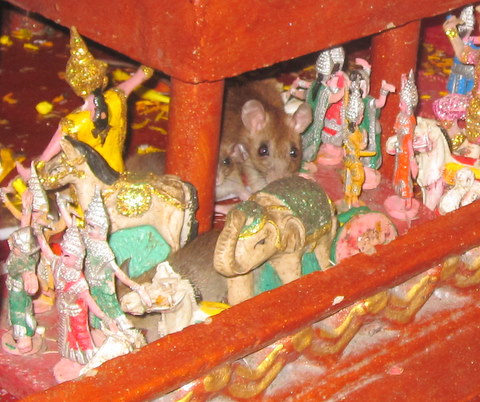 |
| And here’s a shot of the true beneficiaries of the offerings. Yep, those big eyes are alive… |
 |
| A wig shop outside a bar and an indication that many tourists are Russian speakers. So are some of the sex workers. |

I am home now, but here’s some more from Pattaya Beach, Thailand.
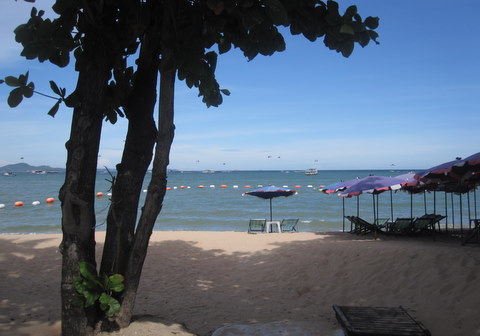
The first thing you have to understand about this town is that daytime Pattaya and nightime Pattaya are two different places. And this is Pattaya in the daytime — the beach.
 |
| Lines of umbrellas and deckchairs |
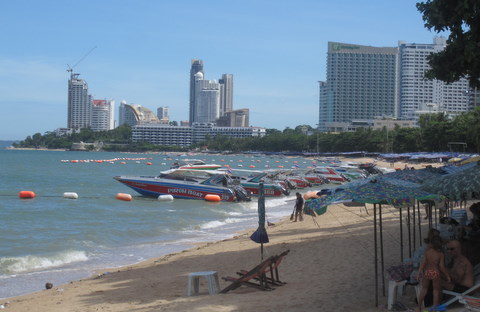 |
| And boats, ready to take you out to the islands and the corals…or water scooters to zip around on |
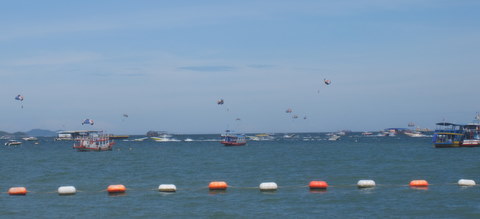 |
| And paragliding — a cat’s cradle of towlines and speedboats zipping this way and that |
 |
| And yes, a quiet corner for the kids to play in the sand. |
Pattaya