Is it so strange that I speak the language of the country I live in?

In English speaking-countries, we assume that everyone we meet – either visitors or inhabitants – will speak English. Well, some English anyway. And we (with a touch of arrogance) tend to be a bit miffed if they don’t.

Here, the reverse is in force. Everyone thinks that someone not born here will NOT speak the Malaysian language – and they get really, really surprised when they do. And to someone like me who has lived here on and off since 1970, that can get a bit wearing, especially as my “otherness” is loudly declared by my skin colour.

Yes, I do speak the language. Maybe not as well as I should – I wouldn’t like to give a formal speech in it – but I can chat about most everyday things*.

Today, while shopping in a K.L. shopping complex, I selected some clothes and told the young girl sales assistant that I wanted to try them on. The following conversation ensued (in Malaysian).

Sales assistant: Oh! You speak Malay!!
Me: Yeah, that’s right.
S.A.: Where are you from?
Me: Selangor state. [Not quite the answer she was expecting.]
S.A.: Oh, you live here. For how long?
Me: Since before you were born. [She does a double take as she absorbs the implication – I’ve been speaking the language longer than she has. She hands me on to the fitting room sales girls – there are two of them, one of whom is an ethnic Indian – and tells me to try the clothes on. I disappear into the fitting room. the following conversation takes place – right outside the room, between the three of them].
S.A.2: You spoke to her in Malay. She won’t understand.
S.A.1: She speaks Malay!
S.A2: No, of course she doesn’t. How can she understand? She’s a white woman!
S.A.1: She lives here.
S.A.2: So? That doesn’t mean she understood you.
S.A.1: She does so too! [raising her voice] Madam, how many years have you lived here?
Me: What’s the matter – don’t they believe you?
S.A. 2&3: [accompanied by fits of giggles]. Oh! She understood!
S.A.3: Do you think she speaks Tamil too?

At that stage I opted out.

The first part of that conversation was repeated on 3 or 4 separate occasions today, so you can understand that I do get tired of it. In fact, if I can, I prefer to speak English for this very reason, and will only revert to Malaysian when I have trouble making myself understood. Or when I want to embarrass someone for referring to me as a Mat Salleh, thinking I won’t understand, which also happens with monotonous regularity. (That’s the local expression meaning a white person, akin to any rather impolite term used in English to describe an ethnic group.)

Funnily enough, when I first came here I was constantly called “Mem” – the term used to address a white woman (akin to the Indian Mem Sahib), and I was even more uncomfortable with that, as it smacked of all the things wrong with imperialism. Frankly, I’d rather be called a Mat Salleh.
————-
*(Funnily enough if I get angry, my command of any language except English flies out the window).
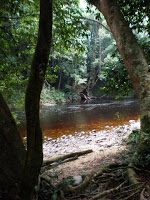
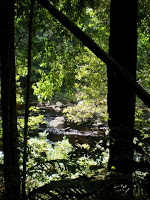
Untitled Post

The heavily populated Klang Valley, where I live, was in chaos this evening. Flash floods closed numerous roads around Kuala Lumpur, and just to add to the misery, a substantial fuel price hike from tomorrow made every second car owner head for the nearest petrol station – which clogged up roads even more. Ah, the joys of modern transport convenience.

I come home and a letter in the newspaper catches my eye. Someone wrote in about the recent law which is aimed at enforcing the use of seatbelts in the rear seats of vehicles. She wants authorities to “provide an explanation” to her of how families of more than five are supposed to travel.

Huh?

She has chosen to have more than three children, yet has never given the slightest thought to their safety while travelling in their family car? Pile them in the back seat, or sitting on Mum’s knee in the front – that’s fine! Ask them to belt up, and she gets indignant. “How is my family of six people supposed to travel?” she asks.

Well, I would say to her, you should have thought of that before you had so many kids. Now someone else is telling you that you have to think of their welfare, and you have the cheek to be upset. Sorry, I am not in the least bit sympathetic. It’s time Malaysians accepted responsibility for having large families.

My worry now is that there is still no law that says that children have to be seated with restraints appropriate to their age and weight. We might no longer see accidents where children become flying missiles sent headfirst through the windscreen, and see instead accidents where children have their heads ripped off my an adult sized seatbelt that ends up across their necks.

I have never understood how some Malaysians can spend a small fortune on a luxury car and then happily allow their child to stand, unrestrained, in the space between the front seats, or lie on the back window ledge, or stick their head out the window…

Oh, of course! I forgot. If they die, it’s not the adults’ fault. It’s God’s will. That makes it ok.

Clairvoyante

Clairvoyante is the French title of The Aware, published by J’ai Lu in large format paperback. (I haven’t actually seen a copy yet, but my agent has posted a couple, so I hope they will eventually arrive). Over at ActuSf, there is an interview with Thibaud Eliroff who is the J’ai Lu editor for fantasy. Interestingly enough, he remarks that fantasy genre is in its infancy in France – and growing fast.

I like the bit at the end about The Aware which translates (vaguely) as:
Behind what appears at first glance to be a mix of thriller, pirate film and humour (who said Monkey Island?) is a portrait of a woman who has not been spared by life, and a scathing critique of U.S. imperialism. A book which is fun and challenging at the same time.

Wow.

Below are a couple of extracts.

Actusf :
Comment est née l’idée de cette collection de fantasy en grand format et quelle sera sa ligne éditoriale ?

Thibaud Eliroff : On ne s’est pas assis autour d’une table en se disant : “Bon, on va faire de la fantasy en grand format, trouvons des textes.” C’est même plutôt le contraire. Quand vous êtes éditeur, vous tombez parfois sur des romans si bons que vous ne pouvez pas renoncer à les publier. C’est exactement ce qui s’est passé avec les trois auteurs à paraître cette année : Joe Abercrombie, Glenda Larke et Sean McMullen, trois futurs ténors du genre qui nous ont incités à franchir le pas séparant le poche du grand format. Au-delà de ces coups de cœur, notre démarche n’est pas dénuée de sens dans la mesure où J’ai lu a toujours été un pionnier de la fantasy, se spécialisant dans ce domaine très tôt, bien avant le boom que nous connaissons aujourd’hui. Les lecteurs nous font confiance et ont fait de nous les leaders du marché de la fantasy en poche depuis plusieurs années. Il me semble légitime de croire que cette confiance nous suivra sur un autre format, pourvu que nous soyons à même de proposer des textes conformes aux attentes de notre public.

….

Clairvoyante, de l’australienne Glenda Larke, nous relate les aventures de Braise Sangmêlé, une femme méprisée pour sa naissance bâtarde, ce qui lui vaut de n’être citoyenne d’aucun des archipels des îles Glorieuses, et la contraint à vivre en permanence dans la clandestinité. Mais dans un monde ou magie carmine et magie sylve s’opposent sans relâche, Braise dispose d’un talent qui vaut cher : la Clairvoyance, ou possibilité de voir la magie, ce dont les représentants des deux camps sont incapables. Elle s’est rendue indispensable à l’un des deux adversaires qui l’emploie en cachette pour traquer ses ennemis sans se salir les mains.

Braise est envoyée en mission à la Pointe-de-Gorth, l’île des laissés pour compte, refuge de tout de ce que les Glorieuses comptent de malfrats et de rebuts. Mais tandis qu’elle mène son enquête, elle se rendra vite compte que quelque chose ne tourne pas rond et qu’elle s’est fourrée dans un guêpier qui la dépasse.
Derrière ce qui apparaît de prime abord comme un mélange détonnant de roman noir, de films de pirate et d’humour (qui a dit Monkey Island ?) se dessinent le portrait d’une femme que la vie n’a pas épargnée, ainsi qu’une critique cinglante de l’impérialisme américain. Un livre à la fois fun et ambitieux.

The Real Ligea Gayed?

This from The Star newspaper today (paraphrased!):
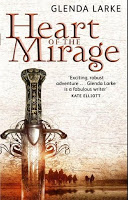
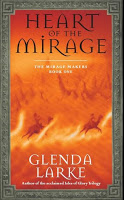
Antonio Azic has been arrested in Argentina. Why? Because he adopted a baby, now a woman named Laura and about the same age as Ligea was at the beginning of Heart of the Mirage. Laura, you see, was born in a secret prison.

Her parents (Silvia Dameri and Orlando Ruiz) were kidnapped prior to her birth, imprisoned then murdered; their elder two small children were dumped at orphanages without their identities and adopted elsewhere. Their kidnappers were military men serving a military junta who routinely slaughtered people who questioned their ruthless regime. (Throwing them out of aircraft over the sea was a favoured mode of killing.)
Laura was – presumably – raised to believe the right-wing junta were the heroes of Argentina, and those horrible lefties were actually dreadful communists about to plunge the country into anarchy.

She refused to cooperate when a group of grandmothers pressed for DNA testing. But the testing went ahead, and her true identity is now revealed. Her young parents died for their ideals, her siblings were torn from one another – and now she, aged 27, has to sort out what she believes, and just who – if any – are the good guys here.

Does it all sound familiar? I wrote Heart of the Mirage for Laura Luis Dameri, and all the others like her from around the world. And for their parents and those indomitable women, the Grandmothers of Plaza de Mayo.

The Spirits of the Fig Tree

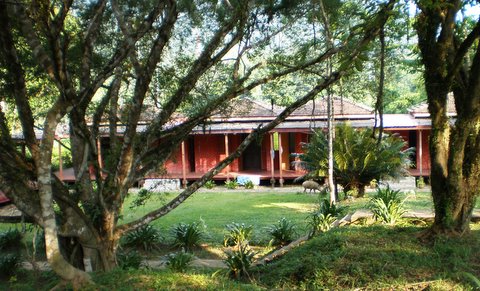
Rooms with a view: the fig tree and the accommodation (note the pig).
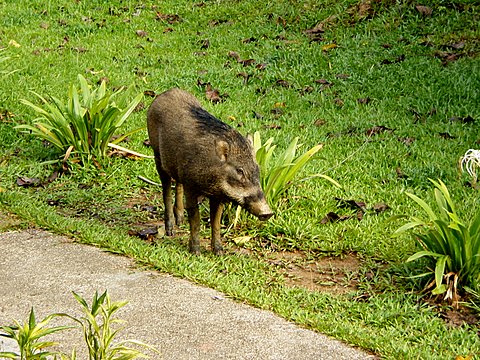
I’ve just come back from introducing our houseguest to Taman Negara.

Once I planted a fig tree in the garden – that is, a tropical ficus species. I did so because they periodically have prolific fruit-bearing extravaganzas, attracting birds, bats and mammals. When we were away living in Europe, our house sitter asked the gardener to cut down the tree – because fig trees are (supposedly) full of scary things like spirits and djinns. Well, in one way she was right. There are lots of lives up there in the ficus when it’s fruiting.

In Kuala Tahan, Taman Negara (Pahang), a fruiting fig tree was probably the highlight of the trip…

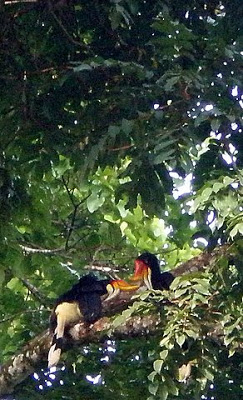
It was quite difficult to drag ourselves away from that fig tree. Everywhere you looked into the foliage, there were birds. Bulbuls predominated, at least at first – from the common garden variety (Yellow-vented), via the secondary forest specialists (Red-eyed, Stripe-throated and Olive-winged) through to the strikingly dapper hill forest species seduced down to the flats by the fig-fest (Ashy), and others – the spectacular (Grey-bellied), the large (the Streaked) and small (Spectacled) and common forest species (Buff-vented). Nine species on one tree…

The much rarer Green Broadbills, with velvet plumage of a lush emerald green and beaks like voracious steam shovels, gorged themselves at regular intervals. A Coppersmith Barbet – with a red cap and matching bib as bright as flame – plinked out its monotonous hammer-on-metal call, at least when it wasn’t eating, to the occasional accompaniment of song from the Gold-whiskered, the Red-throated and the monotonous Blue-eared members of his family. The black and royal blue Asian Fairy Bluebird – as spectacularly clad as a university chancellor at a graduation ceremony – ruled the tree in the afternoon.

Well, he did, until the Thick-billed Pigeons arrived. Fluffy-bottomed, maroon-winged and wearing aqua spectacles, the first ones was hardly competition, but more and more birds came, to be soon lost in the foliage, until at last I decided the tree must have swallowed at least a hundred of them. A few Little Green Pigeons added a bit of variety to the mix. The canopy rustled and shook, branches swayed, while avian voices muttered and murmured and clucked and whined in plaintive chorus, a pigeon pie of conversation.

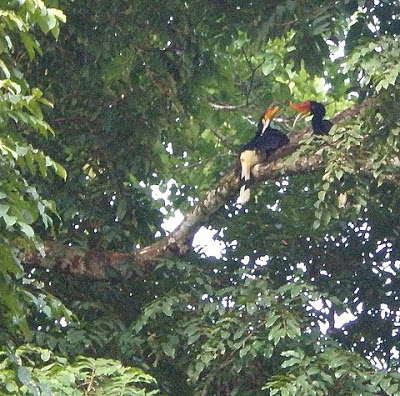
In the morning, the tree was swarming with hanging-parrots, plucking the fruit at the thinner end twigs by means of acrobatic contortions, often upside down. Then came the familiar team-train sound, a pair of Rhinoceros Hornbills in flight – in this instance being hotly pursued by a pair of Racquet-tailed Drongos. Even the macaques in the tree had to take notice of these giants (see final pix of the pair preening after feeding).

Add in a few Common Mynas and Glossy Starlings, plus a few non-fruit eaters who came after insects and we counted 24 bird species at the tree. All just outside our rooms. That’s not bad going.

Ah, yes, I thought. The tree spirits have awoken: the birds at a feast. And to think that there are institutes who have dedicated themselves to producing fig trees that neither flower nor fruit, because the fruit makes a mess.

Food: do Malaysians have a problem?


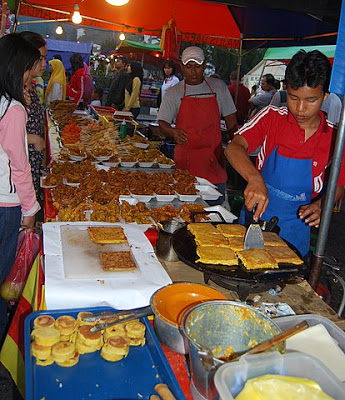
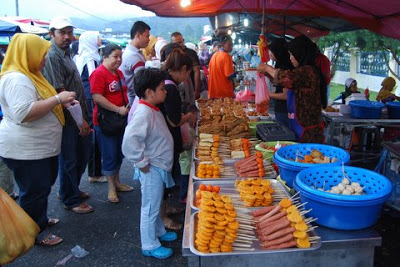
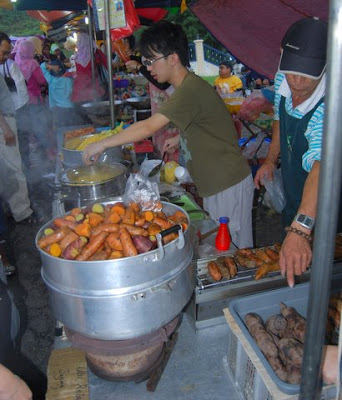
We all know Malaysian food is great. But Malaysians are also eating fast food – a lot.
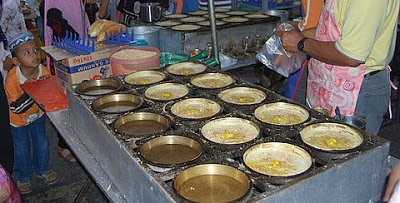
One wonders whether they will eventually rival USA for problems of obesity.

Photo 1: fried food.

Photo 2: chicken nuggets and sausages

Photo 3: hot potatoes and yams


Photo 4: cake (apam balek with corn filling). Look at the kid’s face…

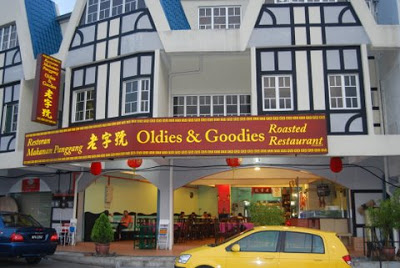
Photo 5: roasted restaurant?

People without shame

How can an executive of a bank receive a retirement deal of 80 million Aussie dollars and not feel profound shame?

Mate, no one deserves that much. No one. Certainly not a banker. The man’s successor gets a base pay packet of $27 million. That’s obscene too. Unless perhaps you personally find a cure for all cancer and Alzheimer’s, all by yourself, which is pretty unlikely.

Shame on Macquarie Bank Ltd.

What happened to the idea of the Aussie “fair go”?

Allan Moss and Nicholas Moore.

Remember those names, folk.

Once, on Wesak Day…

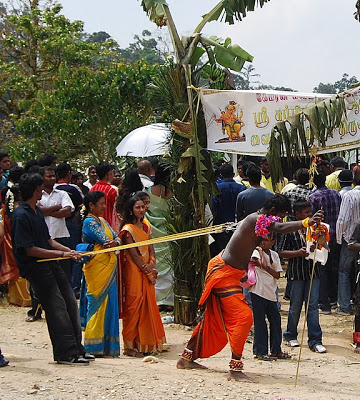
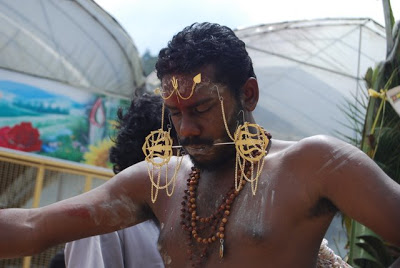
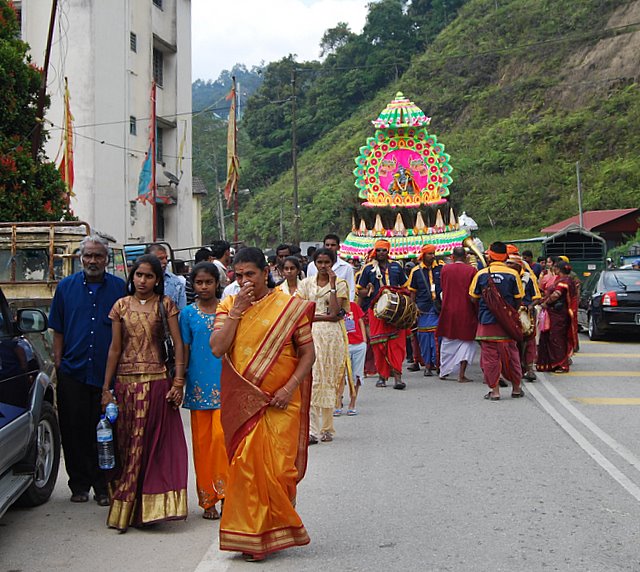
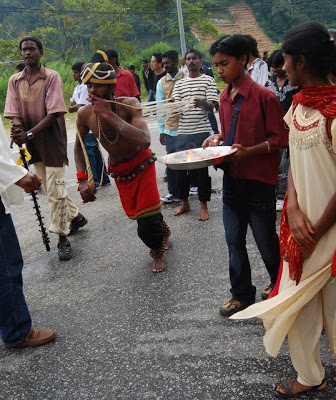
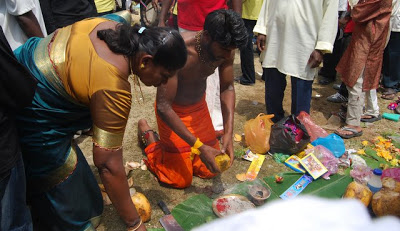
On the Buddhist holy day of Wesak, we came across a Hindu celebration. This was on the way back from Camerons last week.


Photo 1: we stopped because we saw this. The people taking part very kindly allowed photographs.
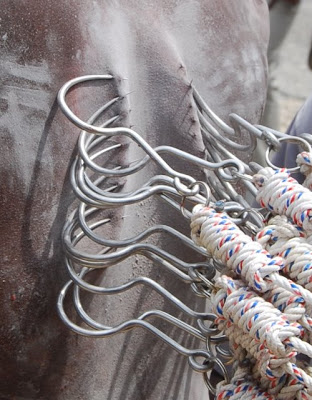
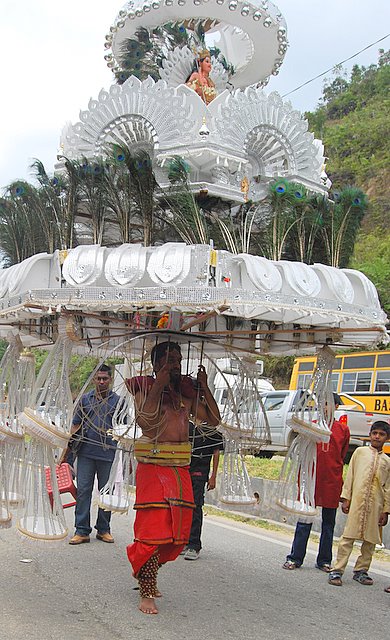
And exactly what were we seeing?

Hindus honouring their god(s) by praying and taking part in pre-performed rituals, and then going into a trance-like state while drums beat and their bodies are pierced. There is no blood. None.

After this the devotees parade through the streets to the temple to the sound of drums and the smell of burning incense. Some carry kavadis.

These palaquin like structures are borne, as an offering to the god, by the devotee who considers the pain will be repaid by spiritual or other benefits received.

I must admit I think the women had the easier parts – occasionally helping with the ritual, but mostly just looking stunningly beautiful in gorgeous clothes and vibrant colours, with sweet-smelling flower buds in their hair.

Want to send a query about your novel to an agent or publisher?

Do your homework first.

In fact, you can even try it out on someone else first, at Query Eagles. Here’s the description of the site by the owner: “I set it up in response to various moanings by agents about the quality, or lack thereof, of query hook paragraphs. Often, as writer, you are so close to your work that you can write what you think is a perfect query paragraph for your novel, but which makes absolutely no sense to a person unfamiliar with the work…The community is about letting a few others read it before you post it off to someone ‘important’.”

A great idea. And if you post your query, wanting comments, don’t forget to comment on other people’s queries first as a matter of courtesy.

Other good sites to consult are Pub Rants (a US agent’s site). And the now defunct Miss Snark. Do a subject search for their posts on the subject of queries.