Help!

Ok, if you know about as much as I do about PCs, don’t bother reading any further. I am about to ask for help with a computer problem because I don’t even know where I should be going for help on this (and I am living in a house full of Mac users…)

The other night I closed down my PC, everything working just fine. Opened it up in the morning to find that – although I could get my usual connection through the LAN line – I couldn’t connect to the server. But then, neither could the other wifi users in the house usibng the same account. We were all without a working server for at least 7 or 8 hours. Then the server solved its problem for everybody else – but not me. Other people can use exactly the same LAN connection, no problem. But my computer just tells me “Cannot connect to server”. I can’t get to the internet using Firefox, or Internet Explorer, or Outlook Express. I can, however, Skype, and Microsoft happily downloaded the latest update patch.

I tried disabling all firewalls and virus protection, still no joy. I uninstalled or disabled the latest downloads. Still won’t work.

What the x#@!! is going on?

When they learnt that they can’t?

I read the site Malaysia Today today. I usually don’t, but I did today. Anything unusual in that? Yep, because it was supposedly officially blocked.

Says Thestaronline: “The controversial Malaysia Today news portal was blocked by the Malaysian Communications and Multimedia Commission (SKMM) because its editor ignored many warning letters, Home Minister Datuk Seri Syed Hamid Albar said.

“When they publish things that are libellous, slanderous or defamatory, it is natural for the SKMM to act against these websites whenever necessary,” he told a a press conference at Parliament lobby yesterday.” … “We do not intend to curtail people’s freedom or right to express themselves. Everyone is subjected to the law, even websites and blogs,” he added. ….
It was reported that all 21 Internet Service Providers (ISPs) in the country had been ordered by SKMM to block the controversial website.

Sigh. When will they learn?

Alien words in our prose


Something written by a talented young Malaysian author, Preeta Samarasan, resonates with me.
She said:
“Schoolchildren studying literature in the colonies had to navigate Cockney speech patterns, imagine for themselves what toad-in-the-hole might taste like, picture moors and bogs and fens and determine the emotional significance of each of these landscapes. Now we get to tell our own stories, and this requires your dealing with my rubber estates and char kuay teow and cursing in Tamil. In the long run, this will be good for all of us. A little cultural immersion never did anyone any harm.” {See here for the full article and reference.}

Good on her. And she’s absolutely right.
As a kid growing up on an Australian farm, there was no end to the things I read that I had to imagine, as they were never explained by the author. Why, after all, would a UK writer think she had to explain the tube, or hares, or galoshes or ices or kippers or gorse or fells or (English) muffins? Why would an American writer bother to expand on what the deck of a house was, or the trunk of a car, or clapboard, or (American) muffins, or what pumpkins had to do with Halloween – and what the heck was Halloween anyway? All these words were as foreign to me as, say, gesundheit, roti canai, bwana, merde or halal.

And I went on reading and learning and understanding with very little help from a dictionary in those pre-internet, pre-TV days.

Preeta doesn’t believe in putting Malaysian words in italics because they will be foreign to non-Malaysian readers. And why should she? Those British writers didn’t italicise “fens” because I didn’t understand what a fen was.

As a writer of fantasy words which have their own vocabulary, I prefer not to use italics for words which are not foreign in the society I am writing about. It’s silly. And I try not to use words unless the context makes it clear – or will do in time – what they mean, because I also prefer not to have to have an appendix of foreign words.

Who won the Olympics?

If we are talking about countries as much as individuals, then it was Jamaica, Mongolia, Georgia and then Bahrain….

If you want to know why, check out Justine’s blog.

Jamaica won 6 gold medals, 3 silvers and 2 bronze and they have a population of 2.71 million. So, in Jamaica, for every 246,727 people, one won a medal. If the USA had achieved that ratio, then they would have won 10 times as many medals as they did.

However, it is the GDP per person which is particularly telling.

There is apparently a physical reason why Jamaicans are good sprinters though…

Planned villainy – or how to freak out your dad

We have been chatting about villains on the comment section of the last blog post. And coming down on the side of a more nuanced villain rather than the totally dark evil overlord type.

I think 4-year-old grandson has also been giving the matter some thought.

Yesterday, a series of misbehaviours led him to being given a serious time-out in his bedroom. As his dad marched him upstairs, lad protested indignantly, “Daddy, you are ruining my plan!”

Dad, taken aback, asks, “What plan?”

Son replies, with perfect 4 year-old seriousness, “My plan to be bad until I’m five!”

How do you like your villains?

Over on Jenny Fallon’s blog the other day, she had a link to this article on villains at io9, a bit tongue in the cheek, which postulates that one of the reasons movies like The Dark Knight have done so well over the summer season (in the northern hemisphere) is because they have decently wicked villains.

The writer, Charlie Jane Anders, then gives a comprehensive list, with comments, of how good villains are ruined by script writers:
1) They get redeemed.
2) Too much information.
3) They become analogs of real-life nasties.
4) We see too much of their world.
5) Too many defeats …
6) …or victories
7) The villain that’s a reflection of the hero.

I can’t really comment because I am not much of a movie goer. What I really liked about the article were two comments towards the end:

  • Good villains make great stories. A truly chilling villain makes the hero seem more important because the stakes are important, and the hero’s actions matter.
  • A good villain has some kind of political message, but it’s subtler and woven into the storyline’s subtext.

I actually don’t feel that it is possible to extrapolate much of what Anders says into a comment on the written medium. Book villains, I feel, are much better fleshed out. In a film it’s OK to be thoroughly villainous; in a book the reader often wants more – why is the villain like that? Where is he coming from? How does she see herself? Readers want more subtlety than film goers. Am I right?

I do agree that too obvious an allegorical portrayal of a real life villain can be a real turn off, as can a miraculous redemption. If you don’t agree with me on this last point, try watching Hindi movies. Omigod. The utter rotter who has done despicable things to hero and heroine throughout a cinematographic marathon, suddenly turns good at the end? Or says, oops, sorry? Yuk. Or rather yuk unless done by a truly great writer.

I just looked back through my reading list for the year (on the bottom left sidebar of the this blog), and one villain stood out as the bloodiest I have read in a long time: Karen Miller’s Hekat from her Godspeaker trilogy. Not for the faint-hearted, the first book details the origins of Hekat’s villainy very well indeed. In fact, Hekat’s descent from sympathetic to hateful is brilliantly done.

More subtle by far, and perhaps even more chilling as a result, are the trio of villains of Marcus Herniman’s Arrandin Trilogy: Emperor Rhydden, his sycophantic and conscienceless henchman and the Archmage. In a way I wish they’d had more scene time and a bit more background detail.

So how do you like your book villains? Who are your great villains of fantasy and why?

Purple Prose


Once, during a workshop I was giving, one of the participants indicated they didn’t know what I meant when I mentioned “purple prose.” I gave the standard sort of answer:

Purple prose is another way of saying that the words and phrases you are using are too much for your subject matter – too colourful, too ornate, too baroque, too flowery, too exaggerated – and probably far too many such, as well.

Romance writing in the past lent itself to this kind of bad writing: her heaving bosom, his tumescent organ (or throbbing manhood), the aching void in her heart, their doomed love…

One self-published book, of which I read the first page, had no less than eighteen adjectives referring to colour (not just purple!) in the first two relatively short paragraphs, so that the reader thought they were sinking under the weight of a paint box. You know the sort of thing: Storm-grey clouds, indigo smudge of her eyes, crimson and russet leaves shining in the liquid golden rays from the molten orb of an autumn sun, etc etc. Guess what: I was not tempted to read on.

But my grandson has developed the art of purple prose speech to a fine art with the use of an expression (produced on average once a day), to provide me with a wonderful example for my next workshop. Such a conversation usually proceeds something like this:

My daughter (in the garden) : It’s time to go inside now.
Grandson: No, I don’t want to.
Daughter: We are going in right now, darling.
Grandson: No! I’m not going to!
Daughter (scooping son up): Oh yes, you are.
Grandson (sobbing and struggling): You are ruining my life!

He’s not impressed when we invariably crack up.

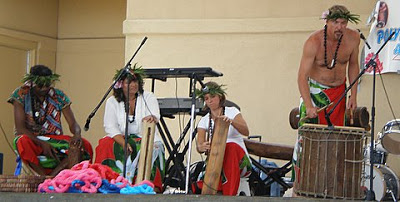
The reason we went to Virginia Beach

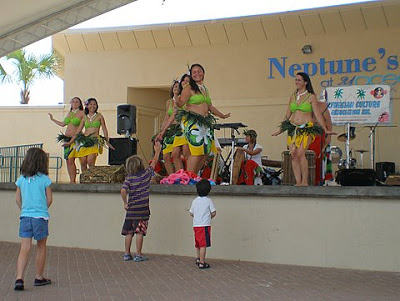
…was to attend the Polynesian Culture Association’s festival of music and dance, in which Daughter No 1 was participating.

In the pix below, the three children of 3 of the dancers (that’s grandson in the middle) suddenly realised that was Mum up on the stage and wanted acknowledgement, which was rather cute.
That night, sitting around the campfire talking, I discovered that two of the drummers were fantasy readers and staunch members of the Society for Creative Anachronism, so I am now fascinated by the idea of attending the huge Pennsic which was 14,000 or so participants.

Wow. that makes the SF Worldcon look minute. One day. Maybe.

Life is simple when you are under five

.
Grown-ups just complicate things.

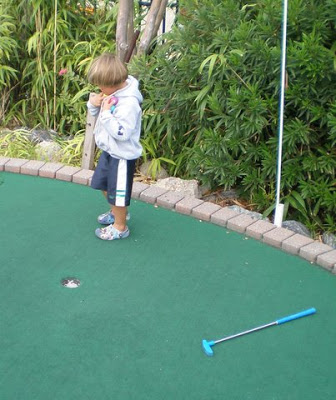
When you are less than five and you want to find out something, you just go look, no matter what the other guy thinks.
Grown-ups really do complicate things.

When things don’t go right, why not throw away the pesky stick that doesn’t work, pick up the ball to drop it in the hole?

Simple.