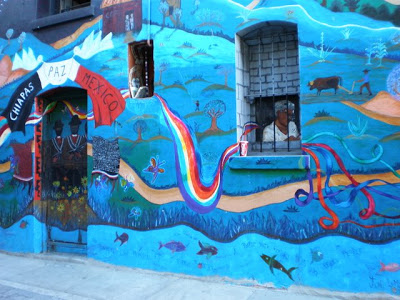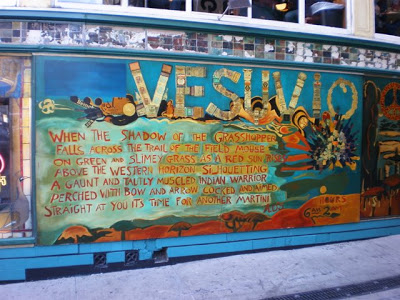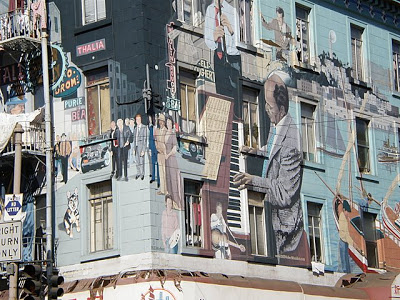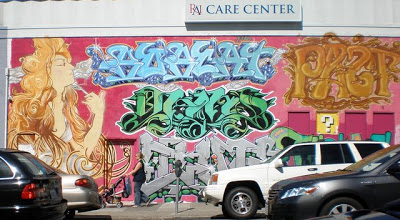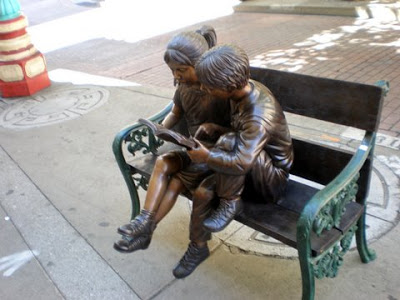
This photo says it all really. Study it carefully…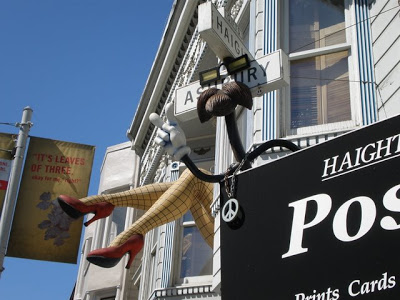 I love San Francisco.
I love San Francisco.
I have read some very fine genre novels lately, all of them Book 1 in a longer trilogy or series. Take a look at the “books I have read” list on the left hand bottom sidebar. The authors include Joe Abercrombie, Patrick Rothfuss, Kate Elliott, David Coe, C.S.Friedman. Every single one I thought a great read – and I’ll be buying book 2 of each as soon as it comes out, if I haven’t already done so.
And reading those books got me to thinking about what makes a good read, and why some good books don’t sell and some not-so-good books sell like icecream to kids on a hot day at the zoo. And then I read this excellent interview with an American editor, Chuck Adams.
And I thought Patrick Rothfuss’s book “Name of the Wind” summed it up beautifully for me. I’ll get back to that in a minute.
First some things about my own writing:
—I like complex characters who change as the book progresses. People who learn things and – as talented as they may be – are never great at everything.
—I like “subverting” the tropes. Genre is full of “tropes” and sometimes you get reviewers making snide remarks about goatherders who turn out to be the lost prince or great warriors, etc etc – see yesterday’s post. I like to use established tropes to lull the reader into thinking something is going to happen, and then give the trope a twist. I love surprises.
—I like world-building and making my worlds different as well as complex and realistic within the rules of that world. You won’t find too many medieval castles in medieval towns with ordinary medieval things going on in my books.*
Those are probably the three aspects that govern my intentions at the beginning of each of my books. Conversely, I am often bored when reading books that adhere too strongly to tropes, or where the story revolves around a Mary Sue or Gary Stu*, or it’s all set in a world where there is no “wow, this is cool” factor in the world itself or, at the very least, in the magic of that world.
I might add, that – given my age – I have read an awful lot of fantasy, and ideas which appealed to me 20 years ago as new and fresh, would now bore me to tears as done to death. Readers relatively new to the genre might find lots to excite them in books that bore me.
So then I read “the Name of the Wind”. There were 722 pages of it. It had the worst Gary Stu I’ve ever come across – no, wait. Maybe that should read the best Gary Stu I’ve ever come across. By the end of the book he is just 15 years old and the list of his accomplishments reads like an unrealistic wish list that most of us had for ourselves as an internal fantasy at one stage or another.
It was full of the usual fantasy tropes; there weren’t any real surprising moments where I sat stunned and thought, “Hell, I didn’t see that coming!” There was nothing about the world or the plot twists or the magic that made me think, “Wow, that’s really neat!” or “I wish I’d thought of that!”
And yet.
I loved this book.
I couldn’t put it down.
When I finished, I wanted to reach out and grab Book 2 immediately.
There may not have been a huge “wow” moment for me, the somewhat jaded fantasy reader – but there was never a dull moment either. I didn’t skip a single word. Nor did I even notice how the book had been put together or the mechanics of the writing. I just read.
So how did this writer do all the things that usually bore me to tears, and get away with it?
You see – Rothfuss is a fine writer who creates atmosphere and tension well, and even more importantly than that, or maybe because of that – he is a great storyteller. None of the other stuff – tropes and Gary Stu and such – none of it matters in the hands of a consummate storyteller, one who just entertains. I hope that as Rothfuss gains experience he will veer away from the Gary Stu and subvert the tropes too; then he won’t just be a brilliant storyteller, he’ll also be a brilliant writer.
Let’s go back to some of the things Chuck Adams had to say in that interview.
“The first thing is the voice. If it’s got a strong voice, I’m going to keep reading. And if a story sneaks in there, I’m going to keep reading. To me, those are the two most important things. I want a voice and I want to be hooked into a story. I believe very strongly that books are not about writers, and they’re definitely not about editors—they’re about readers. You’ve got to grab the reader right away with your voice and with the story you’re telling.” …
“I think beginning writers tend to not think about a reader. They tend to think about themselves. They think about making themselves sound smart and good, and they forget that this is really all about telling stories. I used to joke that I was going to put a big sign over my desk that said, “Quit writing and tell me a story.” The problem is that they just write. They fall in love with their own voice. They write and write and write, and they lose sight of the fact that they’re trying to entertain somebody. You have to reel them in.” …
“There’s a tendency of publishers to pooh-pooh books that are really commercial. You get this at writers’ conferences sometimes. “Oh, how can you edit Mary Higgins Clark?” People just shiver because they think she’s not a great writer. I’m sorry, she’s a great storyteller, and she satisfies millions of readers. I’m all for that. Again, Harlequin romances—give me more of them. (…) I think literary fiction is great, and the ideal book is one that is beautifully written and tells a great story, but if it’s just a great story that’s written well enough to be readable, that’s good too.”
So my advice to anyone who likes fantasy: Read “The Name of the Wind” for damn good storytelling.
And my advice for anyone trying to write publishable fantasy: read “The Name of the Wind” once just to enjoy, and then read it again to try to suss out how he does it. How does he turn age-old tropes, a Gary Stu, not terribly innovative magic and a fairly ordinary world, into something that you want to know about? How does he make you want to keep turning the pages? Because that’s what you need to learn.
_________________________________________________
[*Oddly enough, some reviewers are so caught up in the idea that fantasy books are set in medieval worlds that even when you write something that is palpably NOT medieval (The Isles of Glory – set in an early 18th century sub-tropical islands being discovered by mainland explorers) the reviewer will still refer to the medieval setting!]
[*A quick word about Mary and Gary – this is where your main protagonists is head and shoulders above everyone else in, well, in just about everything. They are beautiful, talented, wise beyond their years. They are save-the-world-before-breakfast people. All the other characters revolve around them and talk about them. They are shining heroes. Often this makes them sickening, but in the hands of a good writer they can be wonderfully heroic as well as interesting: e.g. Francis Lymond in Dunnett’s Lymond Saga. See the wikipedia entry for more.]
Fantasy writing gets mocked a lot for sticking to certain tropes of the genre. You know: Dark Overlords, goat-herding boys who end up being the hero and so forth. There are lots of fun sites about it; see here and here for a start. I even read two books back to back with exactly the same beginning – a boy goes out into the woods to do something or other, comes home to find his whole village/family wiped out by the villains of the piece. And they weren’t the first books I had read chronicling that identical event, either – or the last.
A beginning writer, on reading URLs like those above (apart from laughing like mad), is likely to despair. How do your write a fantasy that doesn’t tread old, much-travelled ground? Well, the answer is that you don’t let it bother you.
And here’s one reason why not:
A long time ago, when I was thinking about writing a new novel – the one that was to become The Aware – I was chatting to someone who began to mock fantasy. Yeah, he said, castles and forests and wolves and riding off on quests. They are all the same. I was so mad at his dismissive, scornful attitude, that I thought to myself, Right – no castles, no forests, no wolves, no horses… Damn it, there won’t even be a tree in this one!
I suppose it would have been easy enough to set the book in a desert, but I thought that was the easy way out. Besides, it had been done before. No, I wanted something that had never been tried, and so I created Gorthan Spit. No trees, no castles or wolves or brooding forests – but a fascinating place nonetheless.
But then…where did I go from there? Well, my first scene in the book was set in an inn.
And guess what: a book opening in an inn is such a fantasy cliché. It’s a great place to start, you see. You can gather some of your main characters together – have them meet one another for the first time. You can introduce so much of the background, politics, the world, in the conversation of the people sitting around having a drink. And you can write the first bit of the nastiness that is going to overtake your protagonist – the monster/villain who comes to the inn door in the middle of the night, or the soldiers riding up, or whatever piece of villainy that is going to confront your hero or heroine.
My point is this: using fantasy tropes is not altogether a bad thing. They have become tropes because they make a good story. It’s how you use them that counts. Think about mainstream literature – how many coming of age books have you read that all follow similar paths? Does it matter? No, because in the long run what counts is the story. And how well you tell it. Each coming of age story is different. Each writer’s way of dealing with the same issues is a different take on the same theme.
More about good storytelling tomorrow…
Winter begins to close in on the north.
And down here, in Malaysia, we know.
We know because the birds start arriving…
Saturday I was one of the presenters at a raptor identification workshop. What better than to spend a day in the company of a group of maniac birders? Great fun for me, anyway. Probably utter confusion for some of the beginners.
Sunday we followed up with an early morning trip to Bagan Lalang, where we got to hang out on a bund (those are mangroves behind us) and watch the bypass of Oriental Honey Buzzards – a few hundred – and Chinese Goshawks, also a few hundred. And an Osprey for good measure. All as they travelled south through the Malay Peninsular, seeking warmer climes for the next few months.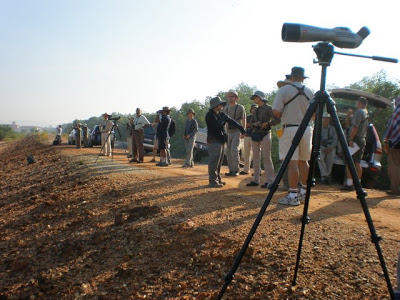
…as we enter day 4 without water. Well, we did get a bit last night. In fact, quite a lot. Trouble was it was so brown it was opaque. Just the sort of thing you’d like to bathe in and wash your clothes with. Quite frankly, I wasn’t sorry when it suddenly stopped running again.
But here’s the interesting thing. The reason WHY we have no water.
Us and 425,ooo other households and hell knows how many people, certainly over a million of us. Oh, and that includes KLIA airport.
Bravo all the people who ignored the mining going on under their noses. (One wonders – was anyone paid to turn a blind eye, or are they just stupid and indifferent?) You don’t do sand mining with buckets and spades and sneaking around in the dark. It involves pumps and heavy machinery and trucks. Lots of trucks. Lots of noise.
A police report has been made. Will anyone be brought to court on charges? Well now, what do you think?
My guess is that no one even noticed – in 5 long years – who was responsible. If they did, then I bet they get a slap on the wrist and a fine that isn’t even 1% of the clear profit they have made – after the taxes they didn’t pay – over the years.
P.S. The water came on long enough to fill the house tank. Now it has vanished again. We progress.
Yuk. One of those days.
Woke to find no water in the taps. In fact, there was no water in the evening the day before, either. No water the whole day long yesterday, and none today…so far it has been two and a half days.
Fortunately, as a matter of course, I keep a huge container of water filled in the second bathroom, as we are subject here to water cuts without warning – for the past 28 years. Of course, they don’t call it water cuts – they say it’s just that we live on top of a hill. And that makes it a) our fault and b) none of their business.
About a year ago they actually decided to do something about it and started replacing the silly little “pipes” with something the proper size for a huge housing estate. Oddly enough, it made not much difference. Evenings and weekends, there is often only a bare trickle into our kitchen.
Apparently, though, this time it was a real water cut: they used a TV announcement (we don’t watch TV, ever, so guess what – I had no idea) to say they were cutting the water as from today for 3 days. So now I haven’t got the faintest idea when we will get our water back. And seeing as they cut the pipes a day and a half earlier than they said anyway, everyone has been caught on the hop.
Anyway, all that meant I was lugging buckets of water from bathroom to kitchen, and pulled a muscle in my shoulder, the pain of which kept me awake most of the night.
I dropped by Jenny’s blog yesterday, to find that she had a really funny post on our cover pole dancing twins. (Actually, it’s more a column than a pole…) The post was entitled “Glenda Larke and I have so much in common” and what do I read at the end? Jenny was off to get a cortisone injection for a painful shoulder. I think she’s channelling…
If you don’t know what I mean by the heading of this post, drop by Jennifer Fallon’s webpage here and take a look at the Russian cover of her book Harshini. Then look at the Russian cover of The Tainted, Book 3 of my Isles of Glory trilogy, below. In Russian, the title means I believe, “Desecration”.
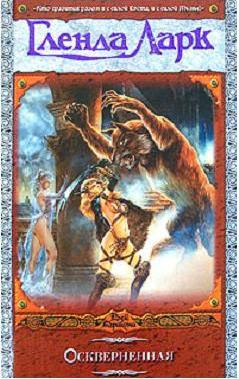 Do I mind? Of course not; my cover has several bonus additions, after all – more than a hint of bondage there, I think, not to mention a rather large cat, neither of which I actually remember being in the book.
(Remind me someone – was there a sabretooth somewhere that I’ve forgotten about?? To be quite honest, I do tend to forget all about the last book once I start working on a new series, let alone the series after that…but I am damned sure Blaze wasn’t tearing around dressed like the star attraction of a brothel for men with, let’s say, interesting tastes. Oh, and there wasn’t a pole dancer in the book either. But then – there also wasn’t a pole dancer in Harshini… )
I really, really love my Russian publisher. They are such fun people. And this cover is definitely better than the Romulans on the cover of Book Two (see the sidebar).
So, to my Russian speaking readers: enjoy! But please don’t expect bondage, pole dancers, or very large cats.