Christmas past

It’s Christmas Eve here.

I haven’t celebrated Christmas in an awful long time…probably not since we lived in Europe and had our first white Christmas evah (I was in my forties…), and did really Christmassy things like go to the Kriskindlemarkt in Vienna, buy a REAL Christmas tree like the one in picture books (also first time evah), drink gluhwein, and walk up Beethovengang at the back of our house into the Vienna woods – to counteract the effect of too much turkey.

Oh, I do remember a lovely family Christmas in Glasgow when my daughters and my niece all met up – that was after we left Europe, and it was memorable too. We ended up in a snow covered cottage near Perth…Scotland. About as far as you can get from my Perth Australia childhood Christmases.

The highlights of those?

  • Making our own Christmas decorations. Paper chains and cutouts…
  • Decorating the tree. Except the year the aunt sent artificial snow that my sister and I turned out to be allergic to…
  • Hot summer holidays that had just begun and stretched away ahead like the promise of heaven, and included two weeks in a caravan by the beach!
  • Waking up to see what was in my stocking. There was ALWAYS a book, so that I didn’t get up too early.
  • Unwrapping presents after breakfast.
  • The book from Grandad. Always a book, always appreciated by a farm kid without access to a library, or a book store.
  • The Christmas packages from the two childless aunts. Especially the one which came from exotic places – Japan, Korea or New York. Oh, the delight of that wooden duck that quacked when you pulled it! Later, the exquisite Japanese lacquered things or that traditional Korean doll, too lovely to play with.
  • The weird books the other aunt used to send – she worked for a printer and when kids’ books were misprinted with pages in the wrong order or upsidedown, she’d rescue them from the bin and send them along to us. We adored them!
  • That lovely home grown roast chicken with sage and onion stuffing and lots of gravy for Christmas dinner, eaten early afternoon. Homegrown vegies, including the peas we shelled ourselves and cooked with mint…which I loved.
  • Finding money in the Christmas pudding.
  • Sitting around all afternoon cracking nuts and eating licorice allsorts and bit black raisins with the seeds still in them.

Ah, to be a child again. I feel sorry for the affluent kids today. When you have it all, all of the time, how can you possibly know the intensity of the pleasure we had? Christmas truly did come only once a year in those days.

The nicest thing about this Christmas is that my two daughters are together, in Los Angeles. Not something that happens too often these days.

So seasons greetings, whatever the flavour, to all the readers of this blog.
What better place to finish a book…

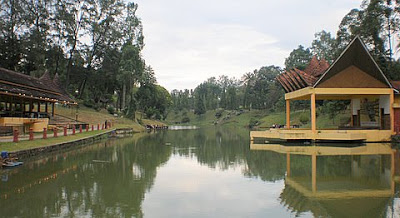
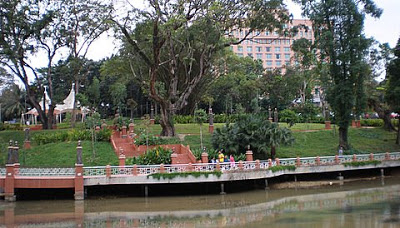
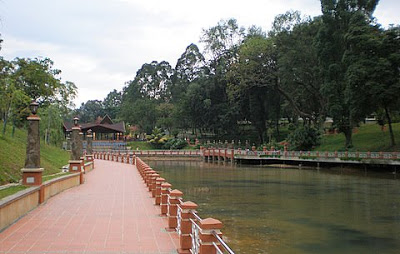
I just spent a day and a night in Seremban, the capital of Negri Sembilan state, because my husband had a meeting there at the lovely Royale Bintang – used to be the Adelphi. That’s the pink building peeking through the trees. The city is actually only half an hour from our house, but it is 40 years since I walked the Lake Gardens there.
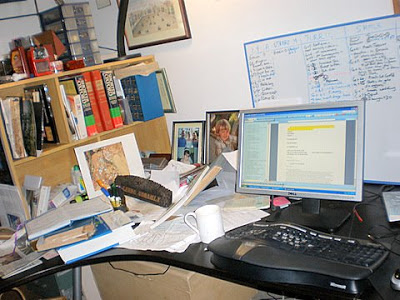
Now Seremban shall be remembered (by me anyway) as the place where I finished the initial draft of Random Rain Book 2. Well almost. I am over 170, 000 and have just two more pages to go. I shall be done before I go to bed tonight, back at home.
Book Two of Random Rain


First draft progress

Due Date: March 1st 2009 … for a polished version
Publication date: March 2010

OO-er, you naughty people…

I have been looking at the analysis of hits to this blog, and you know what? Saturdays and Sundays have substantially less hits than weekdays.

Are you to be commended for spending your weekends communing with your families instead of glued to the computer – or chided for reading blogs at work, hmmm?

You know what…?

I don’t think the first draft is going to come in at quite 170,000. It will be over. But even so, not much to do now. The battle is raging. People are dying. Confrontations are occurring. And love is there in the midst of it all…

Love these exciting bits.

Book Two of Random Rain


First draft progress

Due Date: March 1st 2009 … for a polished version
Publication date: March 2010

More from Lake Chini & Lake Bera


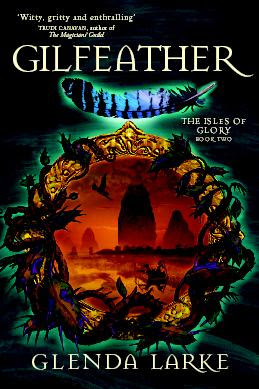
Remember I mentioned that these lakes were the inspiration for one part of Book 2 of The Isles of Glory? The Australian cover depicts the lake as it is portrayed in the book.

Here are a couple of paragraphs.

In this first extract (slightly abbreviated) the narrator is Blaze Halfbreed, as she and her friends pole there way towards their destination, an island in the middle of the Floating Mere :

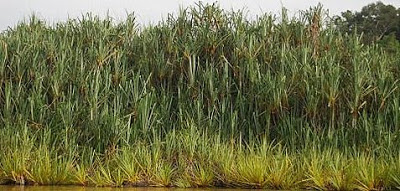
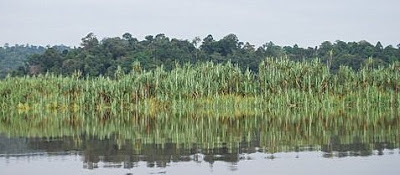
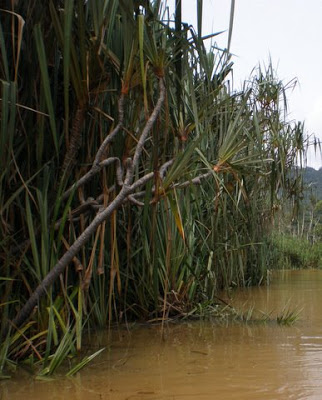
At first glance, there seemed to be a solid wall of plant growth in front of us, a boatman’s nightmare. They grew in clumps, each about the height of a man. We later found they could grow four times as high. Each clump had a barrel-like central core that sprouted stems on which long narrow leaves grew in spirals. Each yellow leaf was thick and solid, edged with a rim of green that sported nasty hooked spines, and each could be three or four paces in length. About three quarters of the way up each leaf the leaf-spike folded over and drooped downwards as if it couldn’t support its own considerable weight.
Creepy,’ Dek muttered. ‘They look like green and yellow spider legs.’

‘Big spiders,’ Ruarth said, awed.

As our craft made ripples on the water, the clumps stirred. When I looked down into the blackness of the tannin-stained water, I could see their thick roots spreading out, tangling with one a
nother, forming rafts, catching their own dead leaves to use in self-cannibalistic nourishment. Fortunately for us, not all the clumps joined. They were floating islands, rafts varying in size from three or four plants to sizable platforms that stretched for several hundred paces. You wouldn’t have wanted to step foot on any of them though: the leaves sprouted out in all directions, each one lethal in its arsenal of spines.

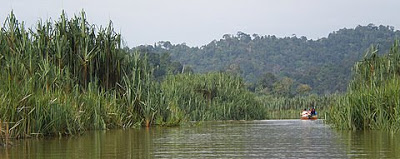
Under different circumstances, I might have found the Floating Mere beautiful. In the occasional clearing in the pandana, the blackness of the open water reflected the plants and sky with mirror-like clarity. The plants floated, serenely peaceful considering their weaponry, and the waterways twisted and slithered blackly between them, like forest paths heading into the depths of some primordial jungle. Sometimes the plants met overhead and the paths became tunnels that undulated gently as we passed through. It was as if it was all one living creature, observing us neutrally as we slipped by.

I wasn’t sure that the place was entirely benign, though. Occasionally we heard strange sounds, eerie song notes that seemed to have no pattern or even discernible origin. They would whisper through the pandana and then die away as mysteriously as they had started. Perhaps unconnected, every now and then something would rise up through the water to break the surface, and I would have a momentary impression that I was being watched. When I turned my head, I’d have the briefest glimpse of something large and of an indeterminate colour, before it slipped beneath the surface, gone in a swill of ripples.

I couldn’t help feeling that we were being followed.


Followed, or hunted? I tried to tell myself that anything that was so skittish was not going to be much of a threat to us, but I didn’t feel comfortable.

The second extract later in the book has a different narrator, Kelwyn Gilfeather, a physician, who is trying to find out why Blaze and her party have gone missing:

There was more that was eerie about this floating world: sometimes we were poled through tunnels for half an hour or more, twisting pathways of black water lit only by sunlight shattered to splinters by the thick network of barbed leaves. Sometimes the tunnels split into branches, then rejoined, rather like a network of arteries and veins and capillaries. Even more disconcerting, sometimes it closed up behind us, as if the floating plants were trying to block our retreat. A silly notion, I know; the islands moved only because we stirred the stillness of the water with our passing.

Probably the feeling was aggravated by the strange noises of the place, dissonant whistles that seemed to seep out of the water on every side at odd intervals, akin to the music a wind may make playing around the corners of a building. I might have dismissed it as nothing, except that there was no wind, and occasionally the notes seemed more …deliberate. Like language. Only who — or what — was speaking? And to whom?

I shivered.The Isles of Glory trilogy can still be bought from Australian bookshops as all three books are still in print. They can be obtained by overseas readers through Australian bookstores such as the book chain Dymocks, or specialty bookshops such as Galaxy in Sydney or Slowglass in Melbourne.

Weird Stuff. Again.

A burglar broke into a small sundry store in Terengganu state when the owner had gone on holiday. When the owner returned, he found a dehydrated and starving burglar on the floor in a sorry state. He said he’d broken in three days earlier, only to find that he was temporarily blinded and a supernatural figure kept pushing him to the floor, preventing his escape, or – one assumes – eating and drinking any of the merchandise. (His story, as later told to the police.)

The store owner had to cart him off to hospital where he has been treated for the past four days for severe dehydration and shock …

Of course, everyone has been asking the storekeeper what black magic he used.

None, says the fellow. My shop has been broken into so many times when I am away, that I prayed to God as I could no longer tolerate it. That’s all.

See? No magic involved…!

More on Tasek Chini

The lake has been in the papers a lot the last couple of days, with many protesting its pollution and degradation, saying the polluters ought to have to pay.

The difficulty with that is this:
Normally, the Chini River flows into the Pahang River.
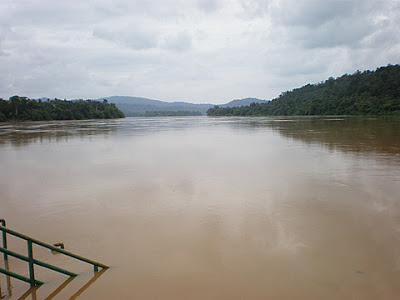
When the huge Pahang River floods, the level of the water is higher than the level of the lake, and the Chini River reverses its flow. In other words, the water from the Pahang flows into the lake.

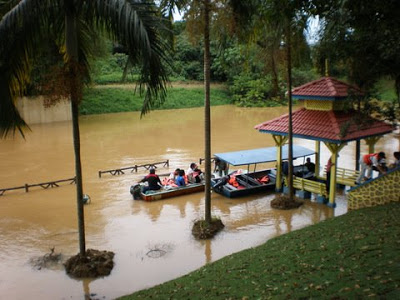
This is the flooded Pahang River near the entrance to the Chini River, taken last week:
  • The River Pahang is thick with the topsoils of the irresponsible vegetable growing and uncurbed hillside clearing in Camerons Highlands,
  • it carries the poisons and fertilizers from thousands of hectares of oil palm estates run by wealthy companies which have planted down to riverbanks and never given a thought to protecting rivers from run off and erosion,
  • it holds the effluent and plastics and toxic chemicals and rubbish from the town drains of Raub and Kuala Lipis and Bentong and Termerloh and Mentakab.

The Pahang River is a flowing brown sewer of mud and poisons – and it all flows into Chini Lake during the wet season. And tell me, where is the public and political and commercial will to actually do something about all that? Or, in fact, about any of that?

If you are a Malaysian, have you even done the very minimum and joined the Malaysian Nature Society, supporting the people who try to do something? Or are you going to shrug and say, “Who cares? Let my kids deal with it when they grow up?” One year’s membership will cost you less than the price of one buka puasa in a K.L. hotel … and you know what? Not even as many as 1 person in every 10,000 Malaysians bothers to join.

This is from a letter in today’s The Star newspaper from someone who used to go to Tasek Chini regularly some 15 years ago:

It was beautiful then – clean waters, beautiful plants and great fishing. (….)
On the way back, on the small stream that led to the Pahang River, we had the shock of our lives. In the distance we heard a very loud splash in the water heading our way. It was so loud and scary that my hair stood on end. When we got near, we noticed that it was hundreds of huge Toman fish heading upstream, feeding on the smaller fish…

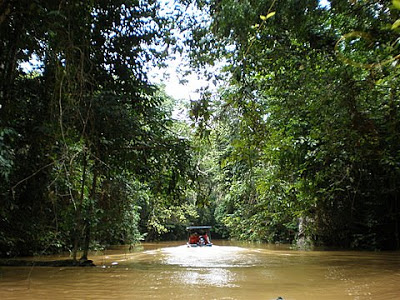
Here is the small clear stream he speaks of, once one of the most beautiful rivers in the world until most of the big trees were killed by mismanagement of the river for tourism:

Not much chance of seeing any fish in that, is there?