
RANDOM RAIN
Book 2
Second draft progress
Book 2
Second draft progress
One of the things that has surprised me over the years is how very particular some readers are about what they read. I don’t mean that they are choosy about a particular book, but rather that they won’t read huge chunks of literature because of a perceived unattractive commonality between the books that make up that chunk.
“I don’t like fantasy.”
“I don’t read historical novels.”
“I don’t read non-fiction.”
“I don’t read fiction.”
“I don’t read Scottish novels.”
“I don’t read women writers.”
“I don’t read travel books.”
And so on.
Of course, we all have preferences. I sure read an awful lot of fantasy. But I am eternally grateful that I don’t read just a certain kind of book to the exclusion of other types. I revel in variety.
Looking back, I think I see why. I owe an awful lot to my childhood. Books were in limited supply. I only had access to a public library once I was eleven, and books in the school library were doled out as if they were too rich a diet for primary schoolchildren. One a week, or you get indigestion.
So I learned to read everything. Before I was twelve, apart from children’s books that came my way, I had devoured much of my mother’s collection – which included:
Throw in some of older brother’s “crime and luscious redheads” books – Carter Brown’s anyone?? – highly unsuitable reading for a ten year old girl, but – well, any book on a wet day…
In other words, just about anything.
Oddly enough, one of the genres that wasn’t on that list was romance – which may account for my lack of interest in that today. Generally, I prefer not to know the ending before I begin, I think. (Hey, but I re-read my Georgette Heyer’s…)
For me, variety is necessary.
As most of you know, I am a birder. I am also lucky enough to have some very fine digiscoper friends (bird photographers who use a digital camera attached to a telescope), folk who drop superb photographs of birds into my inbox every now and then. When you use a telescope, you can get amazing shots like this one without disturbing the birds.
I loved this so much I asked the photographer, Ooi Beng Yean – who has to be the finest of the lot – if I could show you all. These chicks were taken up in Perak last October. Note the hands on hips posture!
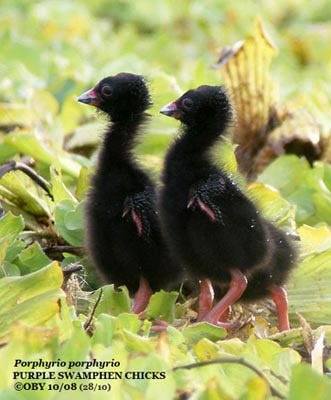 Anyone like to think up a LOL caption?
When I was just beginning, and someone in the business took a look at my writing, one of the comments was this: ‘Has a tendency to overwrite in places.’
I had no idea what overwriting was. I even wondered if overwriting meant it was too long…
You really don’t need to say it three times.
Here’s a more complex example, which I just came across while re-writing:
‘Yes, I know. But he’s going to have it anyway. Seneschal, we’ve lost the Stormlord.’
‘You have what?’
Tallyman and the overman both jumped. The pen Tallyman was holding spun out of his hand. The overman dug a hole in his palmubra with his shaking fingers. Lord Taquar stood in the doorway. He had overheard the last sentence and his face was the colour of a dust cloud rolling across the Gibber.
It is actually quite clear from the context that Lord Taquar overheard the last sentence. So why tell the reader again? Overwriting.
There is an example of another form of overwriting, which I call the recap. It is sometimes hard to pick up, but it leaves the reader feeling that things have slowed down, and that nothing new is happening.
A common way of doing this is to have dialogue between characters – and then for the author to tell the reader what s/he ought to have got from that dialogue. Sometimes this is done by having one of the characters think about the dialogue afterwards – nothing wrong with that – but if they are not thinking anything that the reader didn’t pick up, why re-tell it? Don’t recap and don’t re-tell.
This sometimes is quite hard not to do: for example, if you have a crucial action scene, which is followed by one of the participants telling another character – who wasn’t there – about it. The conversation is necessary for the plot, so what do you do? Well, you could say something like:
Well, that is where your writing skills have to come into play. Perhaps you can have Mary’s re-telling written in such a way as to add more to the action scene as seen through her eyes. Perhaps you can make her retelling more entertaining by being a reflection of her character. You have to work it out. You just have to careful not to tell the reader the same things again and again – repetition is boring, and it is a beginner’s mistake to try to explain everything.
You sometimes hear writing advice something along the lines of:
You have to tell the reader everything twice before it sinks in…
I think this stems from author frustration when their readers complain, saying things like: ‘Why did she do that?’ when all the clues were there; or ‘He acted like a child!’ – when earlier on in the book it was mentioned that the character was in fact only twelve. Or ‘But how did that character get across the river when there was no bridge?’ – when in an earlier chapter, the same character had hidden a skiff on the riverbank.
Readers do miss things and then complain, but believe me, they will complain still more if an you tell them the same thing over and over.
Oddly enough, I find repetition one of the hardest things to get rid of when I am writing. Why?
Because I shift things around a lot – whole chapters sometimes, sometimes just a paragraph or a sentence or a line of dialogue. And keeping track of it all is tough.
Which is why good beta readers and copy editors are such valuable people.
Truth is, there’s no right and wrong way. All I can tell you is how I write a book.
Before I start, I have in my head the following:
During the first draft:
The second draft:
The third draft:
The fourth draft:
The next twenty (that’s what it feels like, anyway) drafts:
The last two books of mine did not work out quite that way. Both of them just wouldn’t come together properly for a long, long while. I could feel there was something fundamental “off” and it took my beta readers to put their fingers on what was wrong, which necessitated quite a big rewrite at the fourth draft stage.
I am hoping that does not happen this time. At the moment, more than 40% through the second draft, I have not got that sinking feeling that there is something “off”. So far, it feels good. Fingers crossed it stays that way as I read on…
People ask me how many revisions I do – honestly, I dunno. Some parts that don’t work well have too many rewrites to count. Other scenes hardly change at all from the moment I wrote them.
One thing I can tell you – for me, writing is not easy. Nor quick. And everybody is different.