YAY!!! The First Review!

.

One of the really nerve-wracking things as publication day approaches is waiting for the first professional review.

Well, I just got it. I can’t publish it here yet, as the review still isn’t officially published – comes out in the September issue of Bookseller and Publisher.

But it is fabulous.

Whew.

I am soooooooooooooo relieved.

.

The Naming System of the World of The Last Stormlord

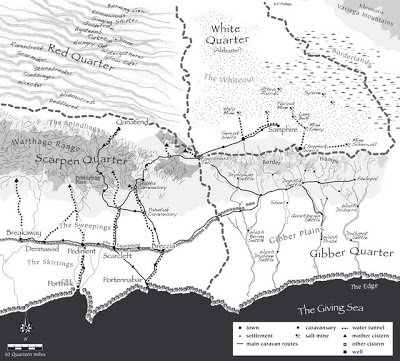
This post is an adjunct to the map I posted previously.
——————————-

When you name towns and people and the geographical landmarks of a fantasy world, you are bound to irritate some readers. But, they say, that name has Celtic origins, and that one Germanic, so how can they both be in your fantasy world? Or something similar.
My reply is, well, they are both in our world, are they not?

This attitude has earned me some criticism in the past. My reasoning is as follows:

Take a look at this selection of names that have been around for generations in England:
Courtney and Chelsea (Old English), Riley and Abigail (Irish), Eric and Arnold (Nordic), Charles and Henry (French), William and Richard (Norman).

Quite a mix, some of them Anglicized, some not. In other words, those who inhabited that section of the British Isles we now call England were no purists. The Norman invaders may have brought their own names, but that didn’t put a stop to the usage of previous names, and so on. I think that a writer who makes their naming system too rigid, must be writing of a world that never changes, and is never influenced by outsiders. So I look askance at a fantasy land where every female name ends in “ia” and masculine names all sound macho; or where all the town names are Germanic – or any other scheme that is just too bound by rules or uniformity.

I could have used names totally unknown to any reader. You know, things like “Neiggharg”, “T’lebb” and “Pottarossmolleth”. I prefer to use names found on – or similar to those found on – Earth, and let you, the reader, deal with them.

In the land of the Quartern, names are a mix, and show many influences for a reason. Some don’t mean anything at all.

Once someone has read the book, some influences should be more clear. Many names which may seem made-up actually have meaning to those with a specialised interest (e.g. Sardonyx) – and in my world, there is a reason for all this. Some names are mispellings, just as happens in real life. (Why – on Earth – did Nova Zeelandia not become New Zeeland?)

So when you look at the towns* or the people** of the Quartern, don’t be surprised if you find names that have varied origins. Of course, just as the reader has to mentally replace “English” with the language of the Quartern, so s/he has mentally to replace the idea of “Portuguese” or “Arabic” with other unnamed languages of countries outside the Quartern. (Btw, the map maker, Perdita Phillips, added in some names of her own too…)

What am I trying to say from all this variety?
That the Quartern was either inhabited by people of many cultural backgrounds, or was invaded multiple times, or had many trading partners or immigrants … just exactly what the answer is, you can work out for yourself if you want, as you read the trilogy. Or you can read the book and not worry about the back story of the world at all. The hints are there for those who like a layered story, and can just as easily be ignored if you prefer a straight tale.

But please don’t expect a naming scheme that is beautifully ordered and systematic, because you won’t get it, any more than you do in, say, England or Australia or America.

* For example:
Scarcleft – based on geographical formations
Sloweater – pertaining to the results of the movement of a geographical formation
Qanatend –
Arabic/English
Dollypot – name of a tool
Fourcross Tell – English/Arabic word for a geographical formation
Athro Purida – Latin/Portuguese

** For example:
Laisa (Danish)
Senya (Greek)
Terelle (American)
.

The Vice-Pres of the largest Muslim country…

When I was at UWA (University of Western Australia) about a million years ago, there were stacks of foreign students from developing nations. I joined the International Club and came to know many of them, and some of those friendships have lasted to this day. (Oh, yeah, I married one of those guys too.)

Now I see that one of those students, whom I remember as a modest guitar-playing guy with a nice singing voice and a charming shyness, is now Vice-President of Indonesia. Congratulations Boediono*! If my memory is not playing tricks (and it does, I will admit), a few times I had a meal in the house he was renting with a group of students – can’t remember whether he was one of the cooks, but it is likely. I have loved Indonesian food ever since…

Actually, many of those international students went on to be leaders in Africa and Asia – when I think about it, I am amazed to see how many cabinet ministers, attorney-generals, accountant-generals and so on that I have known, from so many different countries. They were top of the line students to begin with, but UWA must have done something right too…

*(also spelled Budiono)

Updating…

I am sitting in Greenberry’s coffeeshop in Charlottesville…nice coffee if you pass this way, and good free internet connection!

As you will probably have noticed, I have started to twitter. Had my reservations about it at first, and have resisted, but as usual I cave in to the joys of new techno innovations eventually!

If you read this blog, then the tweets will go up on the sidebar. On my facebook page, they will go up as updates. And of course, you can follow my twitters if you want. (I have very few followers as yet.) You’ll find me @glendalarke.

The other thing I have done this week, with the help of techno savvy daughter, is set up a Glenda Larke group on facebook, which is devoted to news and stuff related to my writing side: for readers, fans and fellow writers, published and unpublished. Join me there, if you haven’t already. And to those who have – it’s great to have you on board.

Another one of those lovely, lovely author days…

Firstly, I went out to post a letter to my agent.
And in the letter were three copies of
a three book contract…

…specifically, for the translation rights of one of my trilogies.

Now this was extra special for a number of reasons. Firstly, it’s the first time I have sold all three books of a trilogy at once for translation. Because the publisher also has to pay the translator, they often buy one at a time.

Secondly, it was the first time this particular trilogy has gone for translation.
Thirdly, it was …um… ok, you don’t need to know that. Let’s just say that it was nicely surprising.

So then I come back to the house to find another nice thing had happened –
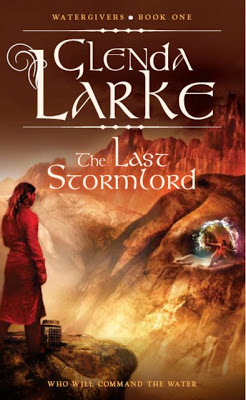
my lovely editor Stephanie at Voyager Australia has sent me a hot-off-the-presses copy of The Last Stormlord. It had been couriered and was leaning against the front door.

What can I say?
Firstly, it looks even better than the pix I posted yesterday!!
The colour is somehow more intriguing, and it kinda glows.
My name is BIGGER than the title. Does that mean I have arrived??? Only the French and the Russians have done that before… (I think I sell rather well in Russian speaking countries, actually.) Oh, and my name is shiny. Nice.

Here is one happy, happy writer…

What do you have to give up to be a writer?

John Scalzi had a blog post on this subject two days back. Basically he was saying in answer: nothing much. Give up an hour’s TV (or internet surfing or gaming or similar), 5 days a week, and you can write a book in a year.

In a way he is right. Many people do just that. Plus they write while commuting in trains or waiting in queues or other odd moments. And in a year or so, you have your book written.

However, I don’t think Scalzi tells the whole truth, at least not as far as most people are concerned. It’s one thing to write the prerequisite number of words, it can be a much more prolonged affair to hone them to something that a publisher will buy.

Then, just when you think you have solved all problems and you have a contract…that’s when you get introduced to something called the deadline. You have a contract that specifies a date by which you have to hand in your next book. And suddenly, that one hour a day begins to look like an over-optimistic time frame.

Typically, this is what happens. You have written the first book of three you have planned. You have just got a 3 book proposal accepted, with a proviso. The editor has said, we want book 1 submitted by 1st September, but we want you to cut out the dwarf character and change the setting from fairyland to 19th century Armenia. And book 2 is due 1st June next year, book 3 1st March the year after.

And you, in the first flush of success, agree to everything…

That’s when those dates begin to loom large, and one hour a day begins to look sick indeed. What if, when you are halfway through book 2, you realise it’s not working and you have to start again? And that is when you start searching for more time (in between keeping the boss at work happy – plus the spouse and kids at home happy, not to mention the dog walked, the garden weeded and the bath cleaned or whatever your chores are…).

And then you discover that the publisher sends you the copy edit of book 1 to correct. Two weeks work. Then later the proofs. Four days. And asks you to do some publicity. And oh, they aren’t happy with book 2, could you possible insert 6 dwarves and skip the 19th century Armenian scenes entirely?

You dream of giving up the day job – but everyone tells you not to be crazy. Statistically, it is doubtful you will EVER be able to earn enough to match your day job, although if you write genre you probably have a better chance than mainstream “literary” novels.

And in the end, something has got to give. The housework. Or time with the family. That holiday at the beach (or you go and spend all the time working.) In the end most of us make sacrifices beyond an hour’s TV a day. (I actually watch no TV. We don’t own one.)

Is it worth it? Of course!

And my best advice to budding writers? Learn to write in small bytes. Ten minutes in the doctor’s waiting room. Five minutes in a queue. In the car waiting to pick up the kids. Early in the morning before anyone else is up. Carry a netbook with you if you can. Use it. Or settle for the back of an envelope and a pencil stub if you must. Every minute means a few more lines towards meeting that deadline.

Do we give up something to write? Yes, I think so. But we gain satisfaction.